1 / 7
Nuclear History 009
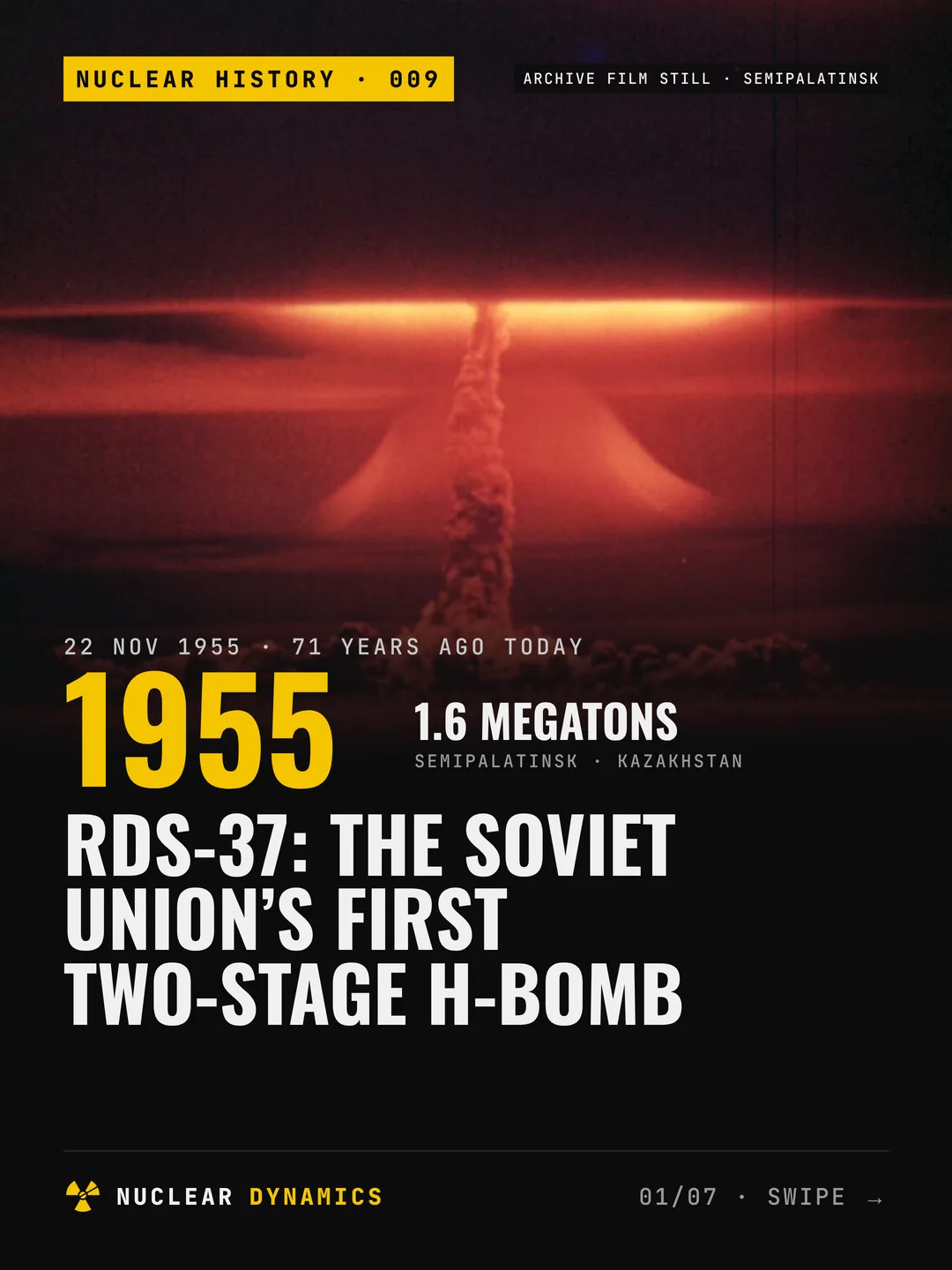
RDS-37, 1955
The Soviet Union’s first two-stage H-bomb. ☢️
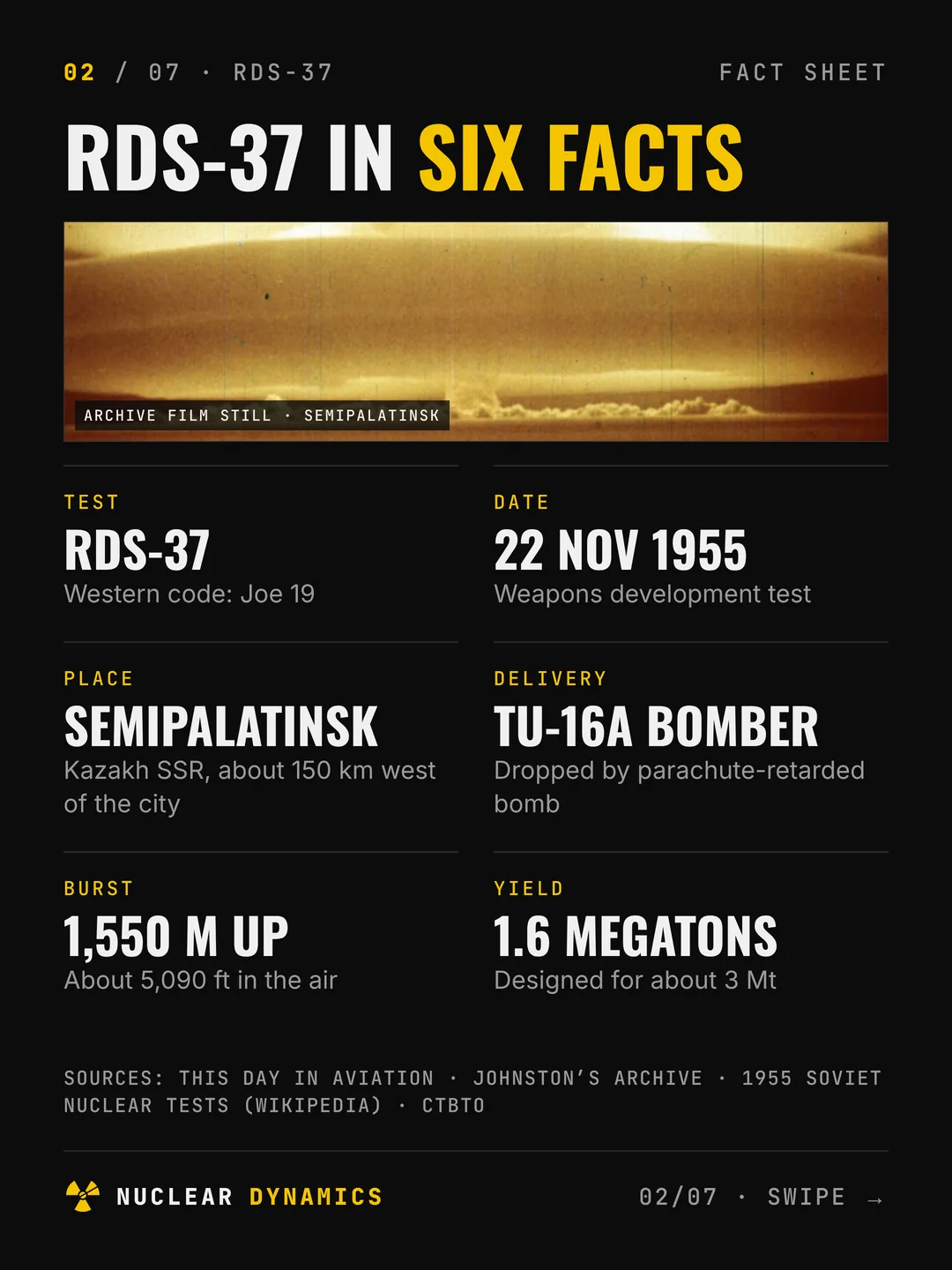
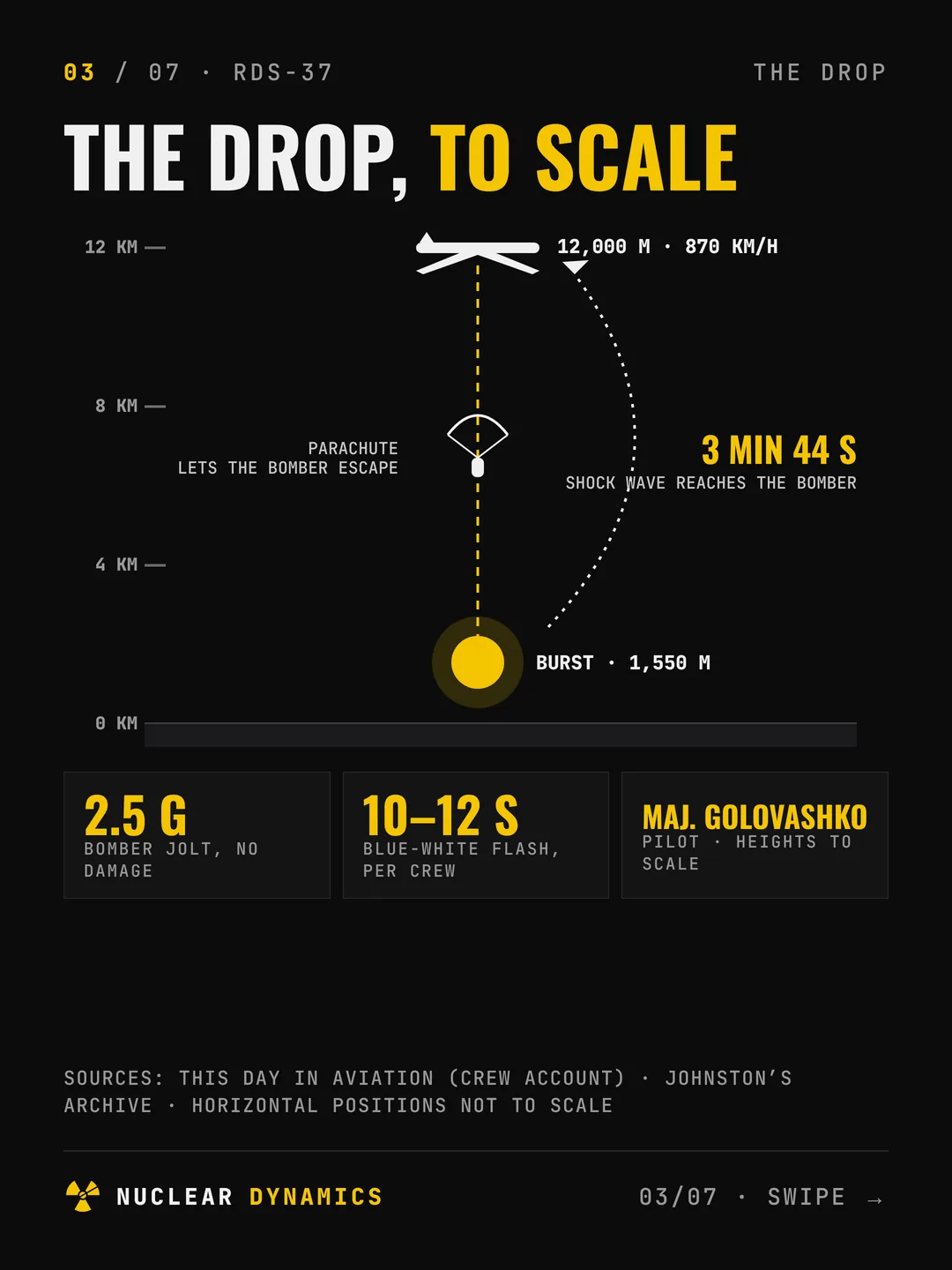
On 22 November 1955, a Tu-16A bomber flown by Maj. Fedor Golovashko dropped RDS-37 over the Semipalatinsk Test Site in Kazakhstan. The bomb fell by parachute so the bomber could escape, and detonated at 1,550 m with a yield of 1.6 megatons. Western analysts called it Joe 19.
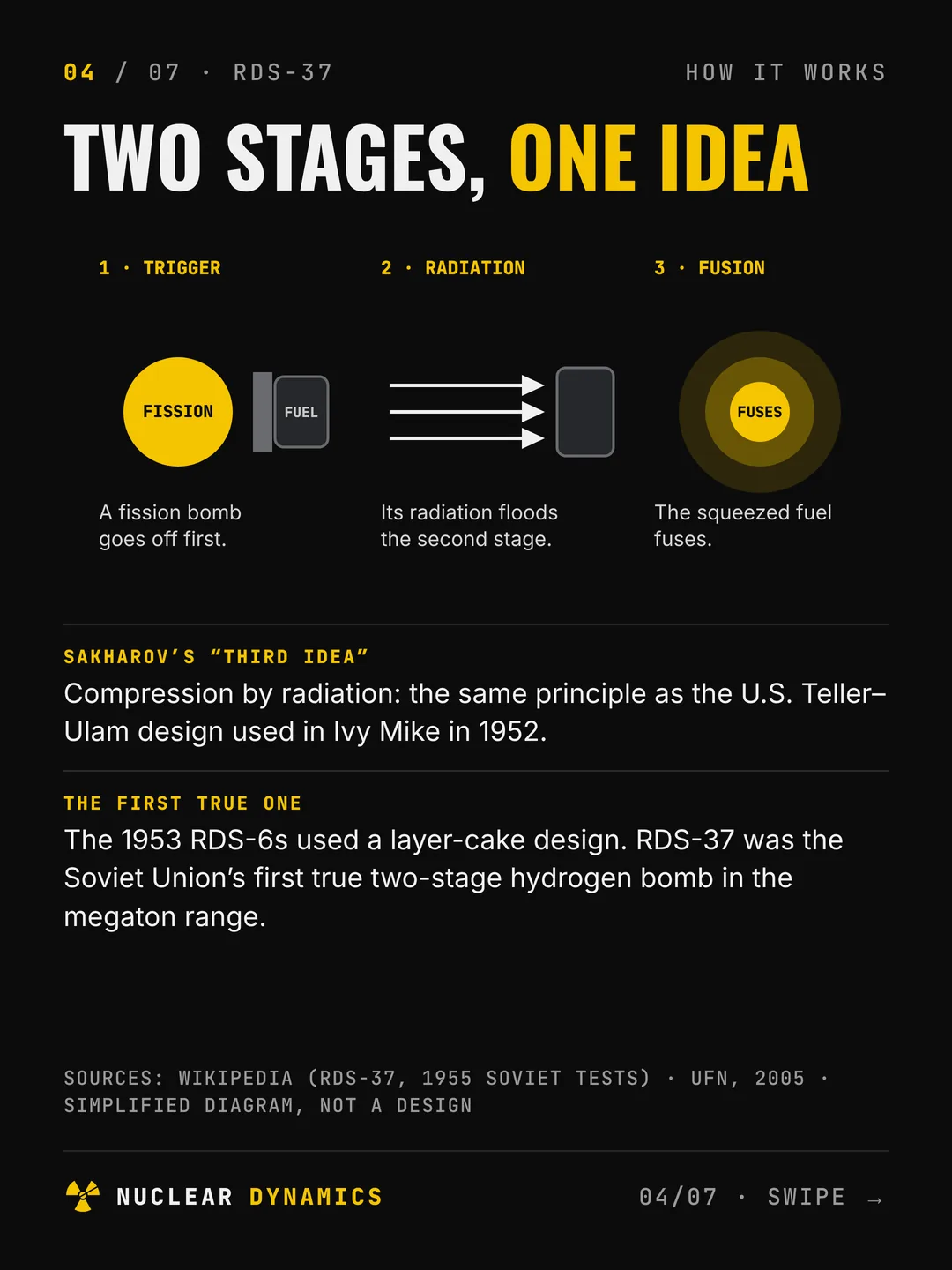
It used a two-stage design: a fission trigger goes off first, and its radiation compresses a second stage so the fuel fuses. Sakharov called it his “third idea”, the same principle as the U.S. Teller–Ulam design behind Ivy Mike in 1952.
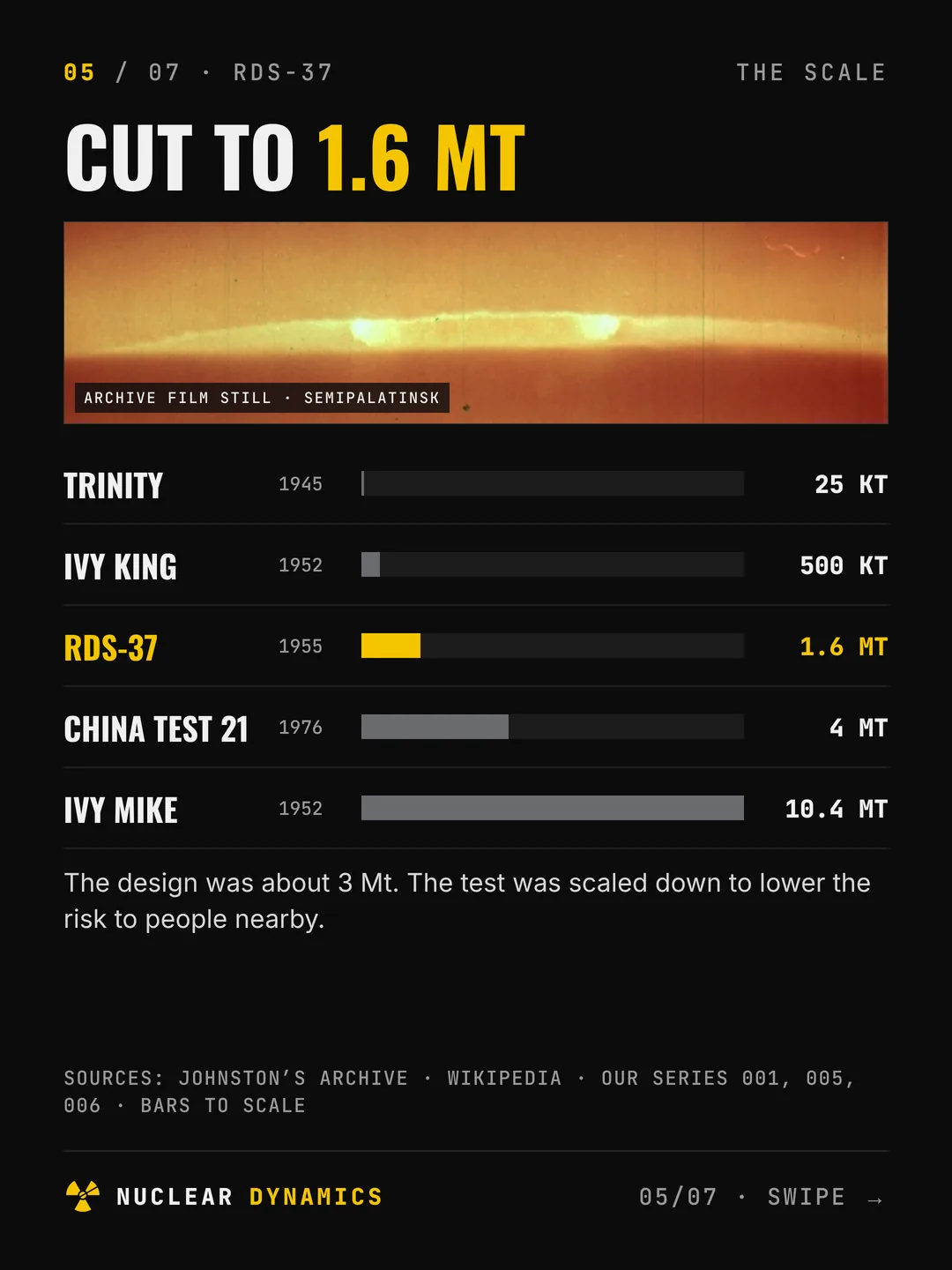
The weapon was designed for about 3 megatons. The test was cut to 1.6 Mt to lower the risk to people nearby.
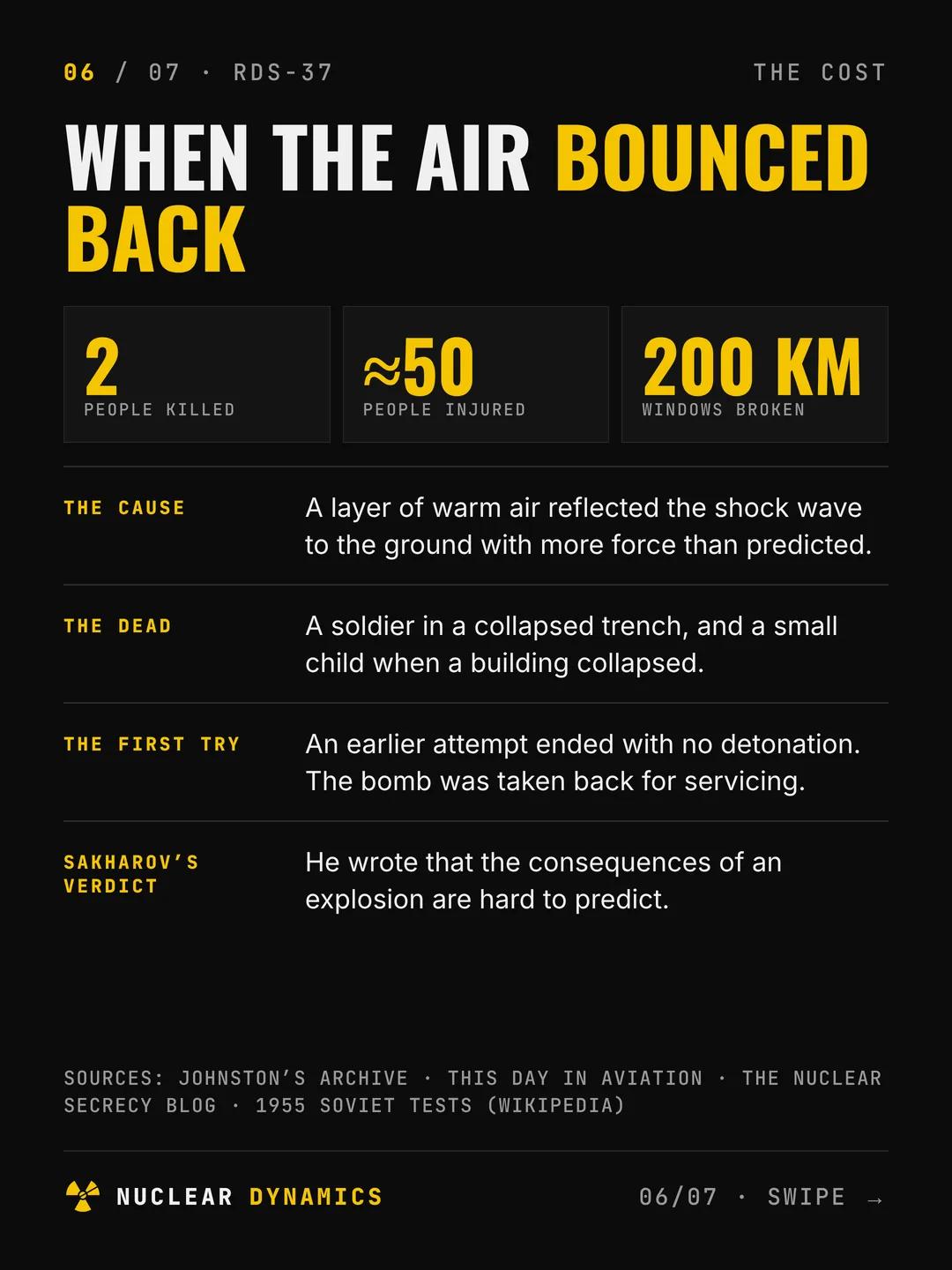
It was still the largest test ever held at Semipalatinsk. A layer of warm air reflected the shock wave back to the ground with more force than predicted. A soldier in a collapsed trench and a small child in a collapsed building were killed, nearly 50 people were injured, and windows broke up to 200 km away.
The shock wave reached the bomber 3 minutes 44 seconds after the drop and jolted it with 2.5 G. It was not damaged.
This is Nuclear History 009. Catch up on 001–008 in our grid.
📌 Save this post and follow @nucleardynamics for nuclear history, alerts and analysis.
Sources: Johnston’s Archive · This Day in Aviation · Wikipedia (RDS-37) · The Nuclear Secrecy blog · CTBTO
Photos: archive film stills, Semipalatinsk
Sources
- Johnston’s Archive
- This Day in Aviation
- Wikipedia (RDS-37)
- The Nuclear Secrecy blog
- CTBTO
- Photos: archive film stills, Semipalatinsk
Read the slides as text
- NUCLEAR HISTORY · 009 ARCHIVE FILM STILL · SEMIPALATINSK 22 NOV 1955 · 71 YEARS AGO TODAY 1955 1.6 MEGATONS SEMIPALATINSK · KAZAKHSTAN RDS-37: the Soviet Union’s first two-stage H-bomb
- 02 / 07 · RDS-37 FACT SHEET RDS-37 in six facts ARCHIVE FILM STILL · SEMIPALATINSK TEST RDS-37 Western code: Joe 19 DATE 22 Nov 1955 Weapons development test PLACE Semipalatinsk Kazakh SSR, about 150 km west of the city DELIVERY Tu-16A bomber Dropped by parachute-retarded bomb BURST 1,550 m up About 5,090 ft in the air YIELD 1.6 megatons Designed for about 3 Mt SOURCES: THIS DAY IN AVIATION · JOHNSTON’S ARCHIVE · 1955 SOVIET NUCLEAR TESTS (WIKIPEDIA) · CTBTO
- 03 / 07 · RDS-37 THE DROP The drop, to scale 0 KM 4 KM 8 KM 12 KM 12,000 M · 870 KM/H 3 MIN 44 S SHOCK WAVE REACHES THE BOMBER BURST · 1,550 M PARACHUTE LETS THE BOMBER ESCAPE 2.5 G BOMBER JOLT, NO DAMAGE 10–12 S BLUE-WHITE FLASH, PER CREW MAJ. GOLOVASHKO PILOT · HEIGHTS TO SCALE SOURCES: THIS DAY IN AVIATION (CREW ACCOUNT) · JOHNSTON’S ARCHIVE · HORIZONTAL POSITIONS NOT TO SCALE
- 04 / 07 · RDS-37 HOW IT WORKS Two stages, one idea 1 · TRIGGER 2 · RADIATION 3 · FUSION FISSION FUEL FUSES A fission bomb goes off first. Its radiation floods the second stage. The squeezed fuel fuses. SAKHAROV’S “THIRD IDEA” Compression by radiation: the same principle as the U.S. Teller–Ulam design used in Ivy Mike in 1952. THE FIRST TRUE ONE The 1953 RDS-6s used a layer-cake design. RDS-37 was the Soviet Union’s first true two-stage hydrogen bomb in the megaton range. SOURCES: WIKIPEDIA (RDS-37, 1955 SOVIET TESTS) · UFN, 2005 · SIMPLIFIED DIAGRAM, NOT A DESIGN
- 05 / 07 · RDS-37 THE SCALE Cut to 1.6 Mt ARCHIVE FILM STILL · SEMIPALATINSK TRINITY 1945 25 KT IVY KING 1952 500 KT RDS-37 1955 1.6 MT CHINA TEST 21 1976 4 MT IVY MIKE 1952 10.4 MT The design was about 3 Mt. The test was scaled down to lower the risk to people nearby. SOURCES: JOHNSTON’S ARCHIVE · WIKIPEDIA · OUR SERIES 001, 005, 006 · BARS TO SCALE
- 06 / 07 · RDS-37 THE COST When the air bounced back 2 PEOPLE KILLED ≈50 PEOPLE INJURED 200 KM WINDOWS BROKEN THE CAUSE A layer of warm air reflected the shock wave to the ground with more force than predicted. THE DEAD A soldier in a collapsed trench, and a small child when a building collapsed. THE FIRST TRY An earlier attempt ended with no detonation. The bomb was taken back for servicing. SAKHAROV’S VERDICT He wrote that the consequences of an explosion are hard to predict. SOURCES: JOHNSTON’S ARCHIVE · THIS DAY IN AVIATION · THE NUCLEAR SECRECY BLOG · 1955 SOVIET TESTS (WIKIPEDIA)
- NUCLEAR HISTORY · 009 Every nuclear story, from the first Save this post. Catch up on 001–008 in our grid. @NUCLEARDYNAMICS HISTORY · ALERTS · KNOW NUCLEAR