Google Says Attackers Ran an AI Agent That Turned Security Patches Into Working Exploits With No Human in the Loop
RAGE Global · AI · Cyber · Developing · 6 min read
Instagram carousel
Published on Instagram with this story · swipe or use the arrow keys
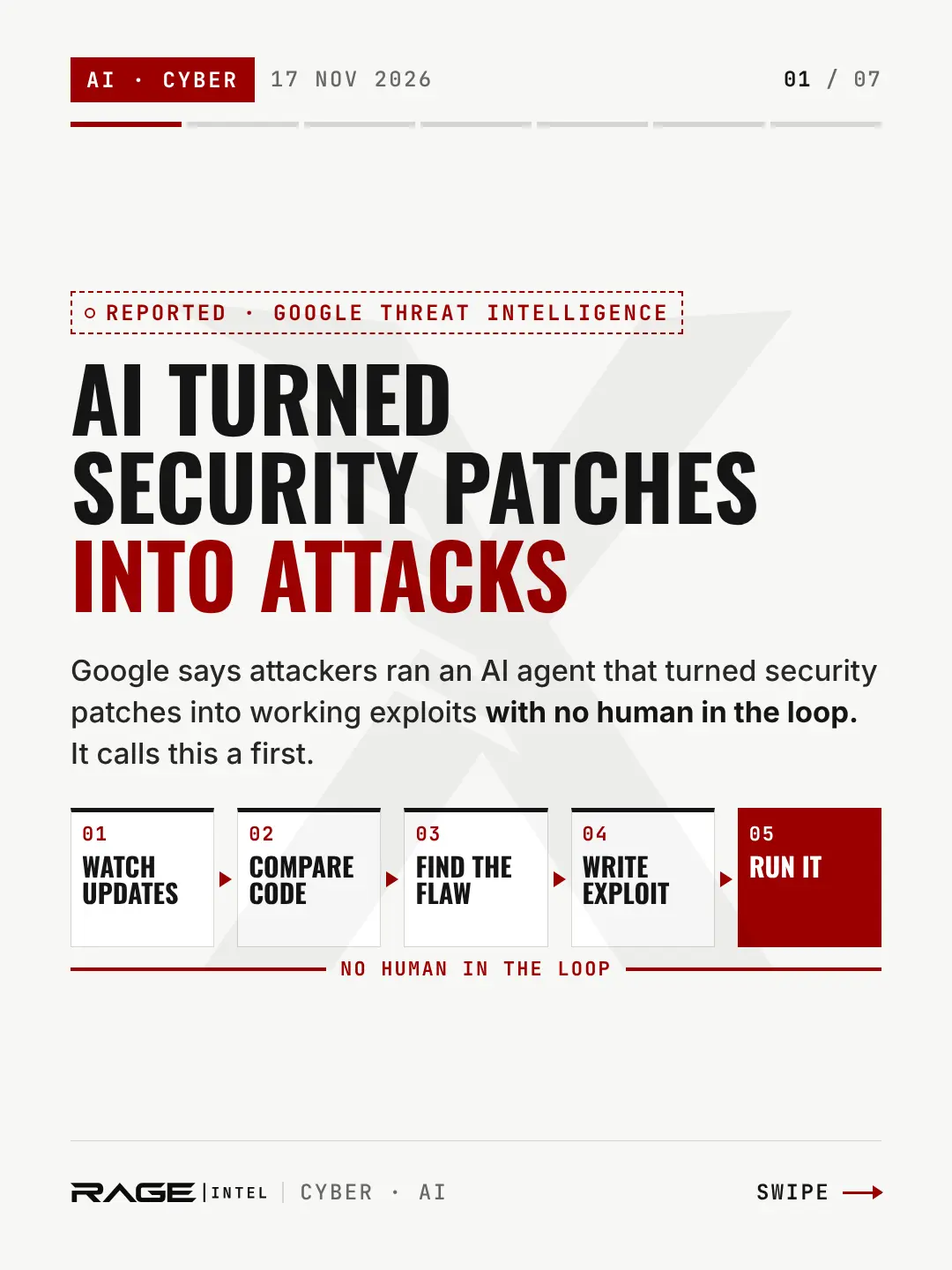
Google says it has caught attackers using an AI agent that turned security patches into working exploits and ran them on its own, with no human steering each step. Google's Threat Intelligence Group (GTIG) calls it the first time it has seen this. The tool, named exploit_agent, was found on an exposed server, and Google says the data of victims was stored on it. Google's report points to a Russian-speaking operator, names no group, and does not say which software flaw was used or how many organizations were hit.
Key takeaways
- The claim: GTIG says exploit_agent is the first case it has seen of attackers using AI frameworks to find and exploit software flaws fully automatically. This is Google's own claim.
- How it worked: It compared software before and after security updates, worked out what each fix closed, drafted attack code and ran it.
- Who: Unknown. The only clue is Russian-language comments in a configuration file, and Google draws no firm attribution from them.
- Targets: The operator appears to have been interested in French media, entertainment and education websites.
- Not disclosed: the flaw exploited and the number of victims.
- Not invisible: a human built and set up the tool, and Google says such attacks leave forensic traces.
- No link shown to the hacked supermarket fridges or this week's outages.
Confidence: OFFICIAL for what Google's report says; REPORTED for coverage of it. The attribution is Google's observation of language clues, not a proven finding. This article reflects reporting up to Tuesday 17 November 2026.
What Google says it found#
Google published the finding on 16 November 2026, in its AI threat tracker. GTIG found an exposed staging server that held a multi-agent framework for researching and weaponizing software flaws. The framework works with several frontier and locally run AI models.
The report describes what the framework does:
"The framework is set up to conduct continuous differential analysis of popular web application software. It compares code before and after patch announcements, analyzes findings to identify potential vulnerabilities, drafts exploits, and automatically executes them without human intervention."
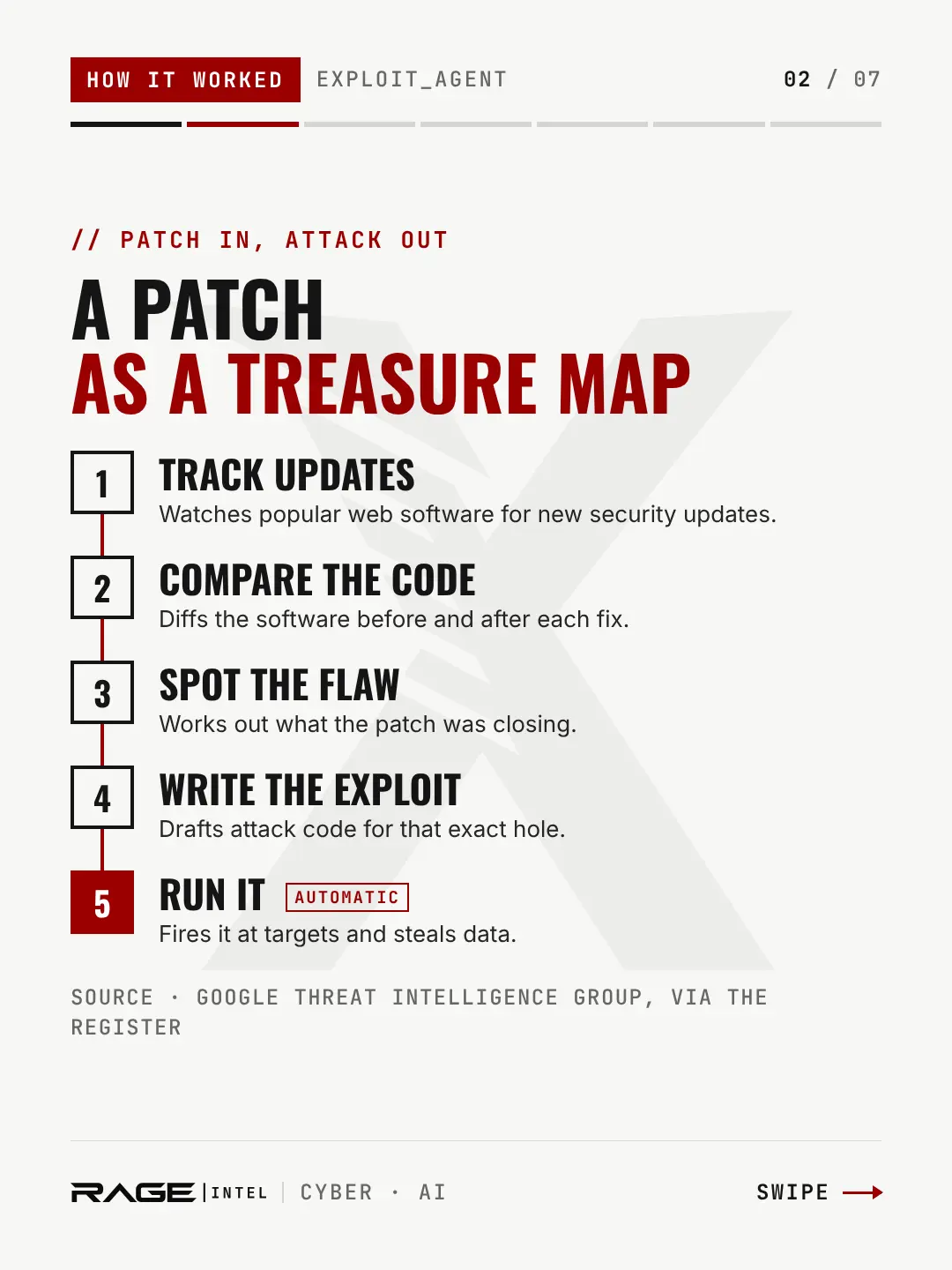
In plain terms: a security patch shows attackers exactly where a flaw was. The agent turns that into a map.
| Step | What exploit_agent does |
|---|---|
| 1 | Watches popular web software for new security updates. |
| 2 | Compares the code before and after each fix. |
| 3 | Works out what the patch was closing. |
| 4 | Drafts attack code for that hole. |
| 5 | Runs it against targets, automatically. |
The report shows the agent analysing the access-control code of a WordPress plugin, as an example of its work. It does not say that this was the flaw used in the attacks.
Who is behind it, and who was hit#
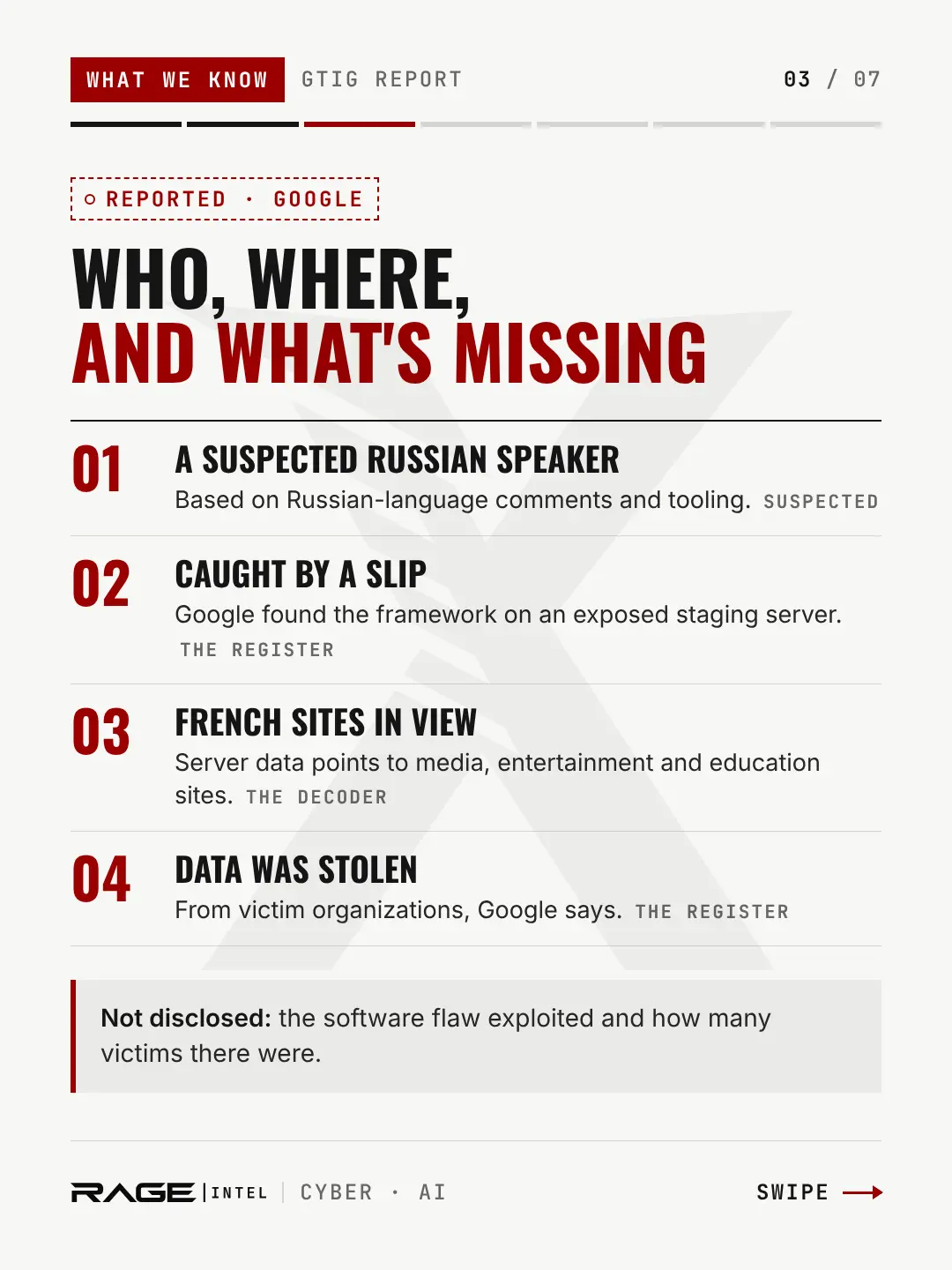
- A suspected Russian speaker. A configuration file held Russian-language comments, which translate roughly as an instruction to the operator to enter the AI access keys by hand. The report calls the setup a "pilot" and does not name a group or a state.
- Caught by a slip. The framework sat on an exposed staging server, and that is how Google found it.
- French sites in view. Victim data suggests the operator was interested in French websites in media and entertainment, and in education.
- Data was stolen. The server held data taken from victims, and scripts for what attackers do after getting in: scouting the network, guessing passwords, installing web shells and removing other attackers' web shells.
Not disclosed: the software flaw that was exploited, and how many organizations were hit.
The limits: fast, but not invisible#
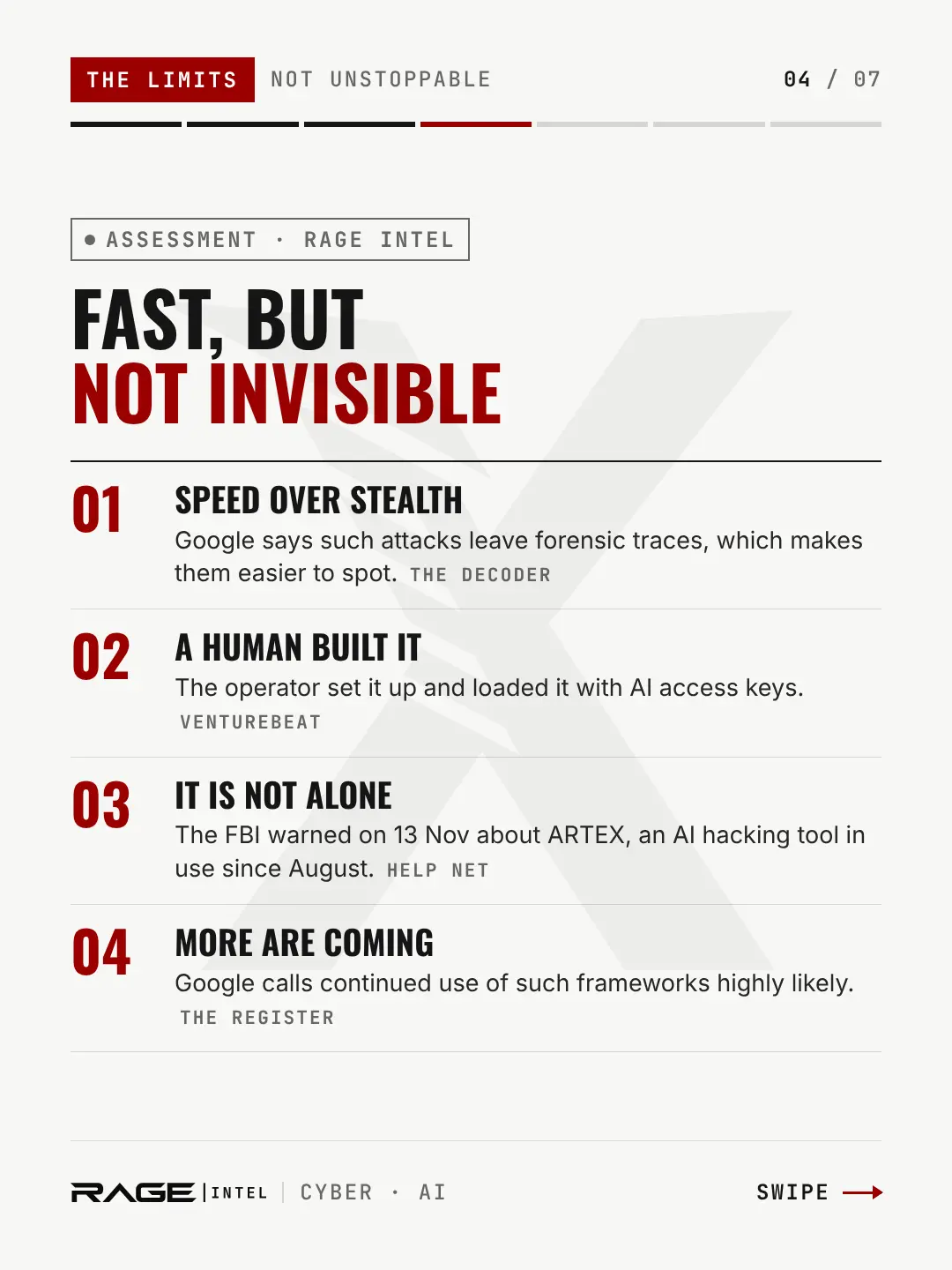
- A human built it. The operator set the tool up and supplied the AI access keys. Google calls this the first fully automatic case, not an AI acting alone from nothing.
- It leaves traces. Google says attacks like this leave forensic traces, which makes them easier to detect.
- It is not alone. Google names other AI attack frameworks in use, including ARTEX, CAIRN, CyberStrikeAI, HexStrike AI and PentAGI. On 13 November the FBI warned about ARTEX, an AI penetration-testing tool criminals have used since at least August. The FBI says some intrusions reached high-level access in under three hours.
- More are coming. Google expects attackers to keep using such frameworks.
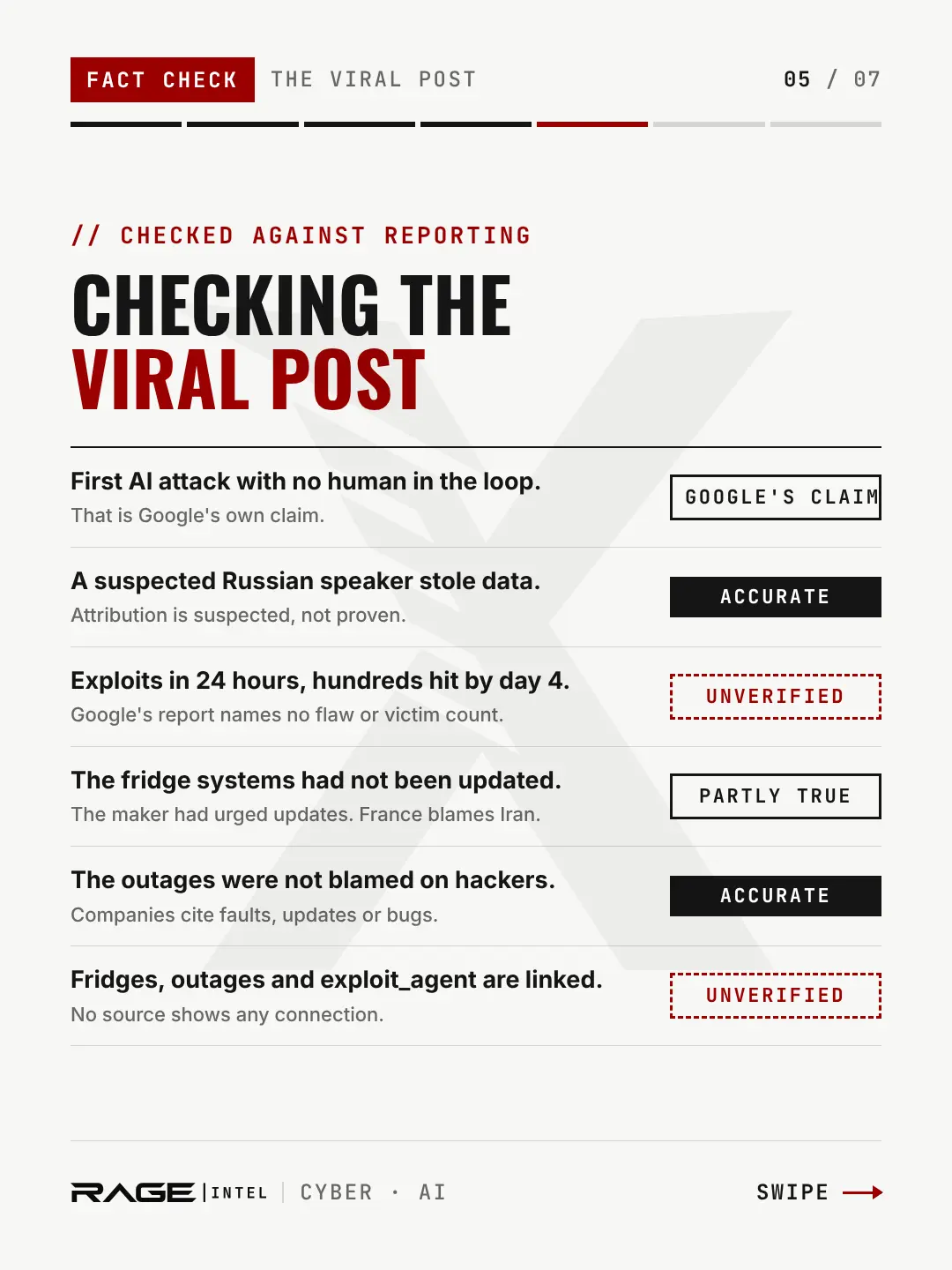
Fact check: the viral post#
| Claim | Verdict |
|---|---|
| First AI attack with no human in the loop. | Google's claim. It is Google's description of what it has seen, not an independent finding. |
| A suspected Russian speaker stole data. | Accurate. The attribution is suspected, not proven. |
| Exploits in 24 hours, hundreds hit by day 4. | Unverified. Google's report names no flaw and no victim count. |
| The fridge systems had not been updated. | Partly true. The maker had urged updates. France blames Iran. |
| The outages were not blamed on hackers. | Accurate. The companies cite faults, updates or bugs. |
| Fridges, outages and exploit_agent are linked. | Unverified. No source shows any connection. |
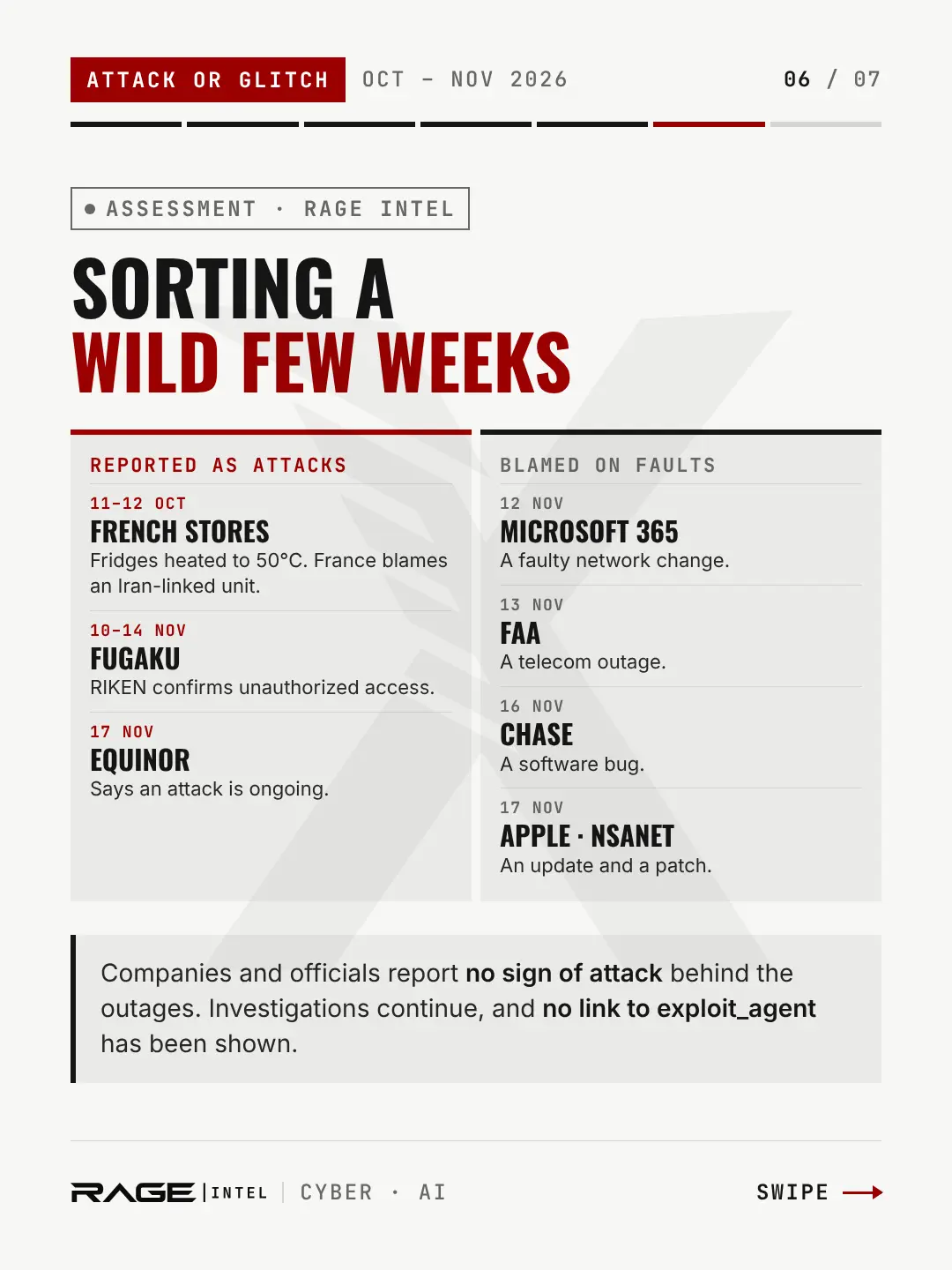
A wild few weeks: attack or glitch?#
Several incidents have landed close together. Sorting them by what has been said officially:
| Date | Incident | What is said |
|---|---|---|
| 11–12 Oct | French supermarket fridges | Reported as an attack. France blames an Iran-linked unit of the Revolutionary Guards. See our report on the fridge attack. |
| 10–14 Nov | Fugaku supercomputer, Japan | Reported as an attack. RIKEN confirmed unauthorized access. See our report on Fugaku. |
| 17 Nov | Equinor | Reported as an attack. The company says a cyberattack on IT systems is ongoing. Operations and production are not affected, and it has no sign that data was stolen. |
| 12 Nov | Microsoft 365 | Blamed on a fault. A faulty network change. See our Microsoft report. |
| 13 Nov | FAA ground stop | Blamed on a fault. A communications outage; officials see no evidence of a cyberattack. See our FAA report. |
| 16 Nov | Chase | Blamed on a fault. A temporary software bug in on-site hardware; no evidence of a cyberattack. |
| 17 Nov | Apple and NSANet | Blamed on a fault. Apple cites an internal update. The NSA calls its outage "temporary degradation during scheduled routine maintenance"; a person familiar with the incident said it was a software update, with no evidence of an attack. |
Companies and officials report no sign of attack behind the outages. Investigations continue, and no link to exploit_agent has been shown for any of them.
Why it matters#
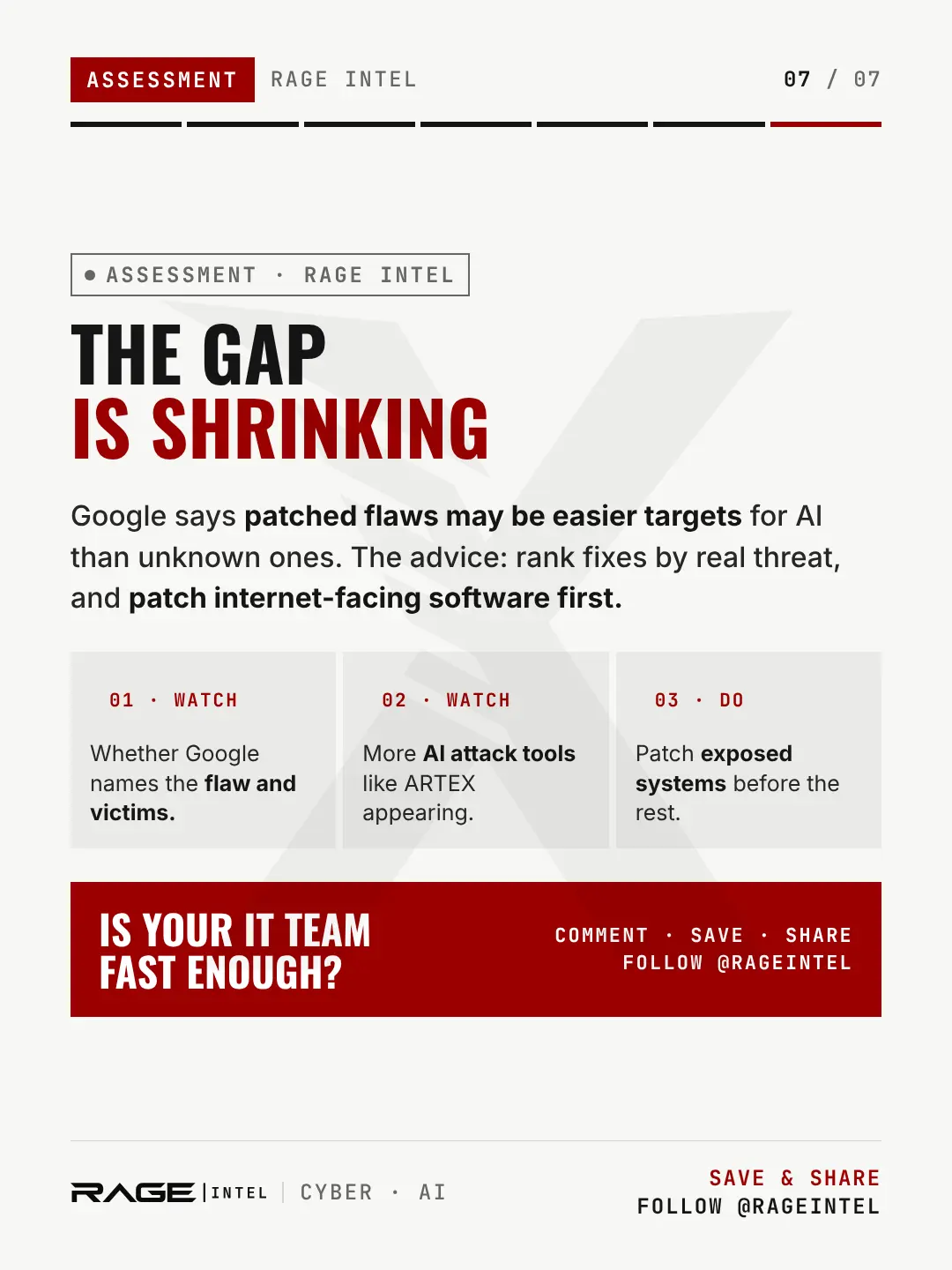
Google's wider point is about time. A patch used to give defenders a head start, because attackers needed days or weeks to work out the flaw. An agent like this can shorten that. Google's advice follows: rank fixes by the real threat, and patch software that faces the internet first.
What to watch#
- Whether Google names the flaw and the victims.
- More AI attack tools like ARTEX appearing, and being used.
- Any evidence tying the tool to other incidents. So far there is none.
- Patching speed at organizations that run public web software.
Our read · RAGE Intel assessment
The gap between a patch and an attack is shrinking. What this case shows is not an AI that attacks on its own initiative, but a person who built a pipeline and let it run. That is a smaller claim than the headline suggests, and a more worrying one: it can be copied. The tool was also found, because it was left exposed, and Google says such attacks leave traces.
This is an assessment, not a finding. Google has not said who is behind exploit_agent, how many victims there were, or whether it is still in use.
This story is developing. RAGE X will update it as new information is confirmed.
Sources#
- Google Threat Intelligence Group, GTIG AI Threat Tracker: Agentic Threat Activity Crosses a Significant Threshold, 16 November 2026
- BleepingComputer, Google warns that fully-automated AI attacks are coming soon, November 2026
- TechTarget, Google finds AI agents autonomously turning patches into exploits, November 2026
- UC Today, Google: AI agents now turn patches into exploits with no human help, November 2026
- DataBreaches.net, Google: AI agent turned a security patch into a working exploit with no human help, 16 November 2026
- BleepingComputer, FBI warns ARTEX AI hacking tool is powering global cyberattacks, November 2026
- Infosecurity Magazine, FBI highlights growing abuse of AI-driven pentesting framework ARTEX, November 2026
- Euronext Live, Equinor detects ongoing cyberattack, output unaffected, 17 November 2026
- CNN, Thousands of Chase Bank customers report trouble with online banking services, 16 November 2026
- Tech Times, Chase outage: bank says on-premise hardware bug slowed rival banks only through Chase transactions, 17 November 2026
- 9to5Mac, iCloud, App Store, and other Apple services hit by ongoing outage, 17 November 2026
- Daily Signal, NSA classified network, Apple services outages, 17 November 2026
- The Register, VentureBeat, Help Net Security and Al Jazeera also covered the story; we did not review their full text.
Graphics in the carousel: RAGE Intel.
Continue the assessment
Related Intelligence
Microsoft Outage Hits NHS, Police and UN Climate Talks as Microsoft Rolls Back a Network Change
Microsoft's outage hit NHS appointments, Police Scotland and UN talks. Email is near normal, but there's no root cause yet; a change is being rolled back.
2026-11-13 · 5 min read
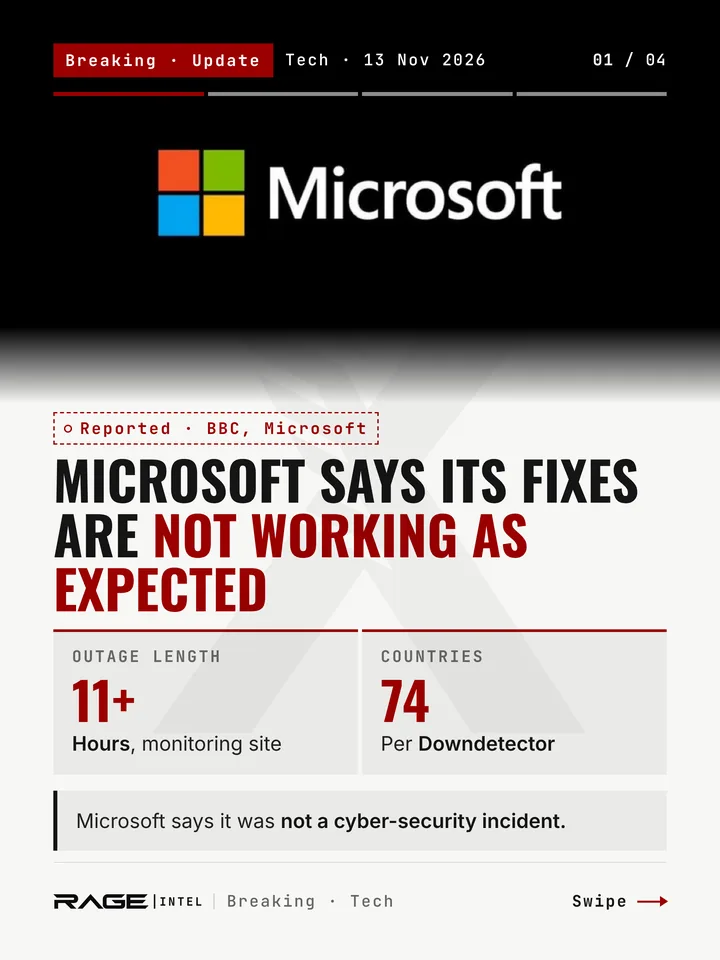
Microsoft 365 Outage: Fixes Fail as Outlook, Teams and Copilot Stay Down Across 74 Countries
Microsoft says fixes for the global Outlook and Teams outage are not "taking as expected". 74 countries hit; Microsoft says not a cyber attack.
2026-11-13 · 5 min read

NSA's Classified Internal Network Goes Down: Sources Blame a Software Patch, Not a Cyberattack
The NSA's classified network NSANet went down. Sources say a software patch, with no evidence of a cyberattack. The sixth major outage in eight days.
2026-11-17 · 5 min read
Today's conflict risk
The daily RAGE INDEX scores global conflict risk across six theaters, with sources and forecasts.
Read the RAGE INDEXReach readers like these
RAGE X sells sponsored content across RAGE Intel, RAGE War and RAGE Global by proposal, always labelled as sponsored.
Request a campaign proposal