Japan's Fugaku Supercomputer Hacked: RIKEN Confirms Breach, Offline With Up to 4,597 Users' Data at Risk
RAGE Global · Japan · Cyber · Developing · 6 min read
Instagram carousel
Published on Instagram with this story · swipe or use the arrow keys
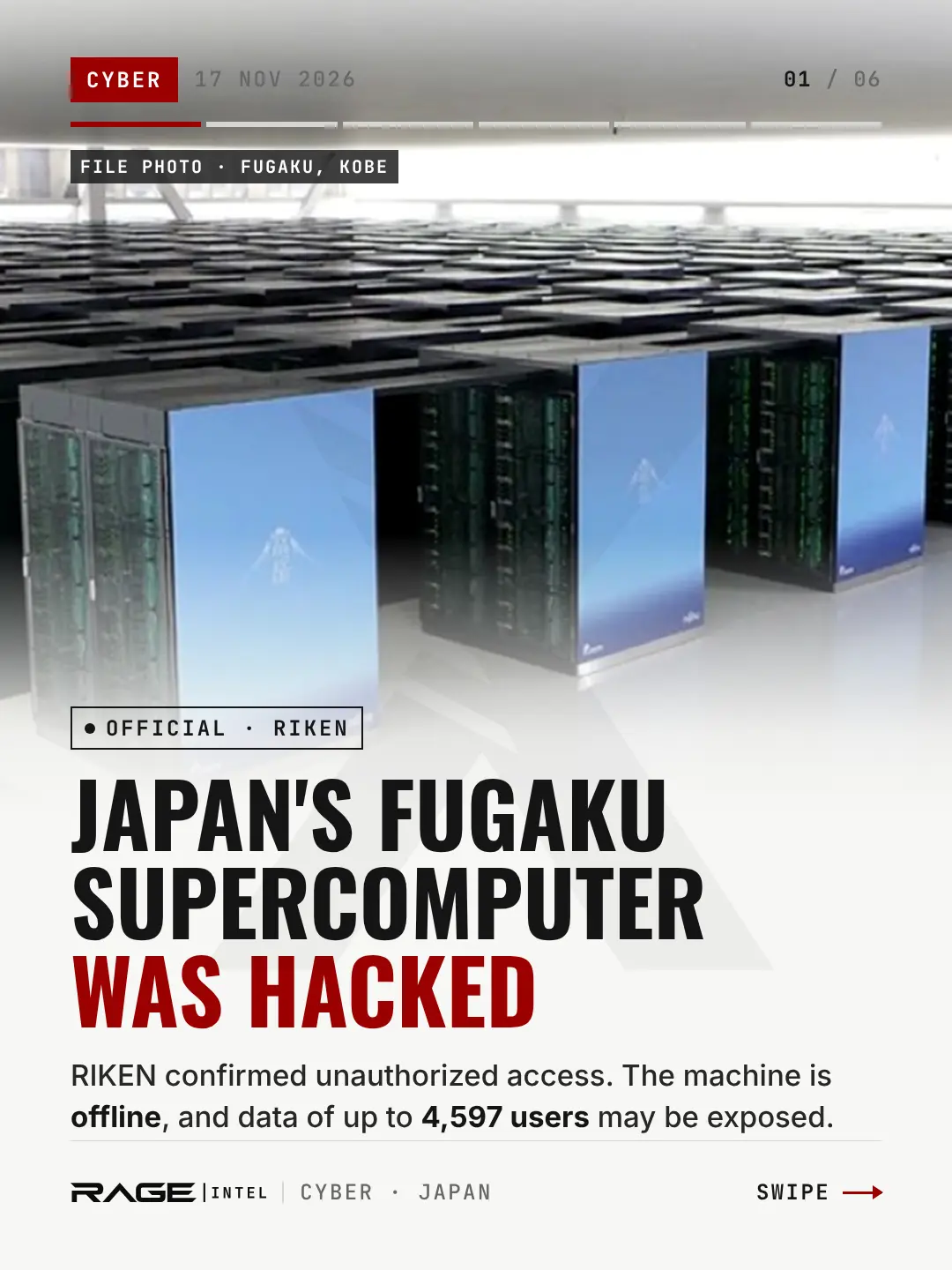
Japan's research institute RIKEN has confirmed that an outsider gained unauthorized access to the system that runs Fugaku, one of the world's most powerful supercomputers. The attackers reportedly got in through a public status dashboard between 10 and 13 November 2026. RIKEN shut Fugaku down on 14 November and it is still offline, with no restart date. Data belonging to up to 4,597 users of Fugaku and the newer Rikyu AI machine may be exposed. RIKEN says it has no evidence yet that research data has leaked, and it has not said who was behind the attack.
Key takeaways
- The breach: RIKEN confirmed unauthorized access to Fugaku's internal operational network between 10 and 13 November 2026.
- The way in: The public web page that shows Fugaku's operating status. How the attackers got from there into the network is still under investigation.
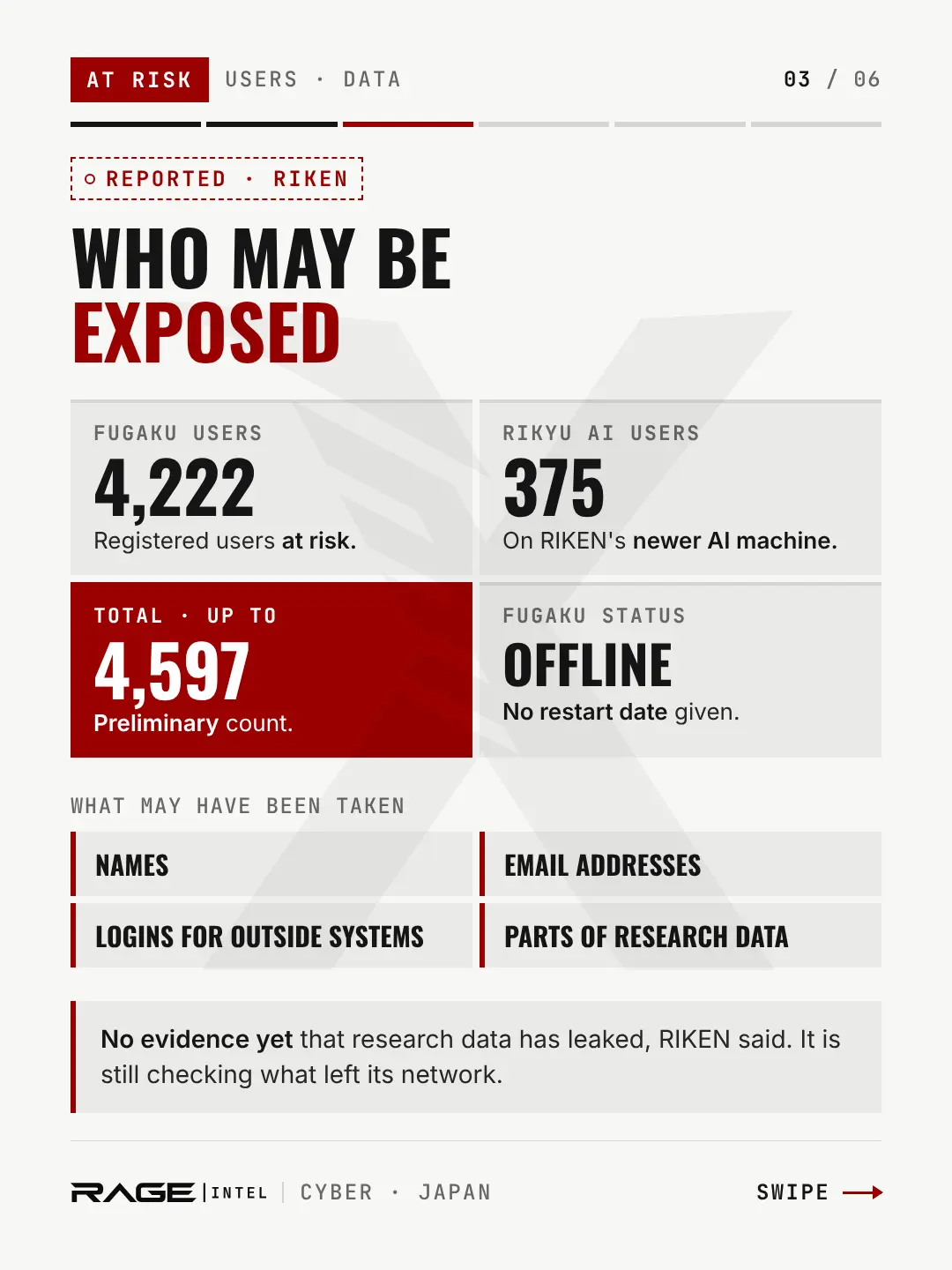
- The exposure: Up to 4,222 Fugaku users and 375 users of Rikyu, 4,597 in total. That is a preliminary count.
- What may be taken: Names, email addresses, files in users' home directories and the credentials used to log in, including SSH keys and logins for outside systems.
- Not known: who did it, how they moved through the network, and whether research data has leaked. RIKEN says there is no evidence of a leak so far.
Confidence: OFFICIAL for RIKEN's notice and its timeline; REPORTED for the attackers' route and activity, which come from news reports of RIKEN's statement. This article reflects reporting up to Tuesday 17 November 2026.
What RIKEN says happened#
RIKEN published a notice on Monday 16 November about a possible personal-information leak affecting users of Fugaku and Rikyu.
| Date | What happened |
|---|---|
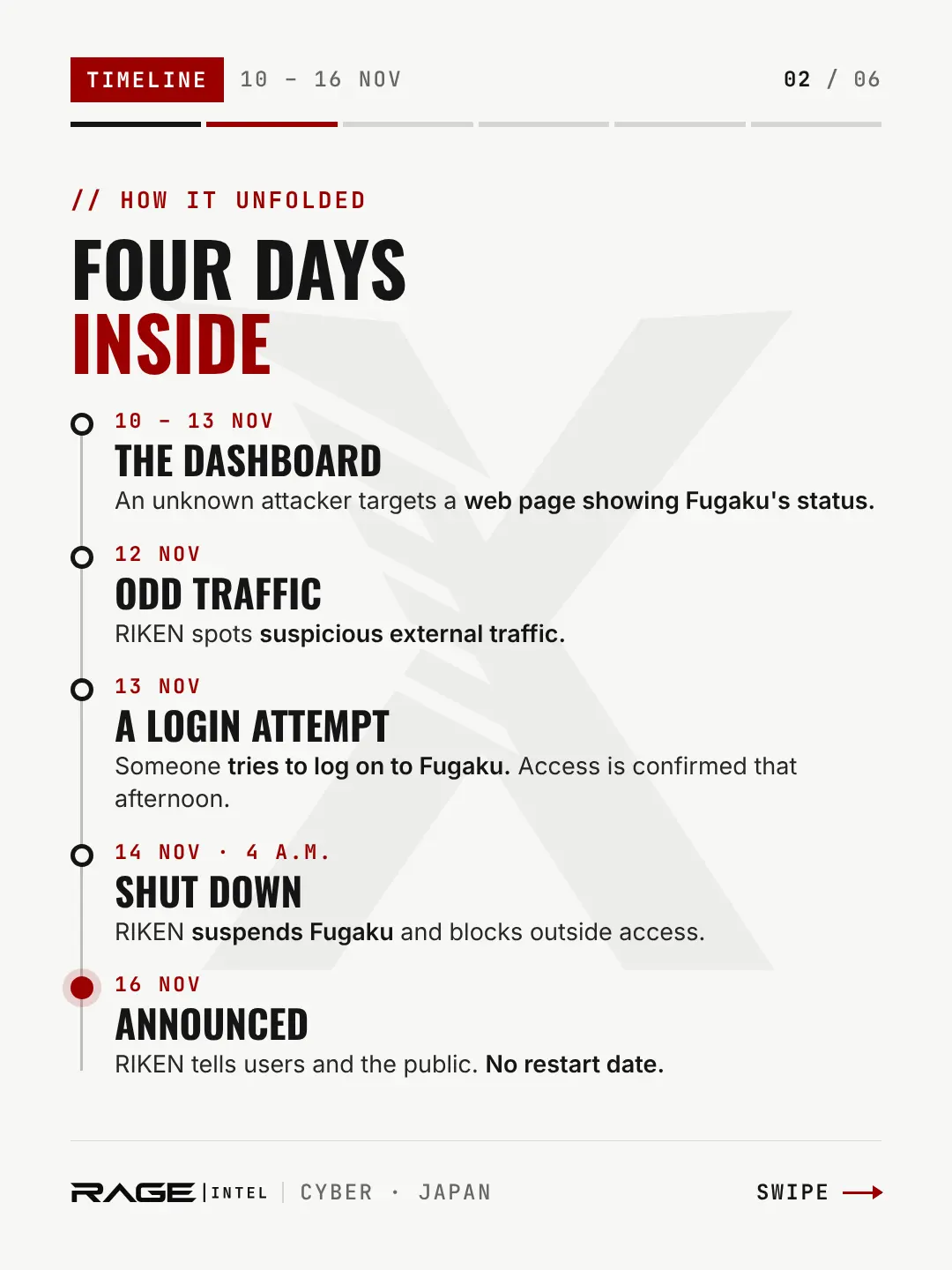
| 10–13 November | An unknown party attacks a public web dashboard that shows Fugaku's operating status, and gets into the internal operational network. |
| 12 November | RIKEN staff record suspicious network activity. |
| 13 November | Someone tries to log on to Fugaku directly. RIKEN confirms the unauthorized access. |
| 14 November, 4:30 a.m. | RIKEN suspends Fugaku and blocks access from outside. |
| 15 November | RIKEN stops all running and queued jobs, cancels the login public keys of all users and notifies affected researchers. |
| 16 November | RIKEN announces the breach to users and the public. It gives no restart date. |
RIKEN has not said how the attackers moved from the dashboard to the servers that hold user data. The Register reports that they crossed the network to those servers. Some reports add that unauthorized software was installed on affected servers. That detail is not in RIKEN's notice, so treat it as unconfirmed.
Who may be exposed#
| System | Registered users at risk |
|---|---|
| Fugaku | 4,222 |
| Rikyu, RIKEN's newer AI machine | 375 |
| Total, up to | 4,597 |
Some outlets report only parts of this. RIKEN's own notice gives the two figures above, and the total is their sum. It is a preliminary count.
According to RIKEN and news reports, what may have been taken includes:
- user names and email addresses;
- files in users' home directories, including parts of their research data;
- the information held in the user authentication system, including SSH private keys and access keys;
- credentials for other supercomputers and services that RIKEN does not run.
One report says the notification email told users that some people's SSH private keys and logins were taken and that RIKEN cannot rule out an effect on all users. RIKEN's public notice is more cautious and says the keys may have been taken.
RIKEN says there is no evidence yet that research data has leaked, and that it is still checking what left its network. It is also working with the institutions that run the outside systems to find out whether the stolen logins were used there. Whether anyone's personal data beyond the users' own has been taken is not yet known.
What RIKEN has done#
- Suspended Fugaku and blocked outside access.
- Cancelled the public keys all users log in with, and replaced administrator keys.
- Told users to remove the matching public keys from outside services and make new key pairs.
- Stopped all running and waiting jobs.
Fact check: the viral post#
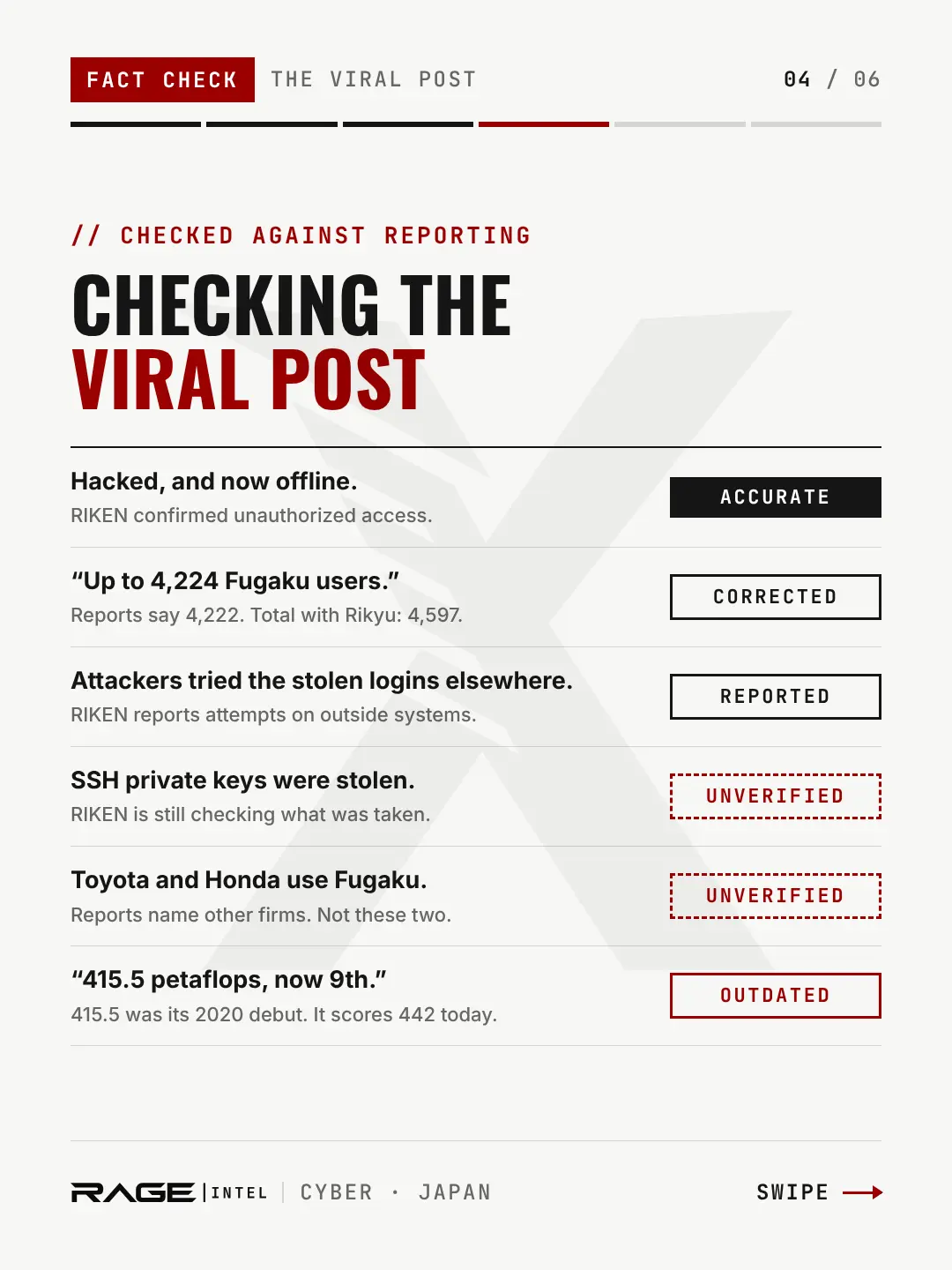
A post on social media has spread widely since the announcement. Here is how its claims stand against the reporting we found.
| Claim | Verdict |
|---|---|
| Fugaku was hacked and is offline. | Accurate. RIKEN confirmed unauthorized access and the machine is suspended. |
| "Up to 4,224 Fugaku users." | Corrected. RIKEN's figure is 4,222. With Rikyu, the total is 4,597. |
| Attackers tried the stolen logins elsewhere. | Reported. Reporting says RIKEN is checking attempts on outside systems. It has not published results. |
| SSH private keys were stolen. | Unverified. RIKEN says they may have been taken, and is still checking. |
| Toyota and Honda use Fugaku. | Unverified. We found no report naming these two. |
| "415.5 petaflops, now 9th." | Outdated. 415.5 petaflops was Fugaku's 2020 debut. It scores 442.01 petaflops on the TOP500 list of June 2026, where it ranks ninth. |
Why Fugaku matters#
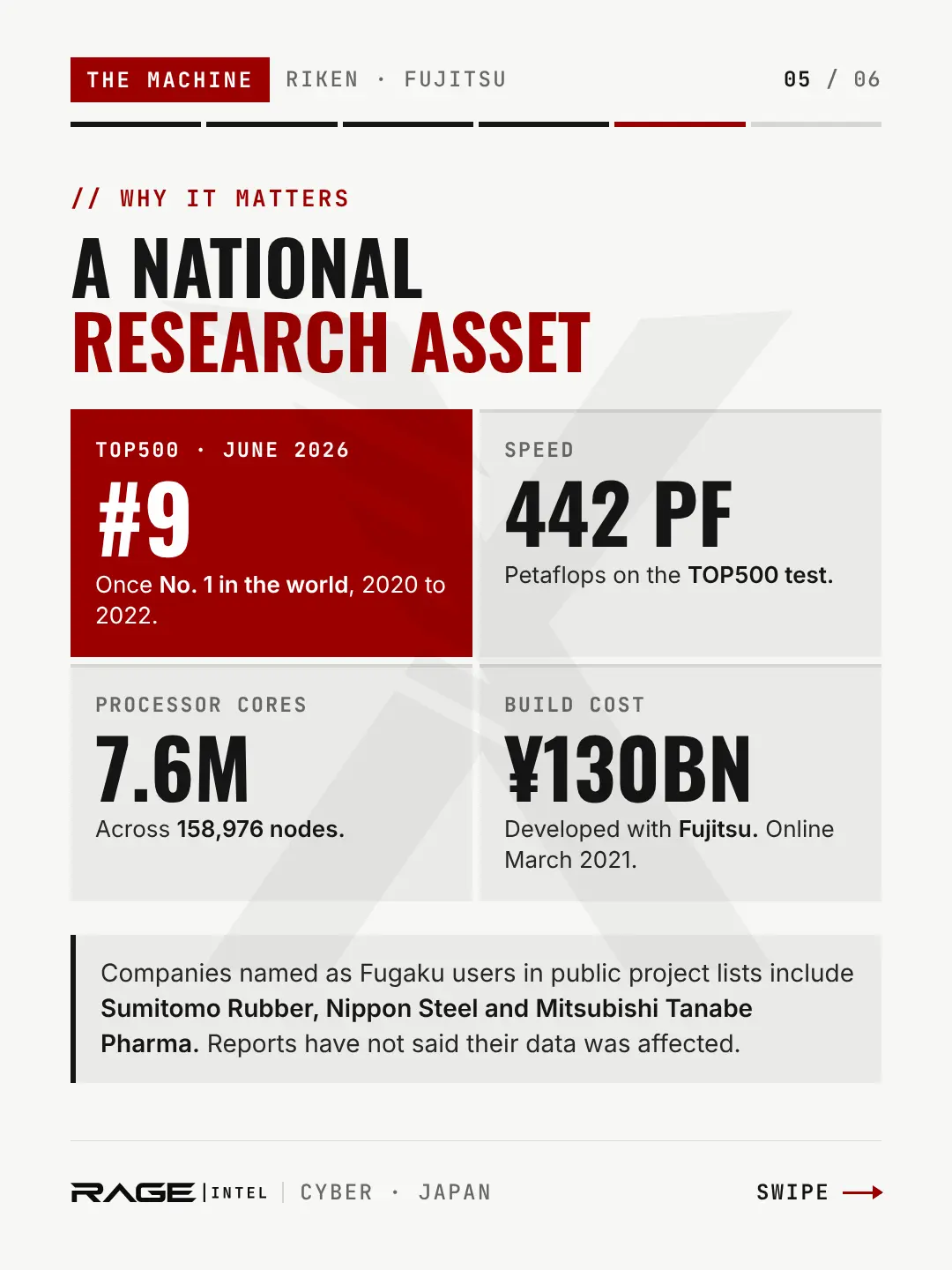
Fugaku is a national research asset. It was built by RIKEN and Fujitsu at the RIKEN Center for Computational Science in Kobe, and has been in operation since 2021.
- Rank: it was the world's fastest supercomputer from 2020 to 2022. On the June 2026 TOP500 list it ranks ninth.
- Speed: 442.01 petaflops on the TOP500 benchmark.
- Size: about 7.6 million processor cores across 158,976 nodes.
- Users: universities, public research bodies and companies. Sumitomo Rubber Industries has said publicly that it uses Fugaku to simulate rubber materials. The reports we found do not say that any company's data was affected.
What to watch#
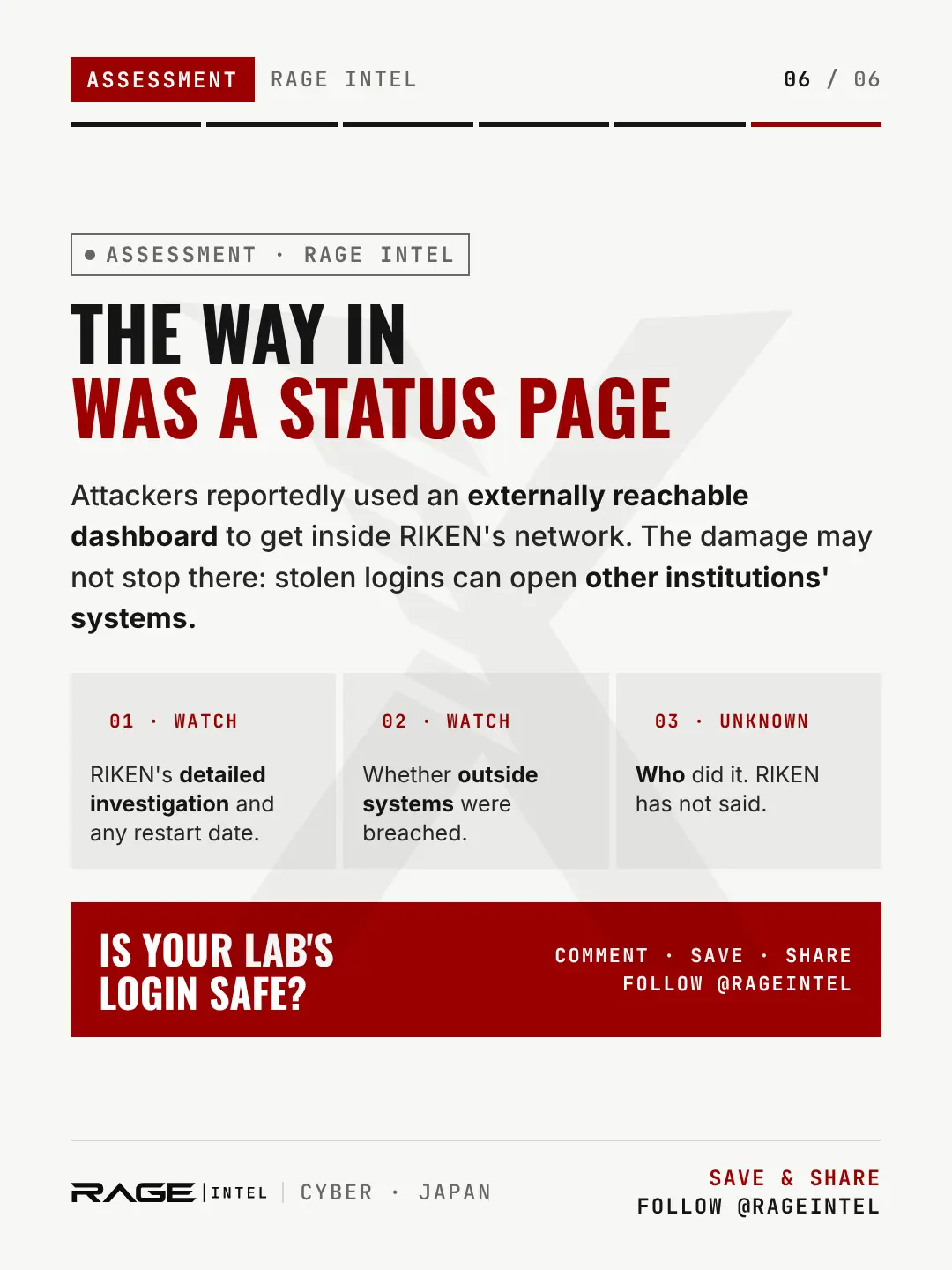
- RIKEN's detailed investigation, and any date for Fugaku to restart.
- Whether the outside systems were breached, since stolen logins can open other institutions' machines.
- Whether research data leaks, or turns up for sale.
- Who did it. RIKEN has not named a suspect or a motive.
- Other research centers reviewing the same kind of public status pages.
Our read · RAGE Intel assessment
The way in was a status page, a part of the system built to be seen from outside. That is the point to take from this case: the target was not the supercomputer's processors, but the network around it and the people who log in to it. The most serious damage may be the stolen logins, which can open other institutions' systems long after Fugaku is back.
This is an assessment, not a finding. RIKEN has not said who was behind the attack or how the intruders moved through its network.
This story is developing. RAGE X will update it as new information is confirmed.
Sources#
- RIKEN, Notice regarding a possible personal information leak affecting Fugaku and RIKYU users following unauthorized access to the supercomputer Fugaku, 16 November 2026
- The Register, Japan's Fugaku supercomputer has decidedly un-super security, 17 November 2026
- Yahoo News, Japan's most powerful supercomputer may have been hacked, over 4,000 users' personal data stolen, November 2026
- Pasquale Pillitteri, Fugaku supercomputer hacked, RIKEN confirms unauthorized access, November 2026
- Digital Watch, Japan's Fugaku supercomputer compromised, exposing credentials of up to 4,597 researchers, November 2026
- Mallory, Fugaku taken offline after dashboard breach puts user credentials at risk, November 2026
- Informat.ro, The Japanese supercomputer Fugaku was accessed without authorization, November 2026
- TOP500, TOP500 List, June 2026
- Modern Tire Dealer, SRI taps into power of Fugaku supercomputer
Cover photo: file photo of Fugaku, Kobe. Graphics in the carousel: RAGE Intel.
Continue the assessment
Related Intelligence
The Philippines Just Said the Quiet Part Out Loud on Taiwan
The Philippines says it can't stay neutral in a Taiwan war. Japan is arming allies. China is training with Russia. The Indo-Pacific map is shifting.
2026-08-01 · 7 min read
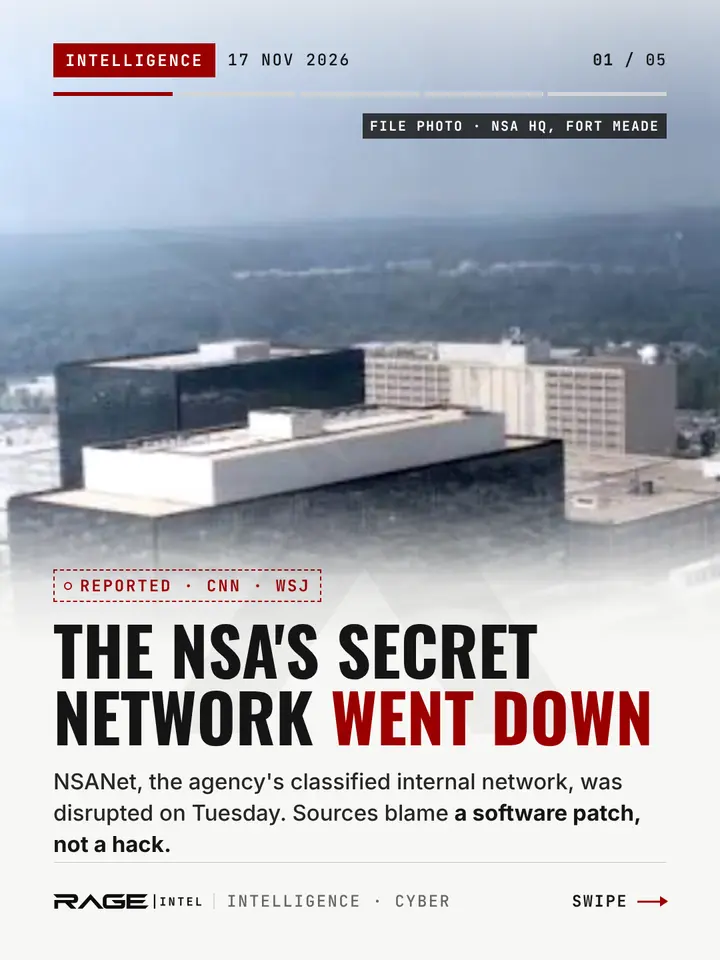
NSA's Classified Internal Network Goes Down: Sources Blame a Software Patch, Not a Cyberattack
The NSA's classified network NSANet went down. Sources say a software patch, with no evidence of a cyberattack. The sixth major outage in eight days.
2026-11-17 · 5 min read
Apple Blames an "Internal Update" for Tuesday's Outages and Says It Was Not a Cyberattack
Apple says an internal update caused Tuesday's iCloud and App Store outages, not a cyberattack. iCloud sign-in was still down. The fourth software failure this week.
2026-11-17 · 5 min read
Today's conflict risk
The daily RAGE INDEX scores global conflict risk across six theaters, with sources and forecasts.
Read the RAGE INDEXReach readers like these
RAGE X sells sponsored content across RAGE Intel, RAGE War and RAGE Global by proposal, always labelled as sponsored.
Request a campaign proposal