Chinese Military Researchers Fear U.S. AI Could Help Find and Destroy China's Nuclear Missiles
RAGE Global · China · Nuclear · AI · 6 min read
Instagram carousel
Published on Instagram with this story · swipe or use the arrow keys
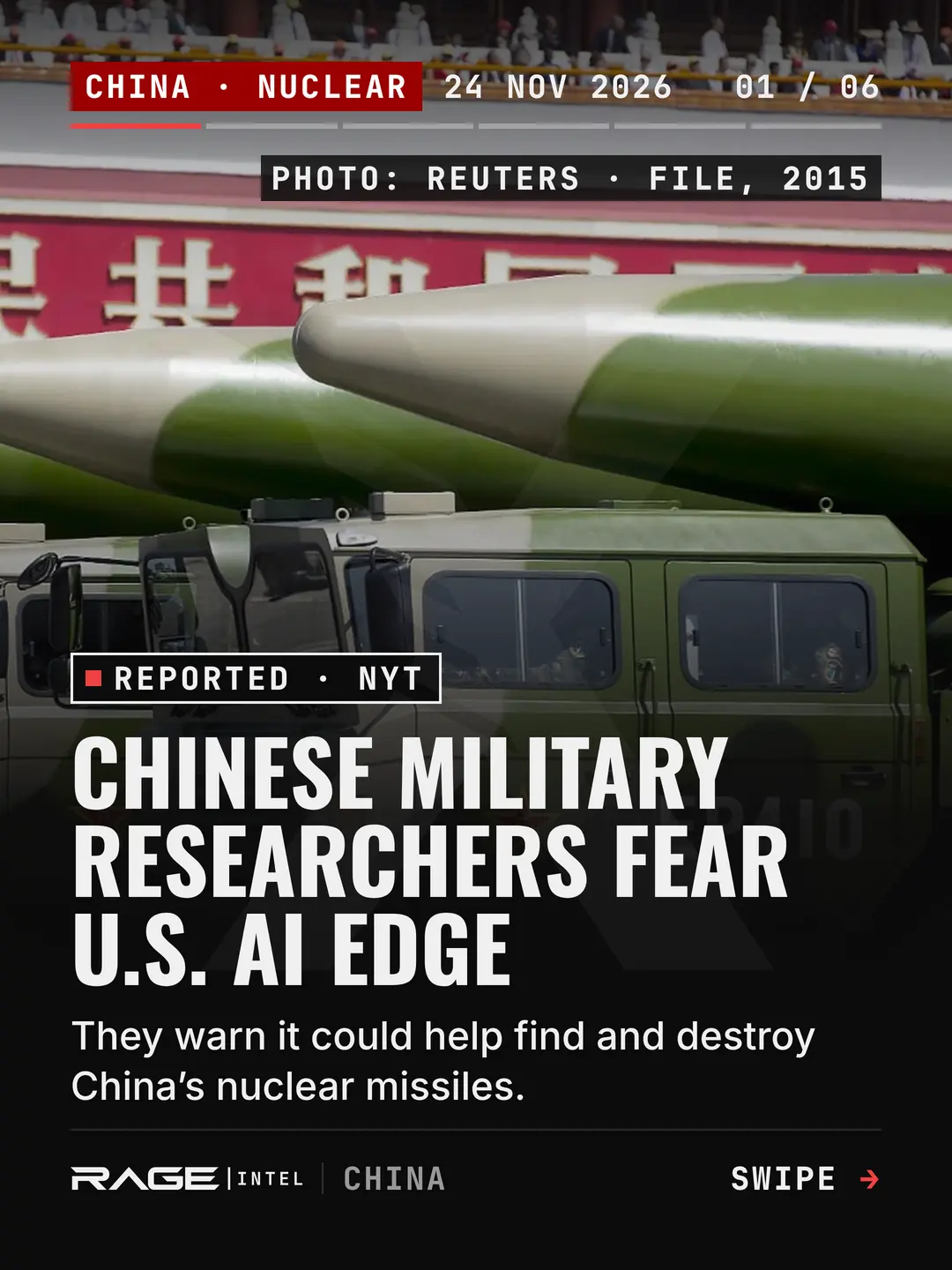
Chinese military researchers fear that American advances in artificial intelligence could make it easier to find and destroy China's nuclear missiles, according to a New York Times review of more than 100 recent Chinese studies, published on 23 November 2026. China's deterrent depends on enough missiles surviving a first strike to hit back. Two researchers at the Academy of Military Science wrote that AI could shrink U.S. nuclear decision time from 15–30 minutes to 90 seconds or less. Beijing is also studying AI to help its own missiles evade defences, and some Chinese researchers warn of the risks of AI-amplified false data. The fears could make Beijing more reluctant to accept limits on its arsenal.
Key takeaways
- The report: A New York Times review of more than 100 recent Chinese studies by civilian and military researchers found worry that U.S. AI could help locate and strike China's nuclear missiles.
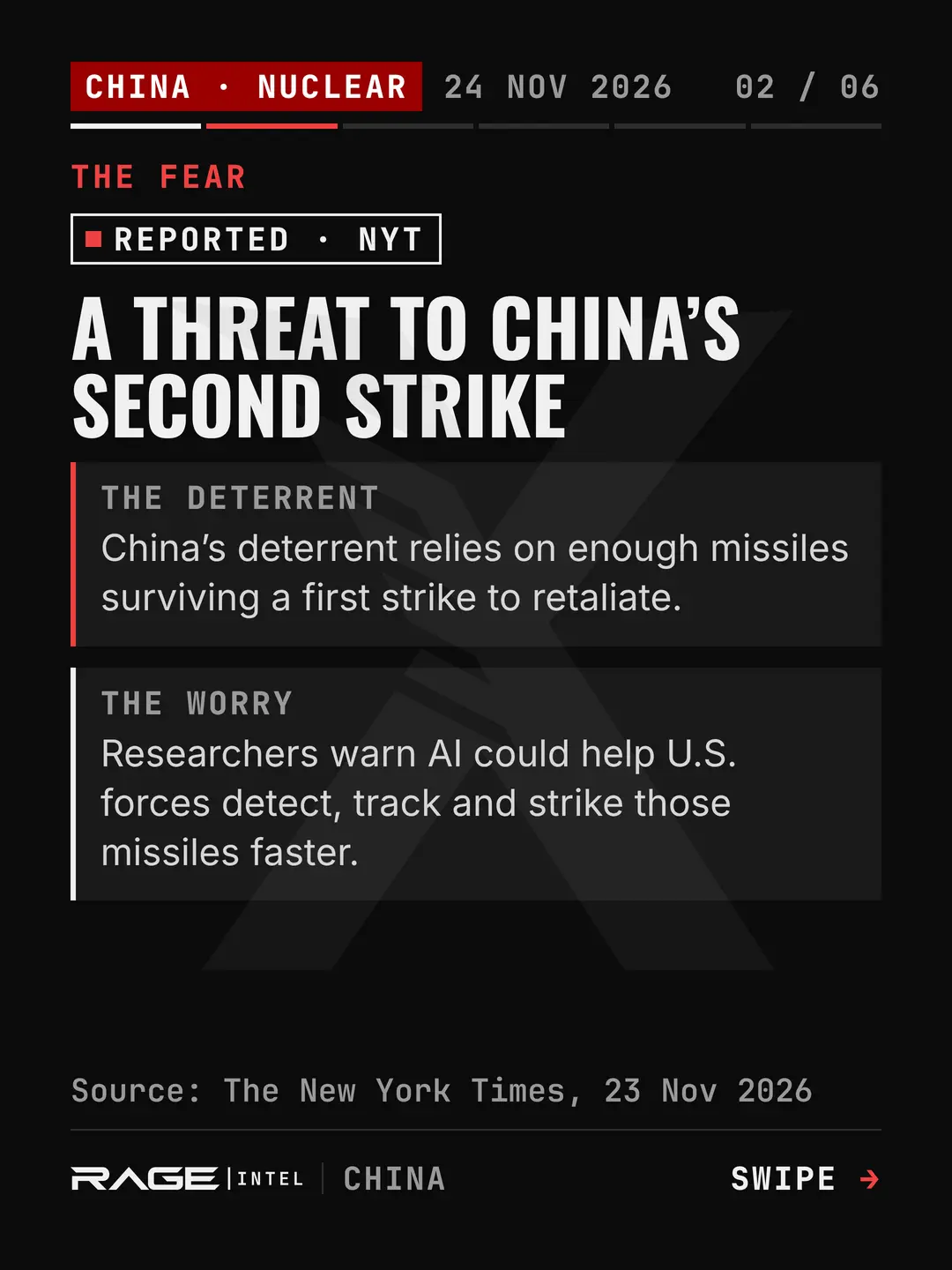
- The fear: China's deterrent rests on a "second strike": enough missiles surviving an attack to retaliate. Researchers fear AI could erode that.
- The clock: Two Academy of Military Science researchers wrote that AI could compress U.S. nuclear decision time from 15–30 minutes to 90 seconds or less. That is a Chinese scenario, not a U.S. capability.
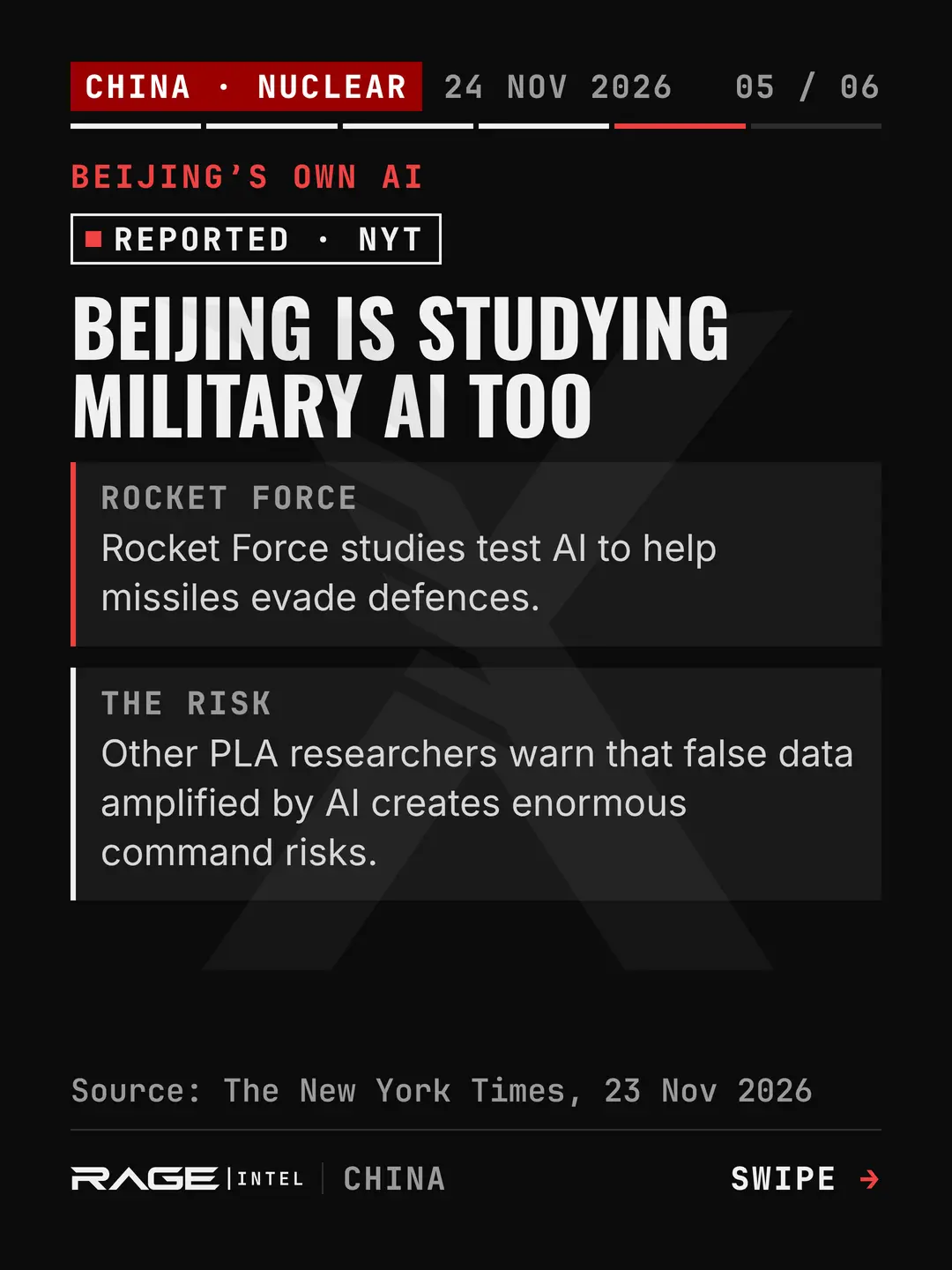
- Both ways: Beijing is studying AI to help its own missiles evade defences, and other Chinese researchers warn that AI-amplified false data creates "enormous" command risks.
- Arms control: The fears could make Beijing more reluctant to accept limits. No talks on AI and nuclear weapons have followed the 2024 Xi–Biden pledge to keep humans in control.
Confidence: REPORTED. RAGE X has not read the New York Times article or the Chinese studies; this report relies on coverage of the review. The studies reflect researchers' views, not official Chinese policy. This article reflects reporting up to 24 November 2026.
What the review found#
The New York Times reviewed more than 100 recent Chinese studies by civilian and military researchers. They show a concern that is both technical and strategic: AI-enabled surveillance, tracking and targeting could help U.S. forces locate China's mobile and silo-based missiles and destroy them before they are launched.
China keeps a much smaller arsenal than the United States or Russia, and it has long relied on being able to retaliate after being struck first. That second-strike ability is what makes the deterrent work. If AI shrinks the time and effort needed to find those missiles, the researchers fear it weakens it.
The 90-second clock#
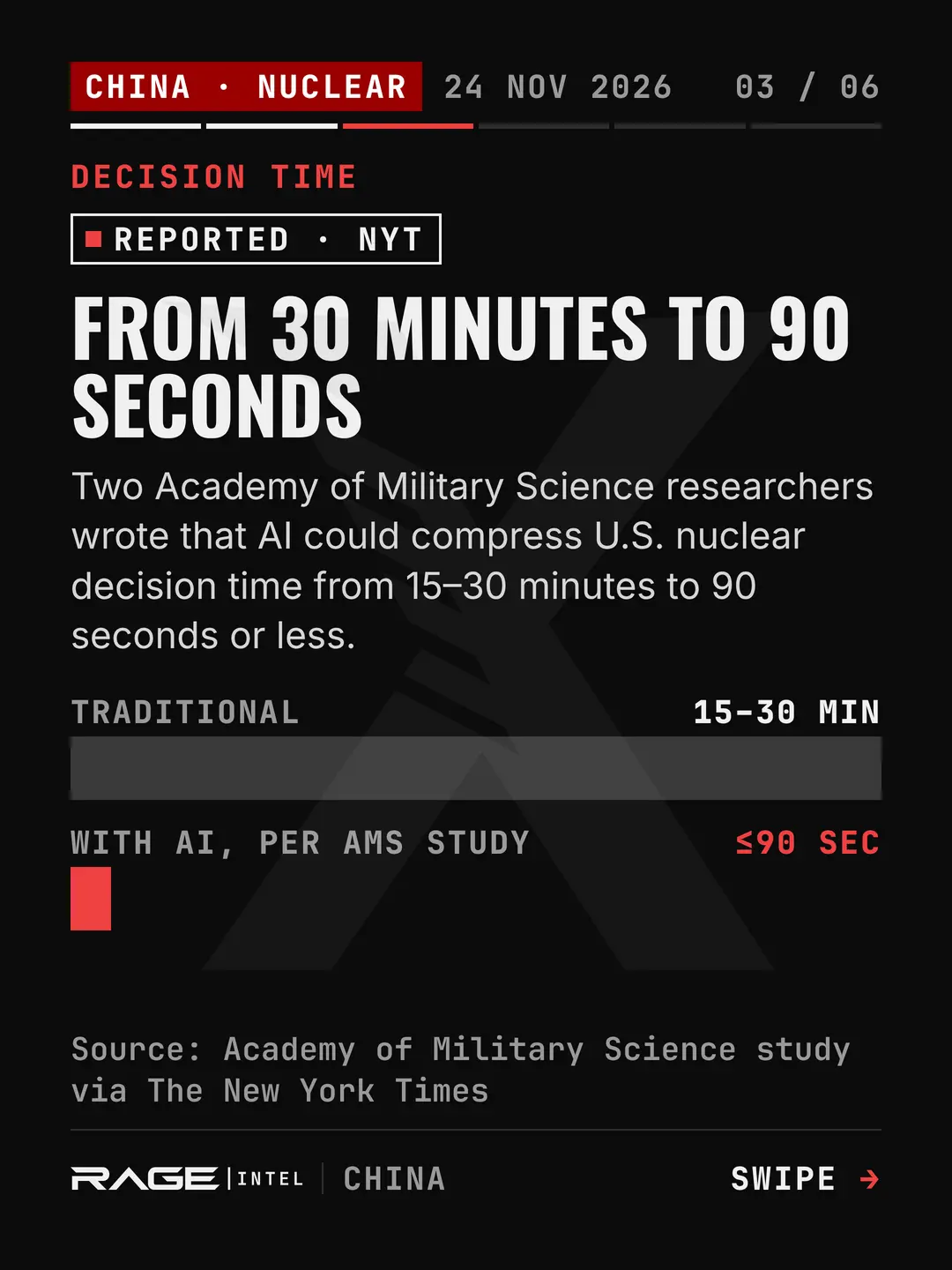
Two researchers at the Academy of Military Science, the People's Liberation Army's top research institution, wrote that AI could compress American nuclear decision-making from 15–30 minutes to 90 seconds or less.
| Time to decide | |
|---|---|
| Traditional U.S. nuclear decision | 15–30 minutes |
| With AI, per the Academy of Military Science study | 90 seconds or less |
Treat the number with care. It is a scenario in a Chinese study about what U.S. AI might do. Coverage notes it is not a demonstrated U.S. capability, and outlets vary slightly on the wording ("90 seconds or less" or "under 90 seconds"). Philip Reiner of the Institute for Security and Technology told one outlet that AI is not making launch decisions, but it could shape the information humans use to decide.
Beijing studies military AI too#
The Chinese studies are not only defensive.
- Rocket Force. Studies from the PLA Rocket Force test AI to help missiles, including hypersonic and ballistic weapons, evade defences and adapt their flight paths.
- The risk inside. Researchers from the National University of Defense Technology and the Academy of Military Science warned that false data amplified by AI creates "enormous" decision-making risks for command and control.
So the same research that fears American AI also doubts how far any command system should trust it.
The arsenals#
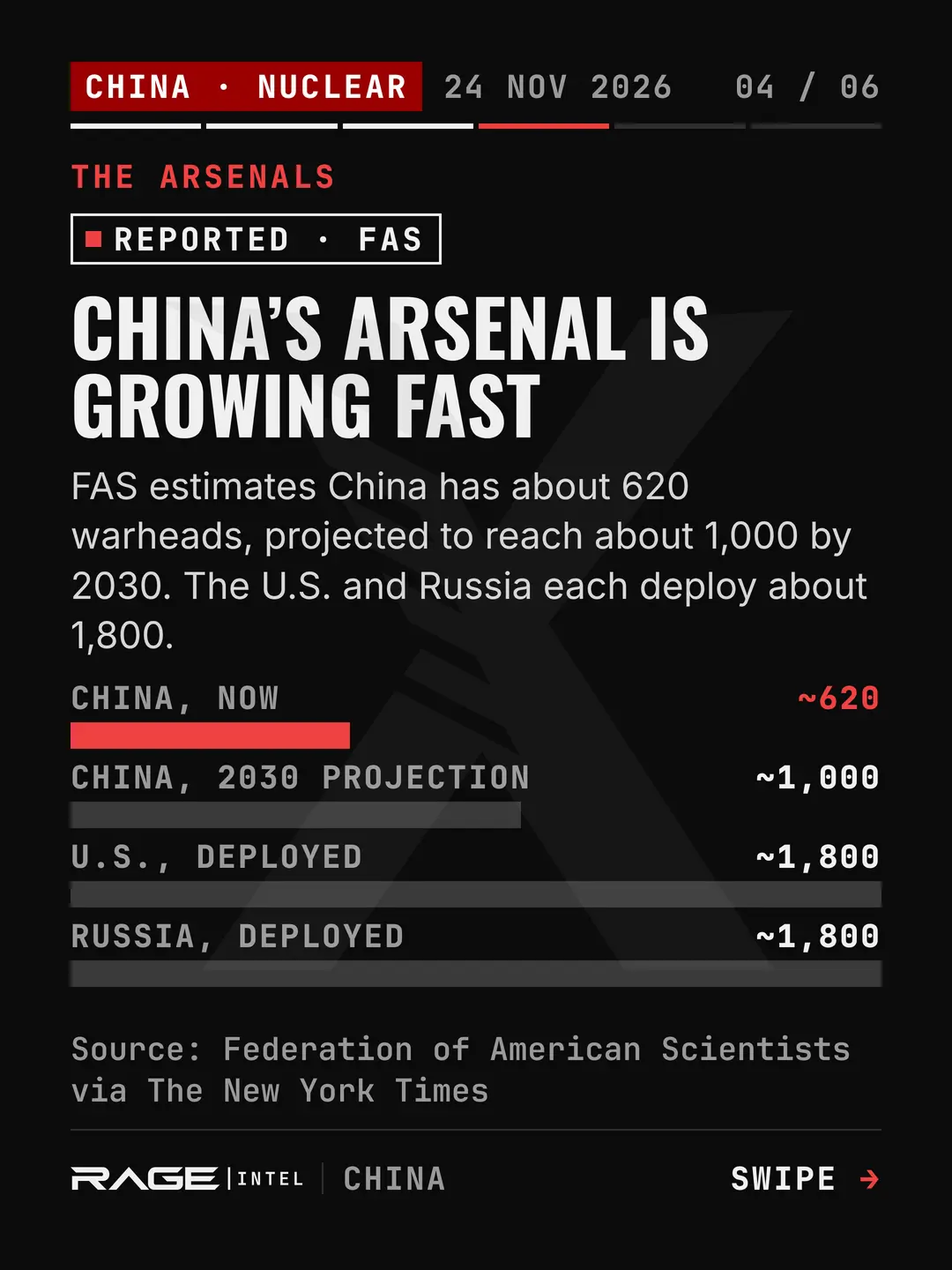
The Federation of American Scientists (FAS) estimates that China has about 620 nuclear warheads, with more in production. SIPRI's 2026 Yearbook gives the same figure.
| Warheads | Note | |
|---|---|---|
| China, stockpile now | ~620 | FAS and SIPRI estimate. Only about 34 are thought to be deployed with operational forces. |
| China, by 2030 | over 1,000 | A U.S. Department of Defense projection; FAS notes it depends on many uncertain factors. |
| United States, military stockpile | ~3,700 | FAS, via the Arms Control Association, March 2026 |
| Russia, military stockpile | ~4,400 | FAS, via the Arms Control Association, May 2026 |
Numbers of deployed warheads are counted differently from stockpiles, so these figures do not compare like with like. The U.S. and Russia each deploy roughly 1,800 warheads on the carousel, a figure we could not confirm in the sources we could reach. The 2010 New START treaty, which capped U.S. and Russian strategic deployed warheads at 1,550, expired in February 2026.
Arms control: no follow-up on AI and nukes#
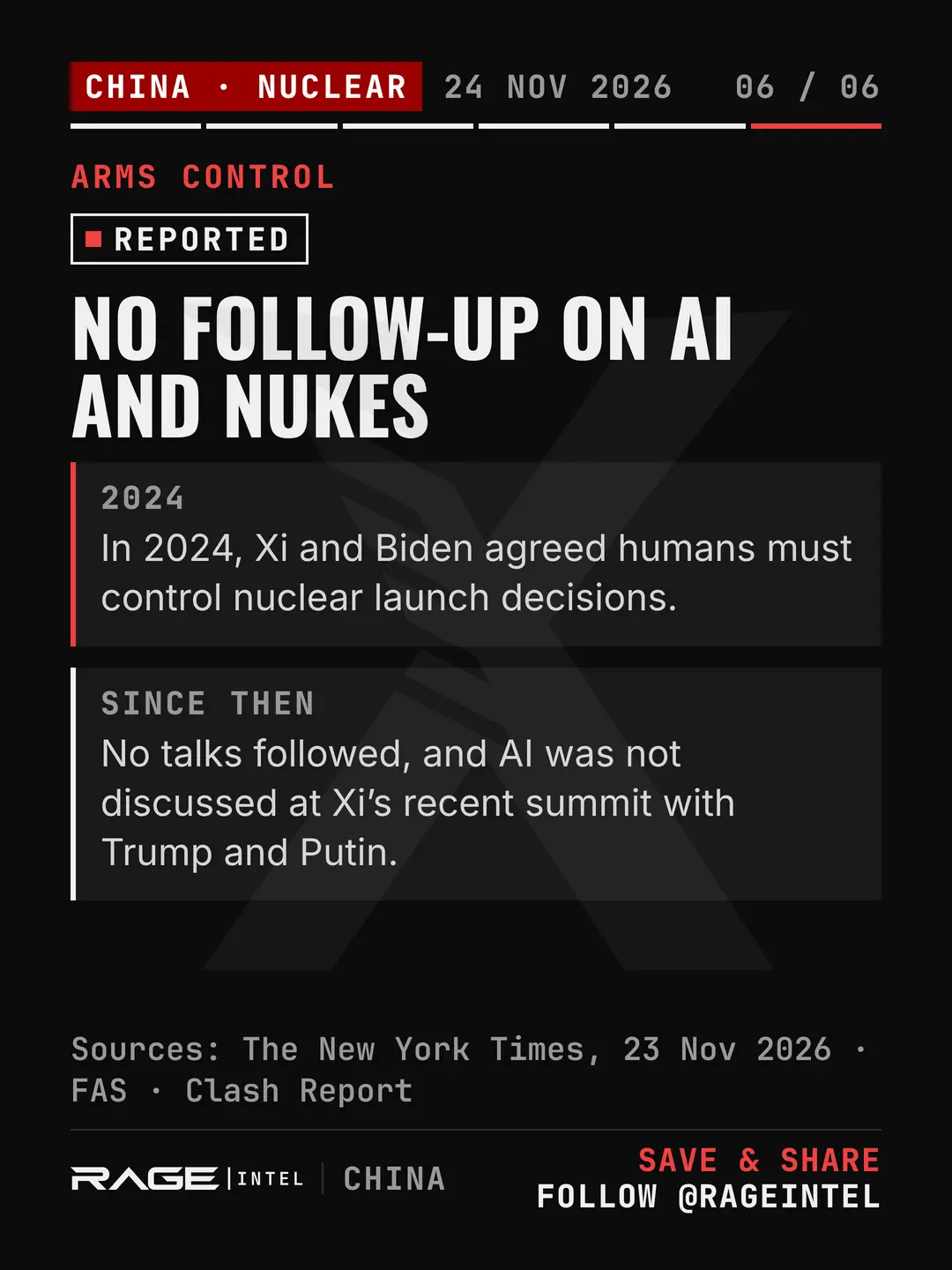
- 2024. President Biden and President Xi agreed in Lima, Peru, that humans, not AI, should control the decision to use nuclear weapons. The White House said the two leaders "affirmed the need to maintain human control over the decision to use nuclear weapons." It was the first time China had said so.
- Since then. No talks have followed. In earlier U.S.–China talks in Geneva in 2024, Beijing was reported to have declined to restrict AI in its nuclear forces. Reports differ on whether AI and nuclear risk came up at the recent APEC-period meetings of the leaders, and we could not confirm that it did not.
- The effect. The New York Times reports that the worries could make China more reluctant to accept limits on its smaller arsenal.
What to watch#
- Whether Beijing responds to the report. We found no Chinese government comment.
- Any U.S.–China talks on AI and nuclear command and control.
- China's warhead count, which is growing faster than at any time in its history.
- PLA studies of AI in missile guidance and early warning.
- U.S. military AI programs that shorten the time from detection to strike. See our analysis of AI in military command and control.
Our read · RAGE Intel assessment
The studies show a worry that could pull in two directions. If Beijing fears that its missiles can be found and hit, it has a reason to build more of them and to resist limits. And if it also fears AI-amplified false data in its own command systems, it has a reason to want rules. Which fear wins is not clear.
This is an assessment, not a finding. The studies are researchers' scenarios, not government policy, and we have not seen the underlying papers.
This story is developing. RAGE X will update it as new information is confirmed.
Sources#
- The New York Times, review of more than 100 Chinese military and civilian studies on AI and nuclear forces, 23 November 2026 (not reviewed in full; reported through the outlets below)
- The Next Web, China's military fears US AI could expose its nuclear missiles, NYT reports, November 2026
- MLQ.ai, Chinese military researchers fear US AI could expose China's nuclear missiles, NYT review of 100+ studies finds, November 2026
- The Defense News, Chinese military warns U.S. AI could threaten China's nuclear missile survivability, November 2026
- Deccan Herald, China fears AI could give the US an edge in nuclear rivalry, November 2026
- AI Weekly, Chinese military studies fear 90-second US nuclear decisions, November 2026
- Bulletin of the Atomic Scientists, Chinese nuclear weapons, 2026, July 2026
- Federation of American Scientists, Status of World Nuclear Forces, 2026
- Arms Control Association, Arms control and proliferation profile: China
- SIPRI, Yearbook 2026: world nuclear forces
- CNBC, Biden, Xi agree that humans, not AI, should control nuclear arms, 17 November 2024
- The Washington Times, White House says Beijing rejects call to restrict AI use in nuclear weapons use, 24 June 2024
- Clash Report also covered the story; we did not review it.
Cover photo: Reuters, file, 2015. Graphics in the carousel: RAGE Intel.
Continue the assessment
Related Intelligence

NVIDIA Opens Investigation Into CEO Jensen Huang After Reports He Was Targeted by Chinese Intelligence
Nvidia's board opened an independent probe after reports CEO Jensen Huang was targeted by Chinese intelligence. He admitted an affair; claims are unproven.
2026-11-08 · 5 min read
Drone Swarms and Autonomy: Where the Line Actually Is
Most "AI swarm" claims describe automation, not autonomy. CSIS found no verifiable evidence Russian swarming has been fielded. What has been, and what hasn't.
2026-08-29 · 12 min read
Counterspace Weapons and Space Warfare: The Orbital Domain in 2026
Analysis of counterspace weapons — kinetic ASAT, electronic warfare, co-orbital threats, Golden Dome space-based interceptors, and the militarization of orbit.
2026-08-06 · 12 min read
Today's conflict risk
The daily RAGE INDEX scores global conflict risk across six theaters, with sources and forecasts.
Read the RAGE INDEXReach readers like these
RAGE X sells sponsored content across RAGE Intel, RAGE War and RAGE Global by proposal, always labelled as sponsored.
Request a campaign proposal