Russian Corvette Merkury: What Russia Lost in Benghazi
RAGE Global · Russia · Naval warfare · Ship profile · 6 min read
Instagram carousel
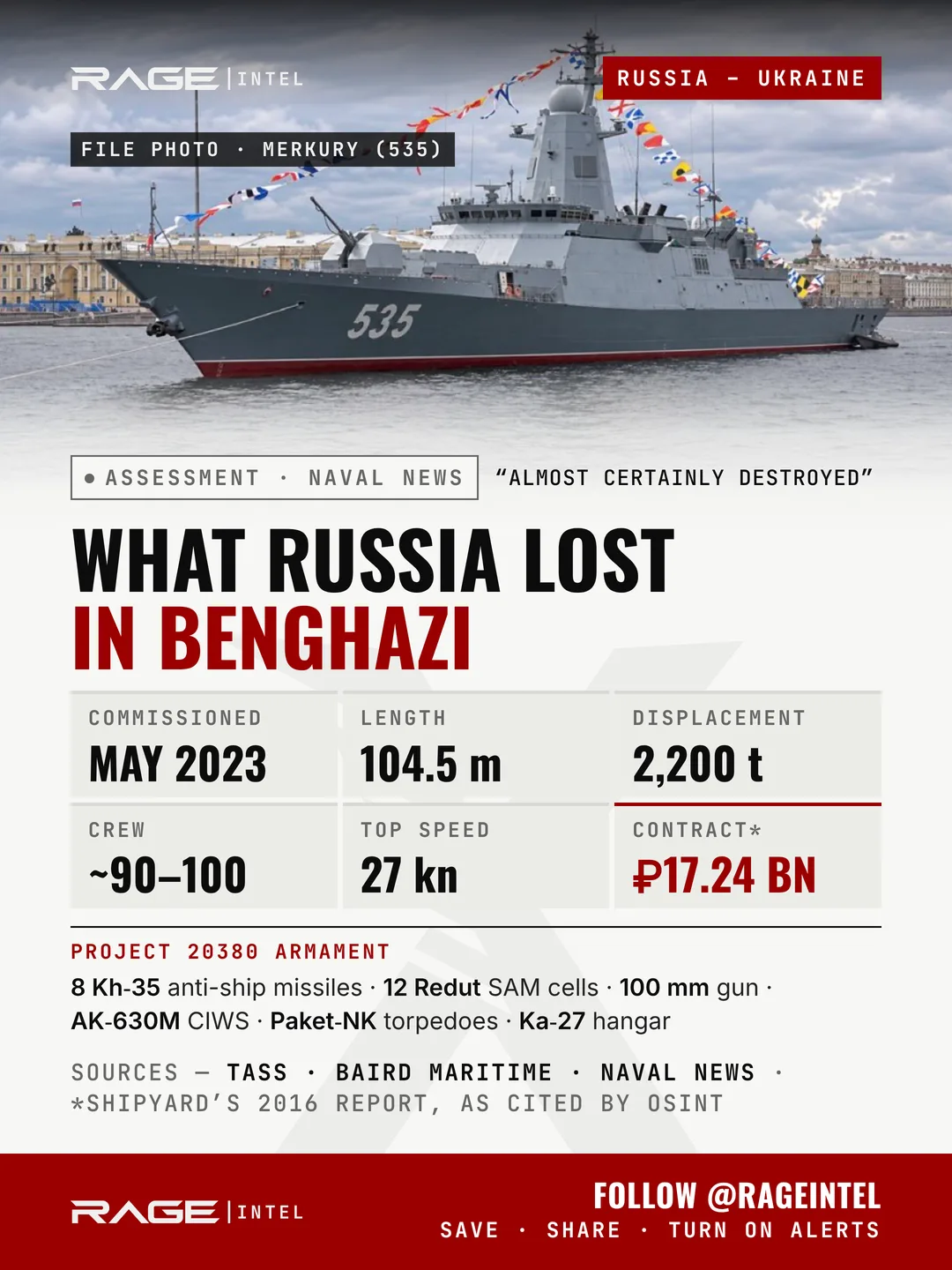
Published on Instagram with this story · swipe or use the arrow keys
The ship at the centre of the Benghazi strike is the Merkury, a Project 20380 Steregushchiy-class corvette that Russia commissioned in May 2023. Naval News analyst H I Sutton provisionally identified it and assesses it as "almost certainly destroyed". Russia has not confirmed the loss, and who attacked it is still unproven. This is the ship profile: where it was built, what it was meant to do, what it carried, and what its loss would mean. For the strike itself, see our report on the Benghazi attack.
Key takeaways
- The ship: Project 20380 Steregushchiy-class corvette, hull number 535, built at the Northern Shipyard (Severnaya Verf) in St. Petersburg and commissioned in May 2023.
- The size: 104.5 metres long, about 2,200 tonnes at full load, with a crew of roughly 90 to 100.
- The name: laid down in 2015 as the Retivy, renamed Merkury in 2021 after the Black Sea Fleet sailing ship Mercury.
- The assignment: nominally the Black Sea Fleet, but it served with Russia's northern fleets during the war.
- The status: Naval News assesses it as almost certainly destroyed. Moscow has not confirmed that, and the cause is unproven.
Confidence: REPORTED for the ship's history and dimensions (TASS, Naval News, Baird Maritime, other published specifications); ASSESSMENT for its condition (Naval News); CLAIM for the contract value and for some details of its weapons fit, which RAGE X could not confirm against a primary source. The ship's class details are standard published figures. Where a figure comes from a single source or varies between sources, this article says so.
The ship at a glance#
| Detail | Figure | Note |
|---|---|---|
| Class | Project 20380 Steregushchiy | Russian corvette class |
| Hull number | 535 | Visible on the hull in file photos |
| Builder | Northern Shipyard (Severnaya Verf), St. Petersburg | Reported as the fifth Project 20380 built there |
| Laid down | 20 February 2015, as Retivy | TASS |
| Launched | 12 March 2020 | Specialist defence press |
| Renamed | Merkury, decision dated 15 October 2021 | TASS |
| Commissioned | May 2023 | Naval News; the ceremony was held in Kaliningrad |
| Length | 104.5 m | Published specification |
| Displacement | About 2,200 t (full load) | Standard load is about 1,800 t; published figures vary slightly |
| Crew | About 90 to 100 | Approximate |
| Top speed | 27 knots | Published specification |
| Fleet | Black Sea Fleet (nominal) | Served with northern fleets during the war |
Published sources do not always agree on the finer points. Displacement is given as about 2,100 to 2,250 tonnes depending on the source, and the commissioning day is given as 13 or 15 May. This article uses "about 2,200 tonnes" and "May 2023" for that reason.
From Retivy to Merkury#
The ship began life as the Retivy. TASS reports it was laid down on 20 February 2015, and a decision to rename it Merkury was taken on 15 October 2021. The new name honours the Black Sea Fleet sailing ship Mercury, a historic vessel of the Russian fleet.
It was launched in 2020 and commissioned in May 2023. Naval News reported on the commissioning under the headline that the Black Sea Fleet was getting a new corvette "kind of": the ceremony took place far from Crimea, in Kaliningrad, and the ship was nominally assigned to the Black Sea Fleet while the war made it impossible for the fleet to operate freely in its home sea. Naval News described it as operating out of northern fleet bases. Another reference work describes it as operating in practice with the Baltic Fleet. In other words, the "Black Sea" label reflects its paper assignment more than where it served.
What a Project 20380 corvette is for#
The Steregushchiy class is a Russian coastal and escort corvette. It is built for patrol, anti-submarine and anti-ship tasks and for escorting other vessels close to shore. It is a small ship, at about 2,200 tonnes.
That role fits what the Merkury was doing in Libya. H I Sutton reported it had been in port for several days escorting a Russian convoy. Escorting convoys is a standard corvette task.
What the class carries#
RAGE Intel's carousel lists the Project 20380 armament as follows. RAGE X has checked each item against published sources and notes below where the picture is not clear.
| System | What the carousel lists | What RAGE X could confirm |
|---|---|---|
| Anti-ship missiles | 8 Kh-35 | Confirmed for the class: eight Kh-35 anti-ship missiles in Uran launchers |
| Main gun | 100 mm | Confirmed for the class: the 100 mm A-190, though some ships carry a 130 mm gun |
| Air defence | 12 Redut cells | Not confirmed for this hull. Published sources describe the Redut system as part of modernisation for the class, and RAGE X could not verify it on the Merkury |
| Close-in defence | AK-630M | Varies by variant. Sources list a Kashtan system on the Project 20380 and AK-630M mounts on the Project 20381 |
| Torpedoes | Paket-NK | Not confirmed in the sources RAGE X checked |
| Aviation | Ka-27 helicopter hangar | Not confirmed in the sources RAGE X checked |
The reliable summary is that the Merkury was a lightly armed corvette built around eight Kh-35 anti-ship missiles and a 100 mm gun. The exact air-defence and close-in fit of this hull has not been independently confirmed, and RAGE X has not stated a firm configuration for it.
What it cost#
RAGE Intel's carousel gives the ship's build contract as 17.24 billion rubles, from the shipyard's 2016 annual report as cited by open-source analysts, and says that is roughly $200 million by some estimates. RAGE X could not find the figure in the sources it was able to check, and could not confirm which contract it refers to. Russian corvette contracts have been signed for several different ships, and the numbers can be confused. Treat the sum as an unverified open-source estimate, not an official price.
Condition: what is and is not established#
| Item | Status |
|---|---|
| The ship in Benghazi was the Merkury | Provisional. Identified by H I Sutton of Naval News |
| It was badly damaged or sunk | Reported. Satellite images appear to show the stern underwater |
| It is "almost certainly destroyed" | Assessment (Naval News) |
| Russia confirms the loss | No |
| The cause was Ukrainian sea drones | Claim (two Libyan military officials, via AP) |
| The cause was accidental | Not ruled out (open-source analysts) |
| Casualties | Unconfirmed |
Some outlets have used stronger language, including "destroyed", "capsized" and "blown up". RAGE X holds to the assessment wording, because the Russian side has not spoken and the satellite pictures show damage, not the extent of it.
Why it matters#
- A recent ship. The Merkury entered service in 2023, eight years after it was laid down. If lost, it would be a loss of a ship barely three years in service.
- The location. It was in a Libyan port, not in the Black Sea or the Baltic. That is far from where Russian ships have been exposed to Ukrainian attack so far.
- The escort role. A corvette escorting a convoy is guarding a supply line. Whoever hit it, the loss shows how exposed a lightly armed escort is in a port it does not control.
- The signal. Whether or not the attribution to Ukraine holds, Moscow will have to decide whether to acknowledge the loss and how to describe it.
Questions answered#
What is the Merkury? A Russian Project 20380 Steregushchiy-class corvette, hull number 535, built at the Northern Shipyard in St. Petersburg and commissioned in May 2023.
Was it always called Merkury? No. It was laid down in 2015 as the Retivy and renamed in 2021.
How big is it? About 104.5 metres long, roughly 2,200 tonnes at full load, with a crew of 90 to 100.
What weapons did it carry? Class-standard Kh-35 anti-ship missiles and a 100 mm gun are confirmed. The air-defence and close-in fit of this hull is not independently confirmed.
Is it destroyed? Naval News says it is almost certainly destroyed. Russia has not confirmed the loss.
How much did it cost? An open-source estimate cites 17.24 billion rubles, roughly $200 million by some estimates. RAGE X could not verify the figure.
Our read · RAGE Intel assessment
The Merkury is not a flagship or a capital ship. It is a small, modern escort that Russia built over eight years and used as a convoy guard far from its home waters. That is what makes the Benghazi image notable: the loss of a ship like this, in a port in a third country, would say more about Russia's exposure abroad than about the size of its fleet.
Two parts of the story are still open. The first is the cause: Libyan officials say Ukrainian sea drones, and analysts say an accident has not been ruled out. The second is the specification: the contract value and the weapons fit of this particular hull rest on open-source figures that RAGE X could not confirm.
This is an assessment, not a finding. It will change when Moscow confirms or denies the loss or when the joint Libya–Russia investigation reports.
What to watch#
- Moscow's position: whether Russia confirms the loss and names a cause.
- The investigation: findings of the joint probe opened by eastern Libya's government.
- More imagery: later satellite passes over Benghazi that show whether the hull is still in the water.
- Replacement or reinforcement: whether Russia sends another escort to the Mediterranean.
This story is developing. RAGE X will update it as new information is confirmed.
Sources#
- Naval News, Russian Warship Explosion in Libya Destroys Corvette Merkury, November 2026
- Naval News, Russia's Black Sea Fleet Gets New Corvette... Kind Of, May 2023
- TASS, Shipbuilders to deliver cutting-edge missile corvette to Russian Navy by late March
- Baird Maritime, Vessel Review: Merkury, Russian Navy corvette optimised for littoral warfare
- Wikipedia, Russian corvette Merkury
- Wikipedia, Steregushchiy-class corvette
- Kyiv Post, Russian Missile Corvette Merkury Engulfed in Flames After Explosion in Libya's Benghazi Port, November 2026
- Associated Press, Suspected Ukrainian sea drones hit Russian warship at Benghazi naval base, Libyan officials say, 22 November 2026
The photograph on the carousel is a file photo of the Merkury (hull 535). The contract figure is cited on the carousel to the shipyard's 2016 annual report, as quoted by open-source analysts, and RAGE X could not open that report. Source check 22 November 2026.
Continue the assessment
Related Intelligence
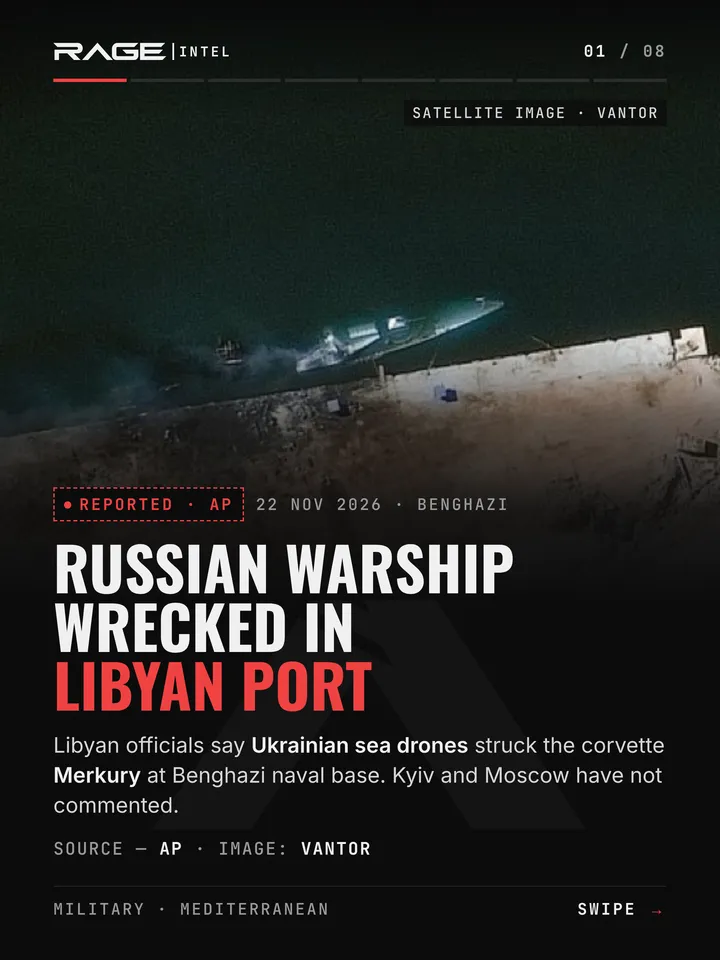
Russian Corvette Merkury Wrecked at Benghazi Naval Base as Libyan Officials Blame Ukrainian Sea Drones
Libyan officials say Ukrainian sea drones wrecked the Russian corvette Merkury at Benghazi. Kyiv and Moscow have not commented; an accident is not ruled out.
2026-11-22 · 7 min read
The Ukraine Front Line in 2026: Where the War Actually Stands
Russian forces have not taken Pokrovsk. Ukraine advanced at Kupyansk. Infiltration replaced assault. What the front actually looks like in 2026.
2026-09-02 · 12 min read
Western Weapons in Ukraine: What Worked and What Didn't
Leopard 2 armour was never penetrated frontally — 57% of the 2A6 tranche was still lost. A verdict on Western systems by what the evidence actually shows.
2026-09-02 · 12 min read
Today's conflict risk
The daily RAGE INDEX scores global conflict risk across six theaters, with sources and forecasts.
Read the RAGE INDEXReach readers like these
RAGE X sells sponsored content across RAGE Intel, RAGE War and RAGE Global by proposal, always labelled as sponsored.
Request a campaign proposal