Fake Bomb Threats Hit Europe's Skies: 13 Flights, Seven Countries, Zero Bombs
RAGE Global · Europe · Aviation · Developing · 7 min read
Instagram carousel
Published on Instagram with this story · swipe or use the arrow keys
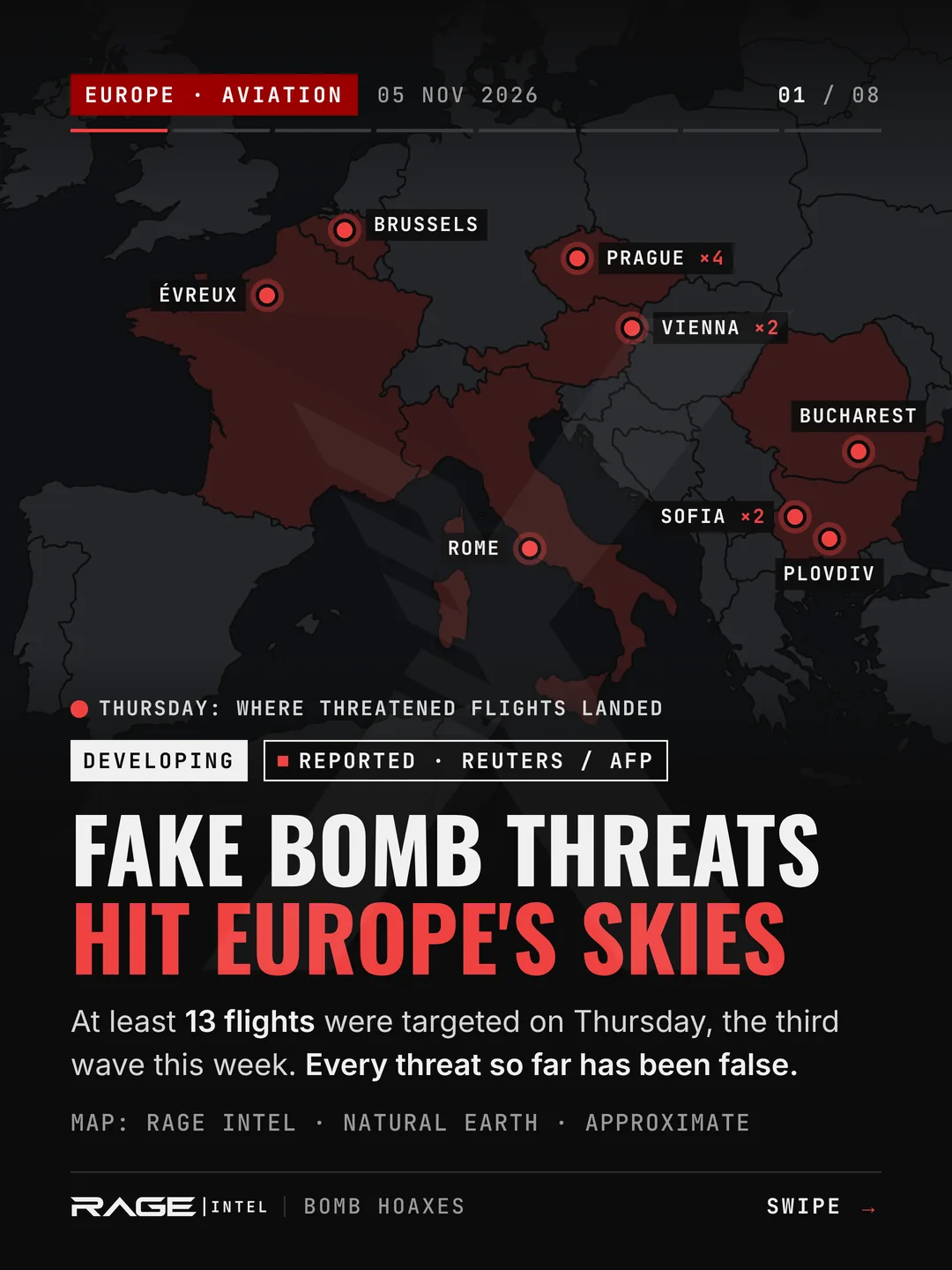
At least 13 flights were targeted by bomb threats across Europe on Thursday 5 November 2026, the third wave of such threats in four days. An Aer Lingus jet bound for Rome was forced down at a French military air base, fighter jets escorted airliners into Rome, and four flights to Prague were met by police on landing. Every threat checked so far has been false. No one has claimed the threats, and no government has named a suspect.
Key takeaways
- Thursday 5 November: at least 13 flights in seven countries were hit by bomb threats, the biggest of three waves this week.
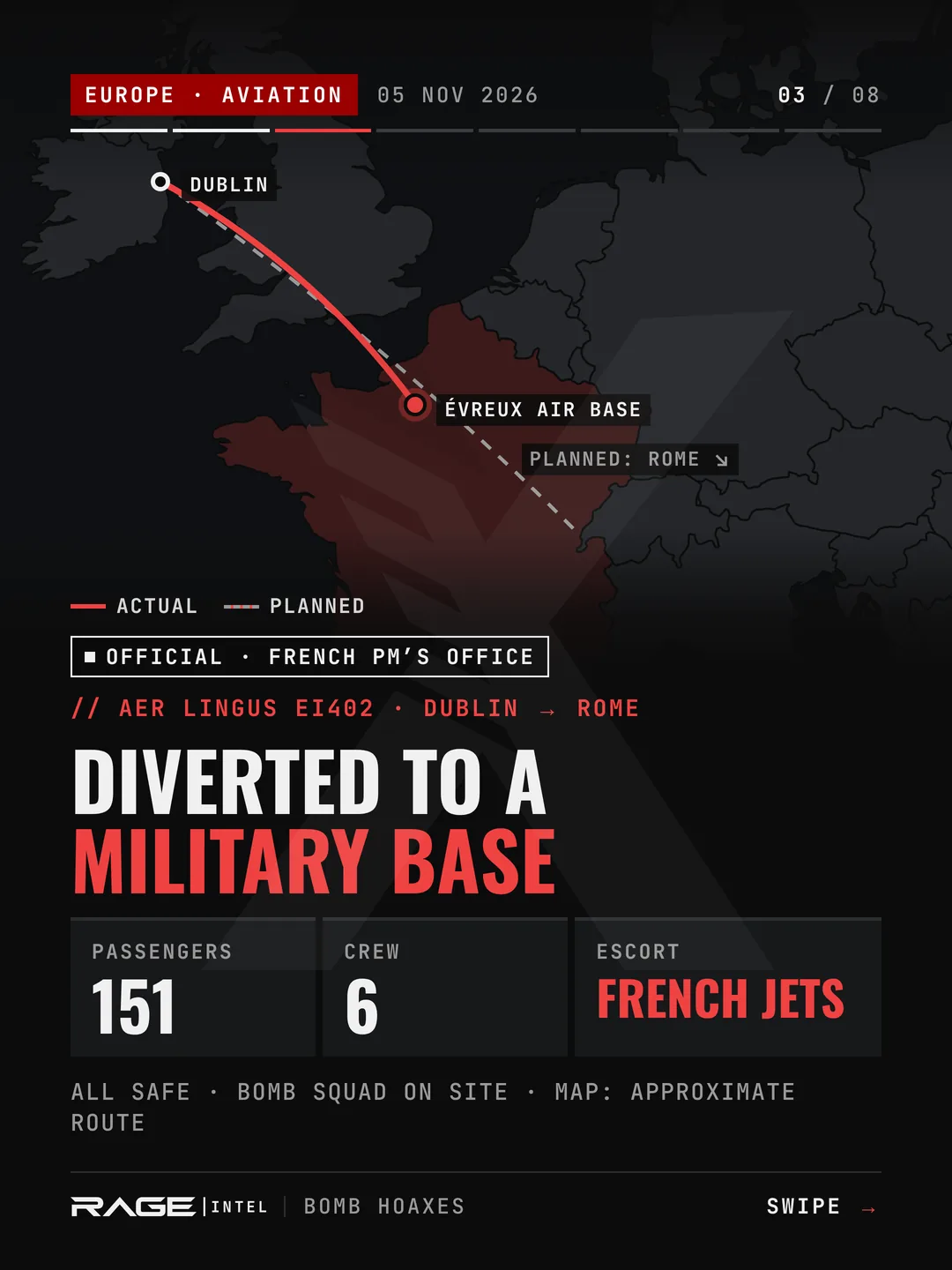
- Aer Lingus EI402, Dublin to Rome, was diverted to the Évreux air base in Normandy. The French Prime Minister's office said 151 passengers and six crew were moved to safety.
- Three waves in four days: Monday 2 November, Tuesday 3 November and Thursday 5 November. No explosives have been found on any aircraft or on the ship searched on Tuesday.
- No claim, no suspect. No government has blamed anyone for these threats, although European officials have blamed Russia and Iran for earlier "hybrid attacks".
- Our read: a deliberate campaign to disrupt, not destroy. Who is behind it is still unknown.
Thursday: one morning, seven countries#
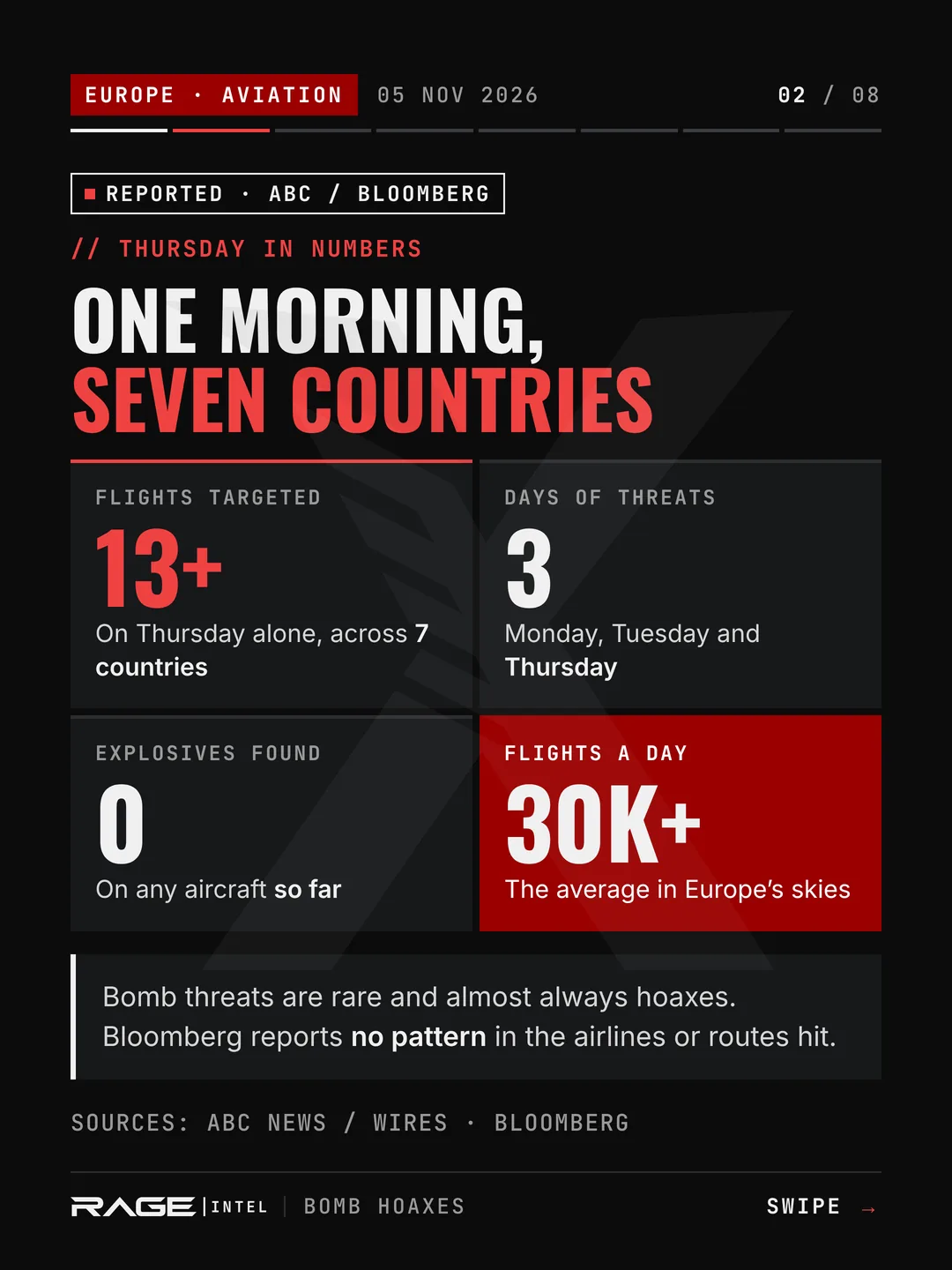
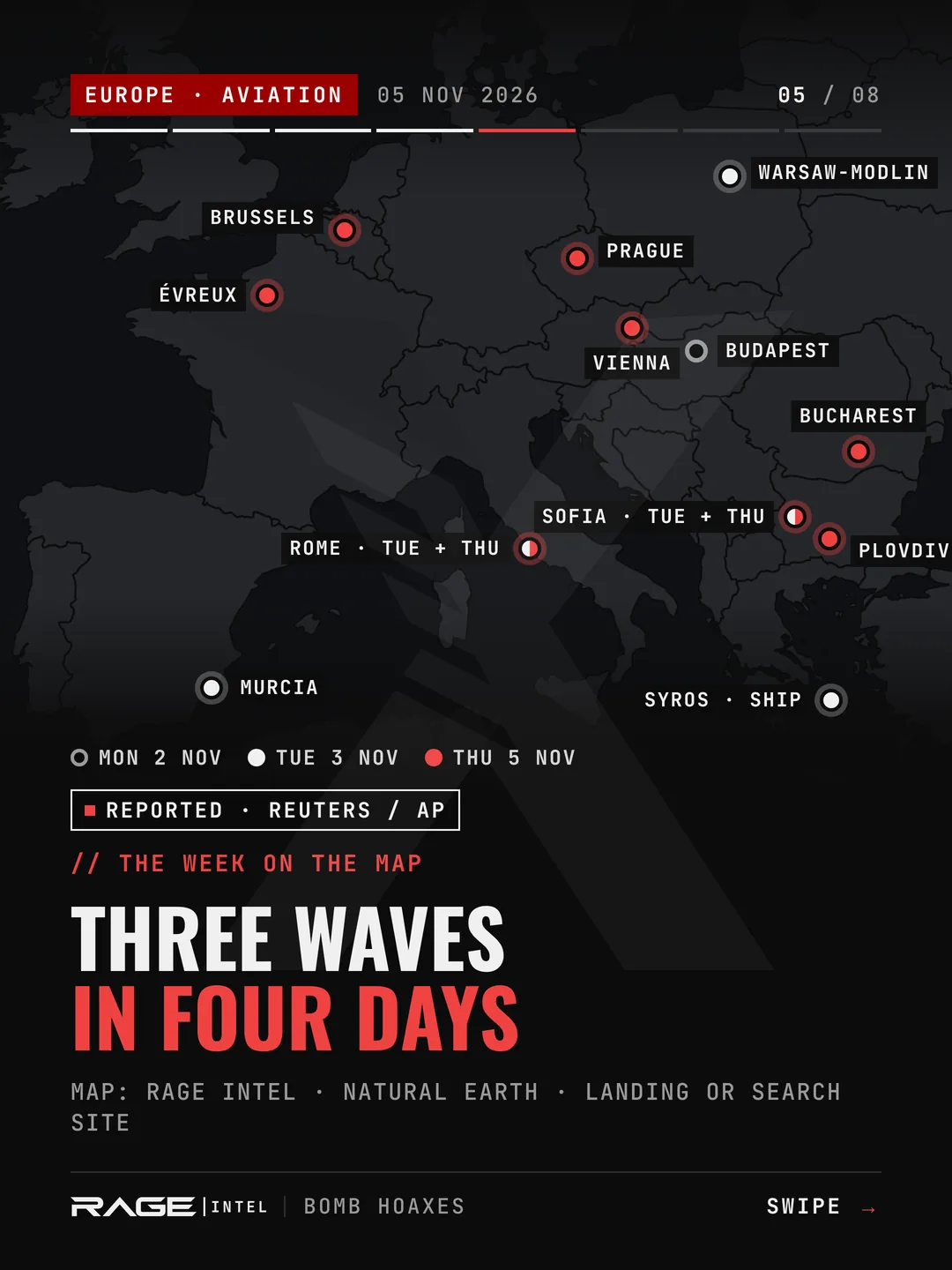
The threats reached flights over France, Italy, Austria, the Czech Republic, Romania, Bulgaria and Belgium. Bomb threats against airliners are rare and almost always hoaxes, but each one still has to be treated as real: the aircraft lands at the nearest suitable airport, passengers come off, and police search the plane and the bags.
The numbers from Thursday alone:
| Measure | Figure | Source |
|---|---|---|
| Flights targeted on Thursday | 13+ | ABC News / wires |
| Countries where they landed or were handled | 7 | ABC News / wires |
| Days with threats this week | 3 (Mon, Tue, Thu) | Reuters / AP |
| Explosives found on any aircraft | 0 | Police and airport authorities |
| Average flights a day in Europe's skies | 30,000+ | Bloomberg |
Bloomberg reported that there was no obvious pattern in the airlines or routes that were targeted.
Aer Lingus EI402: diverted to a military base#
The most serious diversion was Aer Lingus flight EI402, an Airbus A320 flying from Dublin to Rome. After a bomb threat, the aircraft turned away from its route and landed at the Évreux air base in Normandy, about 100 km west of Paris.
The office of French Prime Minister Sébastien Lecornu said a bomb squad was in place at the base and that the 151 passengers and six crew had been moved to safety. Le Figaro reported that a French Rafale fighter escorted the airliner on its approach. According to reports, the original alert came from the Italian authorities. Aer Lingus said the flight landed safely as a security precaution.
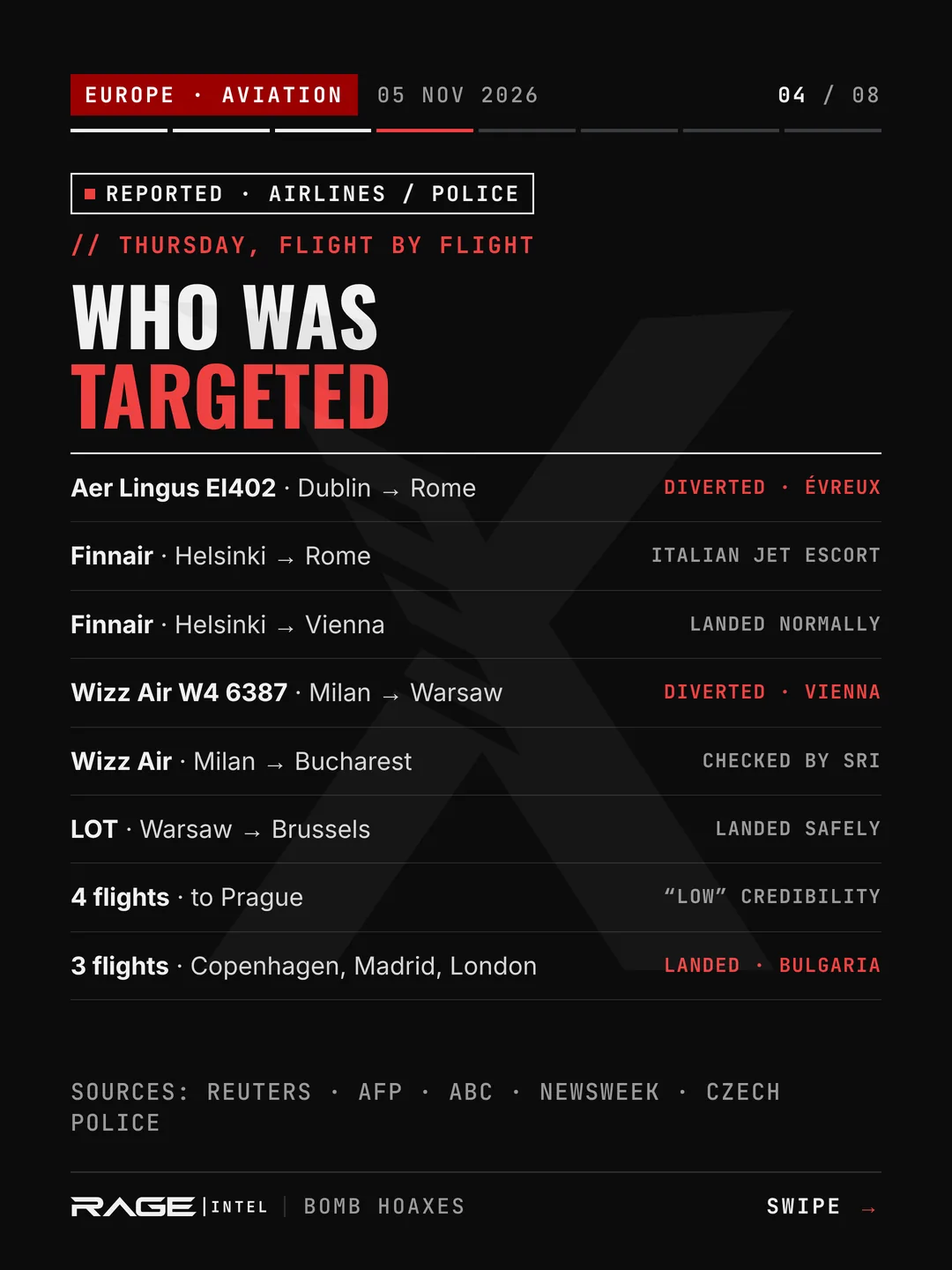
Thursday, flight by flight#
| Flight | Route | What happened |
|---|---|---|
| Aer Lingus EI402 | Dublin → Rome | Diverted to the Évreux air base, France |
| Finnair | Helsinki → Rome | Escorted by Italian air force jets; landed as scheduled |
| Finnair | Helsinki → Vienna | Landed normally |
| Wizz Air W4 6387 | Milan → Warsaw | Diverted to Vienna after a threat received in flight |
| Wizz Air | Milan → Bucharest | Landed safely in Bucharest; checked by Romania's SRI intelligence service |
| LOT | Warsaw → Brussels | Landed safely after security checks |
| 4 flights | To Prague | Police deployed at Václav Havel Airport; threat credibility assessed as "low" |
| 3 flights | From Copenhagen, Madrid and London | Landed in Bulgaria, including a London Stansted–Sofia flight diverted to Plovdiv |
Notes on the list:
- Wizz Air to Warsaw. The airline's spokesperson told the Associated Press the threat was received while the aircraft was in the air.
- Wizz Air to Bucharest. Airport spokesman Teo Postelnicu said the flight landed safely.
- LOT. Reports differ on this flight's destination: the Associated Press described a Warsaw–Paris flight stopped for security checks.
- Prague. Czech police said they assessed the credibility of the threats as low, but that they were not underestimating them.
- Bulgaria. Plovdiv Airport chief executive Krassimir Peshev said the flight from Stansted landed safely in Plovdiv, Bulgaria's second-largest city.
Scandinavian Airlines and Ryanair flights were also reported among those disrupted on Thursday.
How it unfolded: three waves in four days#
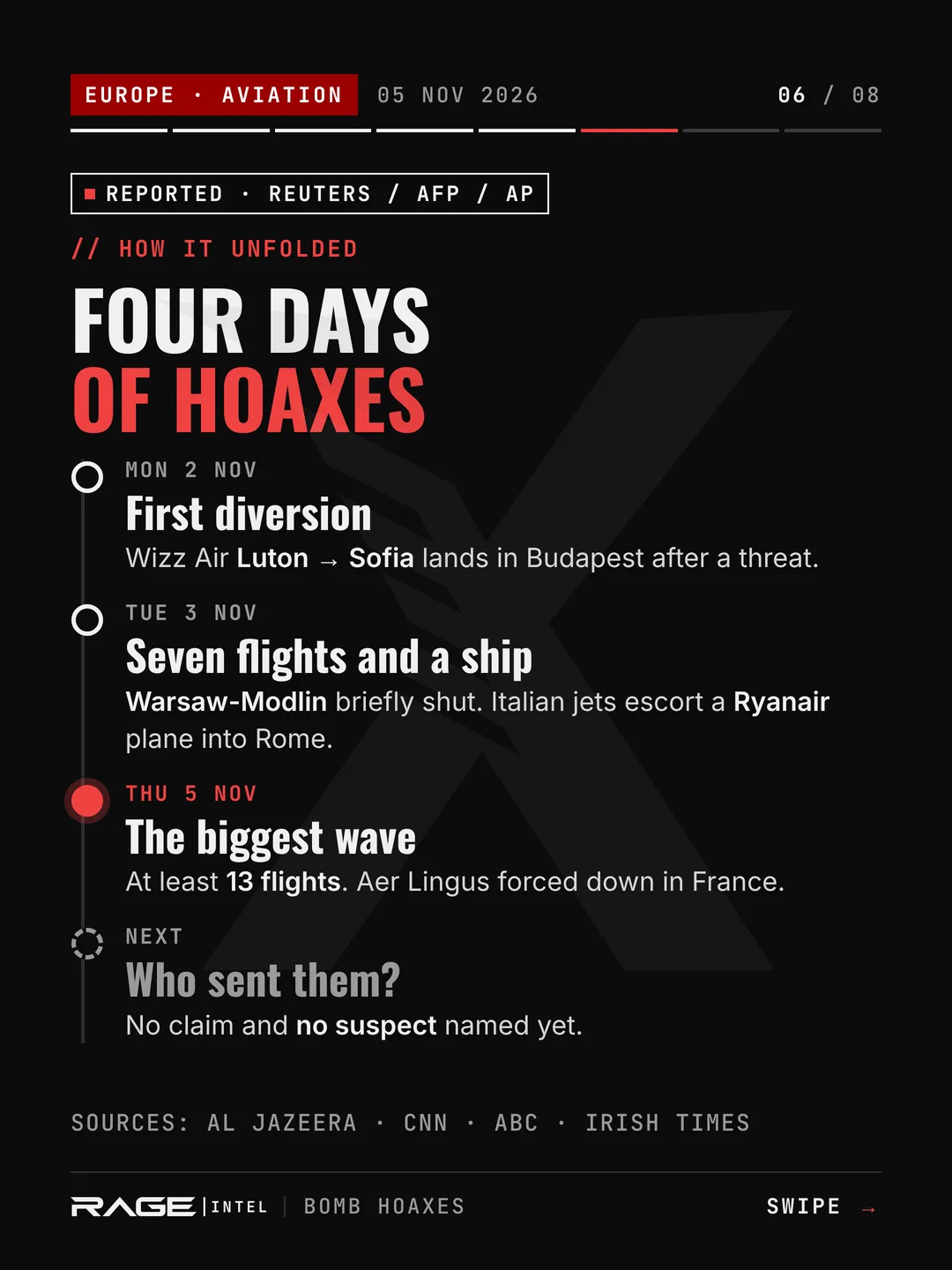
Monday 2 November: the first diversion#
A Wizz Air flight from London Luton to Sofia landed in Budapest after a bomb threat. At the time it looked like a single incident.
Tuesday 3 November: seven flights and a ship#
About seven flights and one cruise ship were targeted on Tuesday:
- Warsaw. Warsaw-Modlin airport was briefly closed while an aircraft was searched. LOT said "nothing was found on the aircraft."
- Rome. The Italian Air Force sent two Eurofighters to escort a Ryanair flight from Dublin into Rome Fiumicino. Two other Ryanair flights, from Lisbon and Dublin, were also searched at Fiumicino.
- Murcia. A Ryanair flight from Manchester was the target of a written threat. Spanish officials ruled out explosives on board.
- Sofia. A Wizz Air flight from Bergamo was inspected after landing in Sofia.
- Syros. A cruise ship bound for Israel was searched in the Greek port of Syros. Initial checks found no explosive device.
- Heathrow. UK police said they were aware of threats against four aircraft due to depart from or arrive at Heathrow.
A British government spokesman told The Telegraph the threats against UK flights were a "malicious hoax", although it was not clear how they had been carried out. One aviation risk analyst called seven confirmed bomb threats in a single day exceptional.
Thursday 5 November: the biggest wave#
At least 13 flights were targeted, almost double Tuesday's count. Aer Lingus was forced down in France, and fighter jets were scrambled again.
Who is behind it? No claim, no suspect#
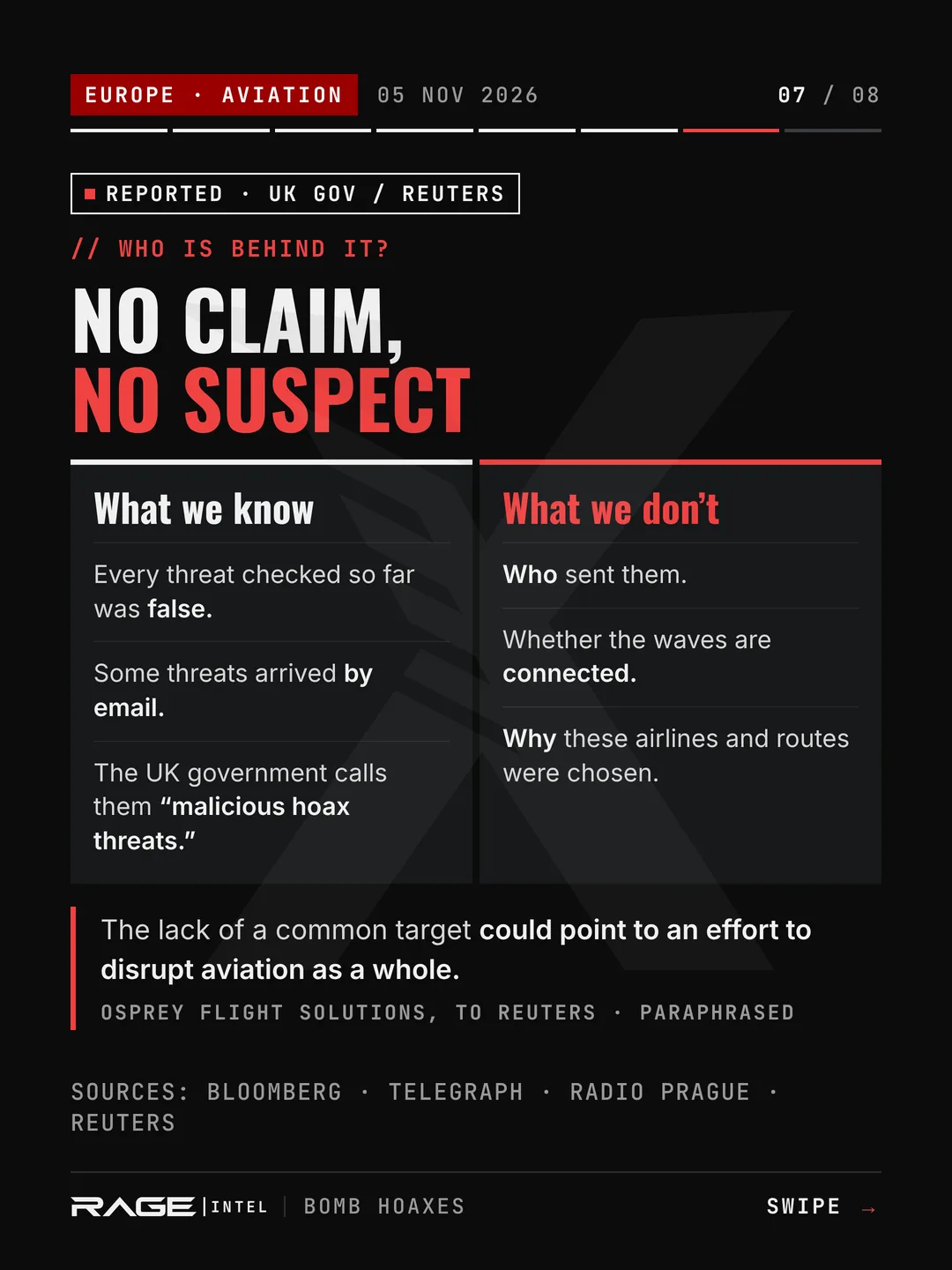
| What we know | What we don't know |
|---|---|
| Every threat checked so far was false. | Who sent them. |
| Some threats arrived by email. | Whether the three waves are connected. |
| The UK government calls them "malicious hoax threats." | Why these airlines and routes were chosen. |
Aviation risk firm Osprey Flight Solutions, speaking to Reuters, said the lack of a common target could point to an effort to disrupt aviation as a whole (paraphrased). After Tuesday's wave, Osprey co-founder Matthew Borie said the hoaxes "would fit into a pattern of hybrid warfare incidents against critical infrastructure."
What it could mean: cheap to send, costly to answer#
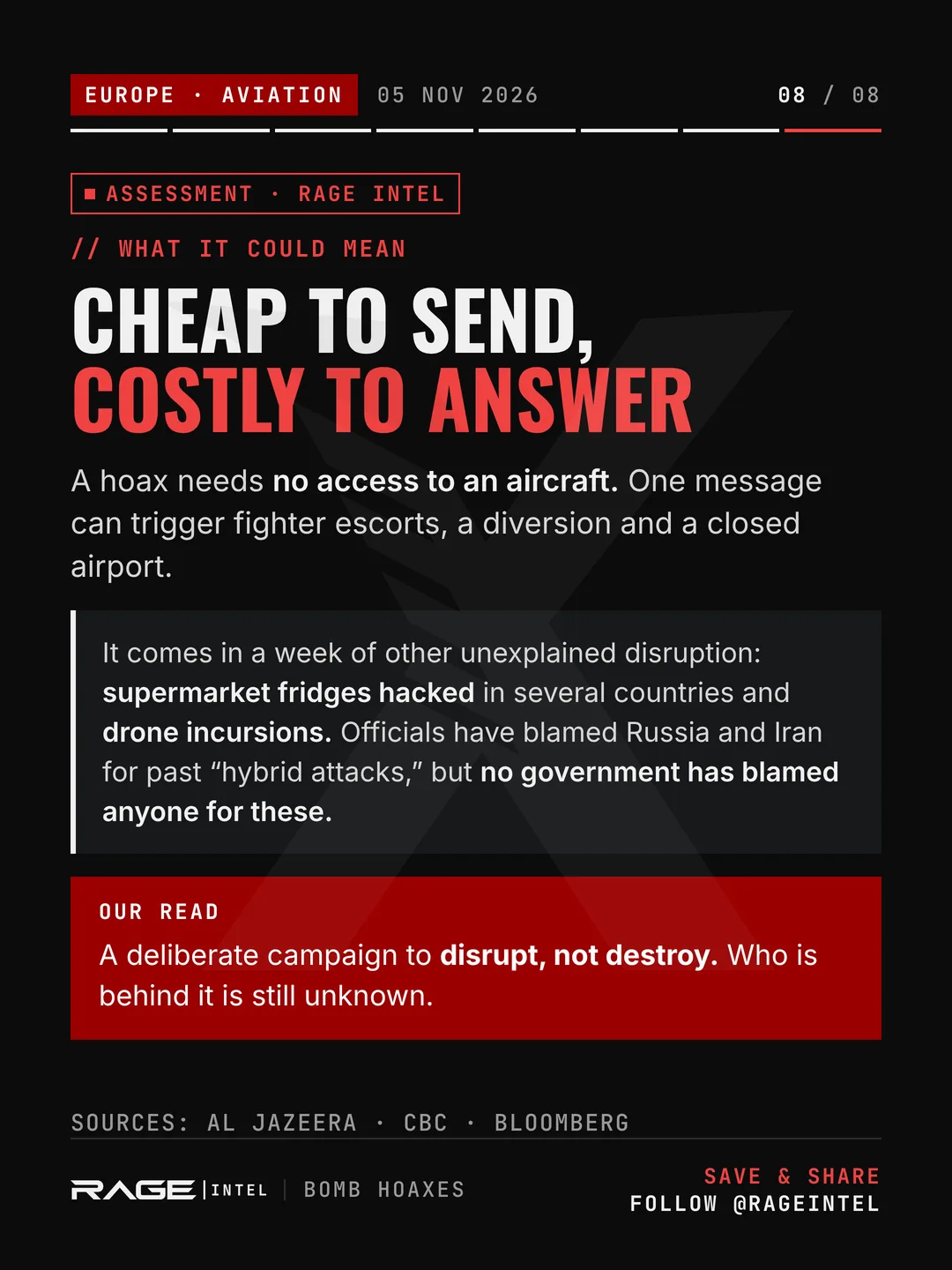
A hoax needs no access to an aircraft. One message can trigger fighter escorts, a diversion and a closed airport. For the sender, the cost is close to zero. For the airline, the airport, the police and the air force, the cost is a full emergency response, because no authority can afford to assume a threat is fake.
The threats came in a week of other unexplained disruption in Europe:
- Supermarket fridges hacked. Unidentified hackers disabled supermarket fridges in at least six European countries, including Sweden, Belgium, Luxembourg, Ireland, Italy and Estonia. One Swedish chain said its units had been set to 50°C. The UK's National Cyber Security Centre told British retailers to urgently update the software on fridge temperature controllers.
- Drone incursions over European sites.
European officials have blamed Russia and Iran for past "hybrid attacks" and acts of sabotage. No government has blamed anyone for these bomb threats, and no source has linked them to the fridge hacks.
Our read · RAGE Intel assessment
A deliberate campaign to disrupt, not destroy. Who is behind it is still unknown.
This is an assessment, not a finding. It rests on the scale of the waves, the use of messages rather than devices, and the lack of a pattern in the airlines and routes targeted. It will change if investigators name a sender or find a different explanation.
What to watch#
- Attribution. Whether any government or investigator names a sender, or links the three waves.
- A fourth wave. Whether threats continue, and whether they spread beyond Europe or beyond aviation.
- The response. Whether authorities change how they screen and grade threats, given that every threat so far has been false.
This story is developing. RAGE X will update it as new information is confirmed.
Sources#
- Al Jazeera, New bomb threats bring fresh disruptions to flights across Europe, 5 November 2026
- Al Jazeera, Bomb threats disrupt flights across Europe, no explosive devices found, 4 November 2026
- The Irish Times, Aer Lingus flight from Dublin to Rome diverted to France following bomb threat, 5 November 2026
- France 24, Dublin-Rome flight diverted to French military base over bomb threat, 5 November 2026
- ABC News, Bomb threats divert planes flying over Europe in third such event this week, 5 November 2026
- The Washington Times (AP), Multiple flights in Europe diverted because of bomb threats after earlier hoaxes, 5 November 2026
- The National, European flights diverted after second wave of bomb threats, 5 November 2026
- CNN, Bomb threats on flights in Europe cause disruption, no devices found, 3 November 2026
- PBS NewsHour, Flights across Europe face disruption after false bomb threats, 3 November 2026
- ITV News, Hundreds of passengers evacuated from planes as "malicious hoax threats" hit flights across Europe, 3 November 2026
- PBS NewsHour, Here's what to know about another cyberattack on European supermarket fridges
Maps in the carousel: RAGE Intel, based on Natural Earth data. Locations are approximate and show landing or search sites.
Continue the assessment
Related Intelligence
Russia's Shadow Fleet and the Undersea Cable Campaign
NATO cut response times from 17 hours to one. Sabotage fell. But attribution remains the unsolved problem — an anchor is not a weapon until someone proves intent.
2026-08-28 · 12 min read
Poland's Missile, Washington's Sanctions Bill: Reading NATO's Escalation Ladder
A Russian Kh-101 crossed into Poland on July 30. Days later the Senate cleared a sanctions package 84-strong. How the two are connected, and what follows.
2026-08-03 · 6 min read
Spain's Immigration Story Is Actually Two Stories, and They're Colliding
Spain just regularized over a million migrants while irregular arrivals surge through a new entry point. Inside the numbers, the politics, and what's next.
2026-07-31 · 8 min read
Today's conflict risk
The daily RAGE INDEX scores global conflict risk across six theaters, with sources and forecasts.
Read the RAGE INDEXReach readers like these
RAGE X sells sponsored content across RAGE Intel, RAGE War and RAGE Global by proposal, always labelled as sponsored.
Request a campaign proposal