Intelligence Analysis 101: How Analysts Turn Raw Information into Insight
RAGE Global · Guide · Updated 2026-10-21 · 15 min read
Intelligence analysis is the discipline of turning fragmentary, uncertain and often contradictory information into judgments that decision-makers can act on. It sits at the center of every intelligence system, from national agencies briefing heads of government to corporate teams assessing political risk in a new market. This guide explains how the intelligence cycle works, where information comes from, which structured techniques analysts use to challenge their own thinking, how they express probability, why famous failures happened, and how the same methods apply in business.
Key takeaways
- Intelligence analysis is the step in the intelligence cycle where raw collection becomes a reasoned judgment for a specific decision-maker.
- Information comes from distinct collection disciplines: HUMINT, SIGINT, GEOINT and IMINT, MASINT and OSINT, each with its own strengths and blind spots.
- Structured analytic techniques such as Analysis of Competing Hypotheses, key assumptions checks and red teaming exist to counter predictable cognitive biases.
- The US (ICD 203) and the UK (PHIA probability yardstick) map words such as "likely" to numerical ranges so that readers understand the same thing.
- Pearl Harbor, 9/11 and Iraq WMD were failures of assembly, imagination and assumption more than of collection; the 2022 Ukraine warnings showed what disciplined analysis and disclosure can achieve.
What is intelligence analysis?#
Information is not intelligence#
A common mistake is to treat intelligence as secret information. In practice, intelligence is the product of a process: information that has been collected against a requirement, evaluated for reliability, placed in context and interpreted to answer a question a decision-maker cares about. A single intercepted message, satellite image or news report is raw material. Intelligence analysis is the work of combining such fragments, weighing them against one another and producing a judgment about what is happening, why, and what is likely to happen next.
Description, explanation and estimation#
Analysts typically work at three levels. Descriptive analysis establishes facts: how many aircraft are at an airbase, who attended a meeting. Explanatory analysis addresses causes and motives: why a government is moving troops, why a militant group changed tactics. Estimative analysis looks forward and deals with probability: whether an invasion will occur, whether a ceasefire will hold. Each level carries more uncertainty than the last, and good analysis is explicit about which level it is operating at.
The role of the customer#
Intelligence analysis exists to serve decisions. US analytic standards, set out in Intelligence Community Directive 203, require analysis to demonstrate "customer relevance" and address implications, alongside requirements to describe source quality, express uncertainty, distinguish information from assumptions and consider alternatives. An analytically brilliant paper that arrives after the decision has been made, or that answers a question nobody asked, has failed. That orientation toward the decision-maker distinguishes intelligence work from academic research, even when the methods overlap.
The intelligence cycle#
Six stages#
The US Intelligence Community describes the intelligence cycle in six stages. In planning, policymakers set priorities and intelligence managers identify what information is needed. Collection gathers raw information through lawful means. Processing converts it into usable form, through decryption, translation or imagery exploitation. Analysis evaluates the information, adds context and produces finished intelligence. Dissemination delivers that product to decision-makers, who may request more. Evaluation reviews products and processes for relevance, bias, accuracy and timeliness, feeding back into the next round of planning.
 Source: US Intelligence Community, "How the IC Works," intelligence.gov, accessed 2026.
Why the cycle is messier in practice#
The cycle is a teaching model rather than a literal workflow. Real analysis is iterative: analysts frequently go back to collectors with new questions, decision-makers change priorities mid-crisis, and dissemination often happens in conversation rather than in a formal document. Critics within the profession have long noted that the cycle can imply analysts are passive recipients of collection. In well-functioning systems, analysts actively shape what is collected by identifying gaps and indicators, which is why the analysis stage sits at the heart of the process rather than at the end of a conveyor belt.
Requirements and indicators#
Two tools connect the cycle's stages. Intelligence requirements are precise questions, such as whether a given state will test a nuclear device within six months, that direct collection. Indicators are observable events that would signal a development, such as unusual activity at a test site or the evacuation of personnel. Analysts who define indicators in advance are better placed to notice change and less likely to explain it away after the fact.
Collection disciplines: where the raw material comes from#
The main INTs#
Intelligence professionals group collection into disciplines, often called "INTs." Human intelligence (HUMINT) comes from people, whether recruited agents, diplomats or debriefed travelers, and is the oldest form of collection. Signals intelligence (SIGINT) intercepts communications and electronic emissions. Geospatial intelligence (GEOINT), which includes imagery intelligence (IMINT), exploits satellite and aerial imagery and geographic data. Measurement and signature intelligence (MASINT) uses scientific and technical data, such as seismic, acoustic or radiation signatures, to identify and characterize targets. Open-source intelligence (OSINT) draws on publicly available and commercially available information.
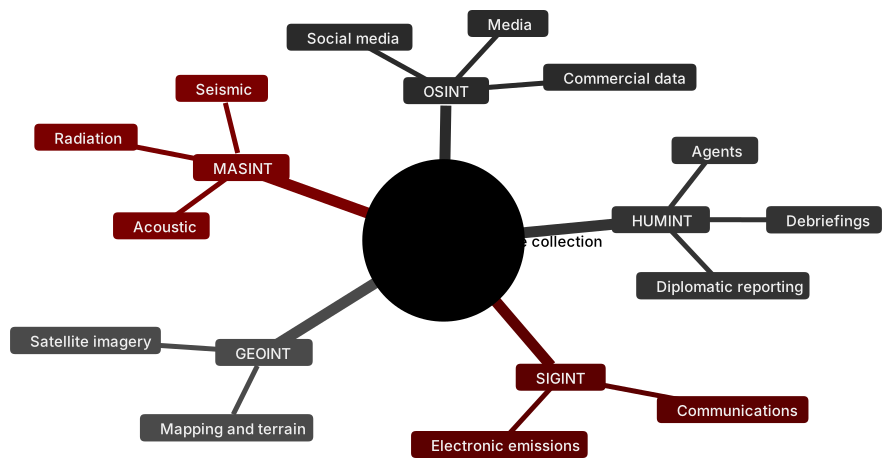 Source: US Intelligence Community, "How the IC Works," intelligence.gov, accessed 2026.
Strengths and blind spots#
Each discipline answers different questions. Imagery shows what is physically present but not what leaders intend; SIGINT can reveal intent but can be deceived or go silent; HUMINT offers access to plans and motives but carries risks of fabrication, as the Iraq case below demonstrates. Analysts therefore seek corroboration across independent disciplines. A judgment supported by imagery, intercepted communications and a human source is more robust than one resting on a single stream, however compelling.
| Discipline | Typical sources | Main strength | Main weakness |
|---|---|---|---|
| HUMINT | Agents, defectors, diplomats, interviews | Insight into intentions and plans | Fabrication, bias, slow to verify |
| SIGINT | Intercepted communications and emissions | Timely, can reveal intent | Encryption, deception, targets going silent |
| GEOINT and IMINT | Satellite, aerial and drone imagery | Verifiable physical evidence | Shows capability, not intent; weather and concealment |
| MASINT | Seismic, acoustic, radiation, spectral data | Technical characterization | Specialist, narrow in scope |
| OSINT | Media, internet, commercial and public data | Scale, shareability, low cost | Volume, disinformation, verification burden |
Table source: discipline definitions from the US Intelligence Community, intelligence.gov; strengths and weaknesses are RAGE X analytical summary, 2026.
The rise of OSINT#
Open sources have moved from a supplement to a core discipline. In March 2024, the Office of the Director of National Intelligence and the CIA published the IC OSINT Strategy 2024–2026, defining OSINT as intelligence "derived exclusively from publicly or commercially available information" that addresses specific intelligence priorities, requirements or gaps. The growth of commercial satellite imagery, social media and digital records has made it possible for researchers outside government to produce analysis that informs public debate, and it has changed how governments themselves collect.
Structured analytic techniques#
Why structure matters#
Structured analytic techniques (SATs) are methods that make an analyst's reasoning explicit, so that assumptions can be examined and alternatives considered. They grew out of the work of Richards Heuer, a CIA veteran whose book Psychology of Intelligence Analysis (published by the CIA's Center for the Study of Intelligence in 1999) argued that the main obstacles to good analysis are cognitive rather than informational. Analysts, like everyone, rely on mental shortcuts; structure is a way of slowing down and checking them.
Analysis of Competing Hypotheses#
Analysis of Competing Hypotheses (ACH), developed by Heuer, is the best-known technique. The analyst lists all reasonable explanations, not only the favored one, then builds a matrix that tests each piece of evidence against each hypothesis. The key insight is to focus on disconfirming evidence: a fact consistent with every hypothesis has no diagnostic value, while a fact inconsistent with one hypothesis can eliminate it. The analyst then tentatively rejects hypotheses with the most inconsistent evidence, tests how sensitive the conclusion is to a few critical items, and identifies indicators that would signal the picture is changing.
Key assumptions check and red teaming#
A key assumptions check asks analysts to list the premises their judgment depends on, then ask of each: how confident are we, what would make it wrong, and has it been true in the past? This is often the most valuable technique because flawed assumptions have driven many historical failures. Red teaming takes the challenge further by assigning a group to think like the adversary or to argue deliberately against the prevailing line. Related methods include devil's advocacy, "what if?" analysis, which assumes an unlikely event has happened and works backward to explain it, and pre-mortems, which imagine a forecast has failed and ask why.
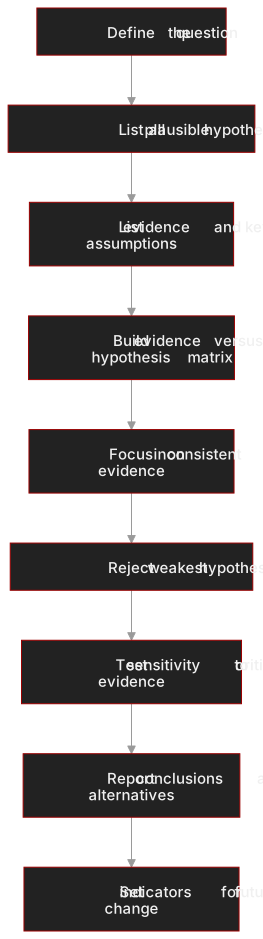 Source: adapted from Richards J. Heuer Jr., Psychology of Intelligence Analysis, CIA Center for the Study of Intelligence, 1999.
Estimative language and probability yardsticks#
The problem of vague words#
In 1964, CIA analyst Sherman Kent wrote about the confusion caused by words such as "serious possibility," which readers interpreted as anything from a long shot to a near certainty. Vague estimative language can be as damaging as wrong analysis, because a decision-maker who misreads the odds may act on a judgment the analyst never intended. Modern intelligence systems address this by tying words to numerical ranges and asking analysts to use them consistently.
ICD 203 in the United States#
Intelligence Community Directive 203, signed by Director of National Intelligence James Clapper on 2 January 2015 and technically amended in January 2022, sets out the US expressions of likelihood. It strongly encourages analysts not to mix terms from different rows, and it separates likelihood from confidence, which describes the quality of the evidence and reasoning behind a judgment.
| Probability range | ICD 203 terms (US) | Probability range | PHIA yardstick terms (UK) |
|---|---|---|---|
| 01–05% | Almost no chance, remote | >0–~5% | Remote chance |
| 05–20% | Very unlikely, highly improbable | ~10–~20% | Highly unlikely |
| 20–45% | Unlikely, improbable | ~25–~35% | Unlikely |
| 45–55% | Roughly even chance, roughly even odds | ~40–<50% | Realistic possibility |
| 55–80% | Likely, probable | ~55–~75% | Likely or probable |
| 80–95% | Very likely, highly probable | ~80–~90% | Highly likely |
| 95–99% | Almost certain, nearly certain | ~95–<100% | Almost certain |
Table sources: ODNI, ICD 203 Analytic Standards (2015, amended 2022); UK Professional Head of Intelligence Assessment, "Explaining uncertainty in UK intelligence assessment" (2025).
The UK PHIA probability yardstick#
The UK's Professional Head of Intelligence Assessment (PHIA) maintains a probability yardstick used across the UK assessment community. Unlike the US scale, it deliberately leaves gaps between ranges, such as between 5 and 10 percent, so that it does not imply more precision than the evidence supports. The UK guidance also requires a separate confidence rating of high, moderate or low, determined by the information base, analytical rigor, and the complexity and volatility of the issue.
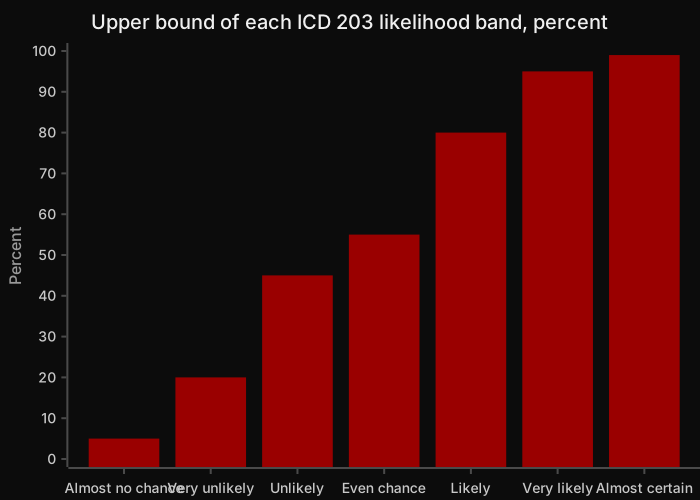 Source: ODNI, Intelligence Community Directive 203, Analytic Standards, 2015, amended 2022.
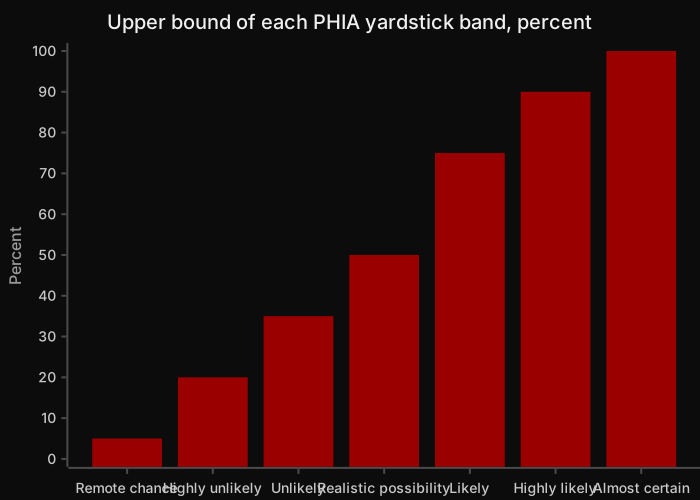 Source: UK Professional Head of Intelligence Assessment, "Explaining uncertainty in UK intelligence assessment," 2025.
Can analysts forecast well?#
Research suggests forecasting skill is measurable and improvable. In 2011, IARPA, the US intelligence community's research agency, launched a multi-year forecasting tournament. According to the Good Judgment Project, which was led by Philip Tetlock and Barbara Mellers, the tournament covered about 500 questions and more than a million forecasts, and the project's forecasts outperformed those of intelligence analysts with access to classified data. The lesson for analysts is that calibrated probability, frequent updating and keeping score improve accuracy.
Cognitive biases and how analysts counter them#
The most common traps#
Heuer and later researchers identified several biases that recur in intelligence analysis. Confirmation bias leads analysts to seek and overweight evidence that supports an existing view. Anchoring causes initial estimates to persist even after new information arrives. Mirror imaging assumes an adversary will reason as the analyst would. Groupthink suppresses dissent inside a team, and the availability heuristic gives too much weight to vivid or recent events. Each is a natural feature of human cognition rather than a sign of incompetence, which is why awareness alone rarely solves them.
Building safeguards into the process#
Effective intelligence organizations build structural safeguards rather than relying on individual discipline. These include requiring alternative hypotheses in major assessments, using dedicated red cells, separating collection reporting from analytic judgment, and conducting post-mortems on both failures and successes. ICD 203's requirement that analysis "explains change to or consistency of analytic judgments" encourages analysts to show why they have, or have not, changed their view as evidence accumulates. Diverse teams, in background and expertise, also reduce the risk of shared blind spots.
Failures and successes: lessons from history#
Pearl Harbor, 1941#
The Japanese attack on Pearl Harbor on 7 December 1941 is the classic case of strategic surprise. Roberta Wohlstetter's 1962 study, Pearl Harbor: Warning and Decision, found that US authorities had many relevant warnings, including the ability to read Japanese diplomatic codes, but the pieces were scattered across agencies and drowned out by "noise" pointing to other Japanese moves. No one assembled the full picture. Wohlstetter's distinction between signals and noise remains central to warning analysis.
The 9/11 attacks, 2001#
The 9/11 Commission, reporting in July 2004, identified four kinds of failure: of imagination, policy, capabilities and management. Its phrase "failure of imagination" captured the finding that the possibility of hijacked aircraft used as weapons was not seriously analyzed, and that information about al-Qaeda operatives was not shared effectively between agencies. The response included the creation of the Director of National Intelligence in 2004 to integrate the US intelligence community.
Iraq WMD, 2002–03#
The pre-war assessments of Iraq's weapons of mass destruction are the most studied modern failure. The US Commission on the Intelligence Capabilities of the United States Regarding Weapons of Mass Destruction, known as the Robb-Silberman Commission, concluded in March 2005 that the intelligence community was "dead wrong in almost all of its pre-war judgments" about Iraq's chemical, biological and nuclear programs. It cited poor collection, including reliance on unreliable defector reporting, and an analytical assumption that Iraq was hiding prohibited weapons. The commission found no evidence of political pressure on analysts but said the environment discouraged challenges to the prevailing view, a textbook case for the key assumptions check.
Ukraine, 2021–22#
The months before Russia's full-scale invasion of Ukraine in February 2022 are widely cited as an analytical success. US and UK intelligence assessed that Russia was preparing to invade and, unusually, made much of that assessment public. On 3 February 2022, US officials said Russia was planning to stage a fabricated attack, including a graphic video, as a pretext for invasion. Russia repeatedly denied it planned to invade. CIA Director William Burns later said the selective disclosure had played a "very effective role" and had "stripped away the pretext" Moscow often used, while stressing that it should remain "the exception, not the rule." Analysts have also noted that Western assessments of a rapid Russian victory proved too pessimistic about Ukraine's resistance.
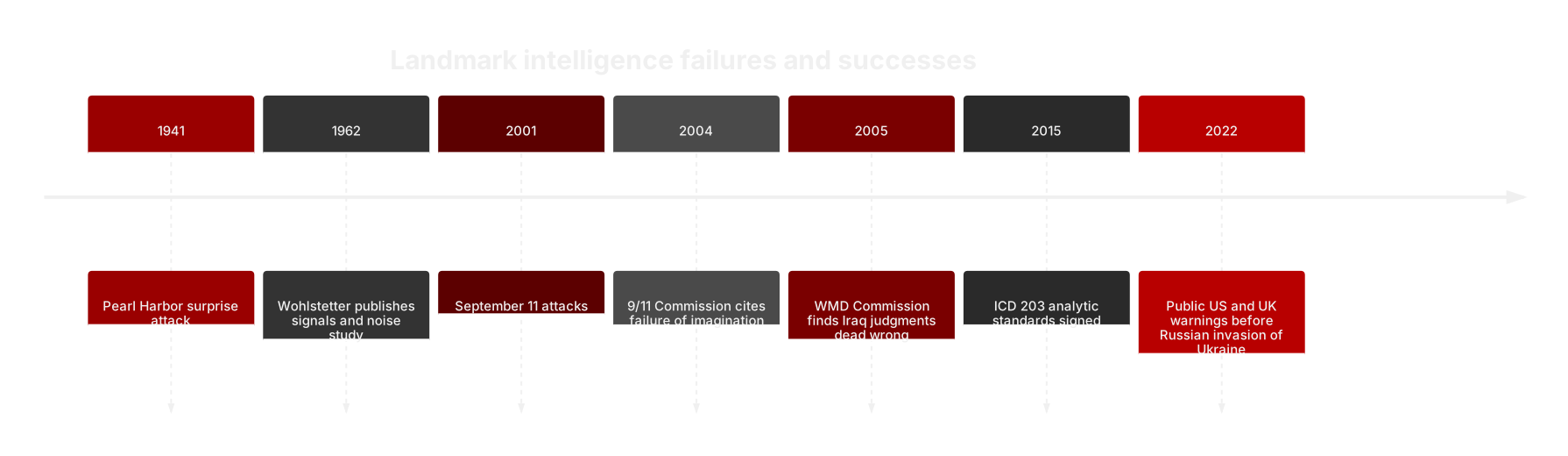 Source: Wohlstetter (1962); 9/11 Commission Report (2004); Robb-Silberman Commission via Arms Control Association (2005); ODNI ICD 203 (2015); NPR and NBC News (2022).
How businesses use intelligence analysis#
From state craft to corporate risk#
The methods of intelligence analysis have spread into the private sector. Multinational companies run geopolitical risk, security and competitive intelligence teams that monitor political instability, sanctions, supply-chain disruption, cyber threats and competitor moves. The questions differ from those of a foreign ministry, but the structure is the same: define the decision, set requirements, collect against them, analyze with explicit uncertainty and disseminate in time to matter. Many of these teams are staffed by former government analysts, and many use the same probability language.
Practical applications#
Common corporate uses include country risk assessments before market entry, travel security for staff in unstable regions, monitoring of strikes, protests and conflict near facilities, due diligence on partners and suppliers, and scenario planning for events such as a blockade or sanctions escalation. Financial institutions apply intelligence methods to sanctions compliance and to investment research. The 2022 invasion of Ukraine, which forced hundreds of companies to reassess exposure to Russia within weeks, reinforced the value of warning indicators and pre-planned scenarios.
Applying the toolkit#
Businesses benefit most from a handful of practices: writing explicit key judgments with probability terms, listing assumptions and indicators, running a red team or pre-mortem before major decisions, and keeping a record of forecasts to measure accuracy. Open-source intelligence, conflict data and commercial imagery now give companies access to evidence that once required a government agency. The discipline lies in using it with the same rigor as a professional intelligence analyst.
Frequently asked questions#
What does an intelligence analyst actually do?#
An intelligence analyst evaluates information from multiple sources, judges its reliability, places it in context and produces assessments that help decision-makers act. Day to day, that means reading reporting from collectors and open sources, building timelines and data sets, testing hypotheses, writing briefs and answering questions from customers. Analysts in government may cover a country, a weapons program or a terrorist group; in business they may cover a region, a sector or security threats. The core skills are critical thinking, clear writing, comfort with uncertainty and the willingness to change a judgment when evidence demands it.
What are the steps of the intelligence cycle?#
The US Intelligence Community describes six steps: planning and direction, collection, processing, analysis, dissemination and evaluation. Planning sets priorities and requirements; collection gathers raw information; processing makes it usable through translation, decryption or exploitation; analysis turns it into finished intelligence; dissemination delivers it to decision-makers; and evaluation reviews quality and relevance and feeds back into planning. In practice the cycle is iterative, with analysts frequently returning to collectors with new questions and decision-makers refining what they need.
What is the Analysis of Competing Hypotheses?#
Analysis of Competing Hypotheses (ACH) is a structured technique developed by former CIA analyst Richards Heuer. Instead of building a case for the most likely explanation, the analyst lists every reasonable hypothesis and tests each item of evidence against all of them in a matrix. The emphasis falls on evidence that is inconsistent with a hypothesis, because that is what allows weak explanations to be eliminated. ACH helps counter confirmation bias, makes reasoning transparent to reviewers and identifies the specific pieces of evidence on which a conclusion depends.
What is the difference between likelihood and confidence?#
Likelihood is the analyst's estimate of how probable an event or development is, expressed through terms such as "likely" or "highly unlikely" mapped to numerical ranges. Confidence describes how solid the basis for that judgment is: the quality of sources, the soundness of reasoning and the stability of the situation. An analyst can judge something "likely" with low confidence if evidence is thin, or "unlikely" with high confidence if evidence is strong. Both the US ICD 203 and the UK PHIA guidance require analysts to keep the two concepts separate.
Why do intelligence failures happen?#
Most major failures stem less from missing information than from how information is assembled and interpreted. Pearl Harbor showed warnings scattered across agencies and lost in noise. The 9/11 Commission cited a failure of imagination and poor information sharing. The Iraq WMD failure reflected unreliable sources combined with an untested assumption that Iraq was concealing weapons. Common threads include cognitive biases, organizational barriers, mirror imaging of adversaries and pressure toward consensus. Structured techniques and institutional reforms aim to reduce, not eliminate, these risks.
Can businesses use the same methods as government analysts?#
Yes. The intelligence cycle, structured analytic techniques and probability yardsticks transfer well to corporate risk, security and strategy. Companies use them to assess country risk, monitor supply chains, protect staff and anticipate regulatory or sanctions changes. The main differences are legal, since private firms rely on open and commercially available sources rather than secret collection, and in the decisions being supported. Firms that write explicit judgments, track assumptions and measure their forecasting accuracy tend to make better use of the information they already have.
The RAGE X view#
Intelligence analysis is ultimately a discipline of honesty about uncertainty. The historical record shows that the costliest failures rarely came from a total absence of information; they came from untested assumptions, fragmented organizations and language that let decision-makers hear what they wanted. The tools that address those problems, structured techniques, calibrated probability and transparent sourcing, are well established and increasingly available outside government. The 2022 Ukraine warnings showed that disciplined analysis, clearly communicated, can shape events as well as describe them.
At RAGE X, we apply these standards to the open-source and conflict data behind RAGE INDEX, our live global conflict intelligence product, and to the reporting published on RAGE Intel. As the volume of available information keeps growing, the advantage will belong not to those who collect the most but to those who analyze it with the most rigor and say plainly what they do not know.
Sources#
- US Intelligence Community, "How the IC Works," intelligence.gov: https://www.intelligence.gov/how-the-ic-works
- Office of the Director of National Intelligence, Intelligence Community Directive 203, Analytic Standards (2015, amended 2022): https://archive.dni.gov/files/documents/ICD/ICD-203.pdf
- UK Government, Professional Head of Intelligence Assessment, "Explaining uncertainty in UK intelligence assessment," 2025: https://www.gov.uk/government/publications/explaining-uncertainty-in-uk-intelligence-assessment/explaining-uncertainty-in-uk-intelligence-assessment
- UK Ministry of Defence, "Defence Intelligence: communicating probability," 2023: https://www.gov.uk/government/news/defence-intelligence-communicating-probability
- ODNI, "The IC OSINT Strategy 2024–2026," March 2024: https://archive.dni.gov/index.php/newsroom/reports-publications/reports-publications-2024/3785-the-ic-osint-strategy-2024-2026
- Richards J. Heuer Jr., Psychology of Intelligence Analysis, CIA Center for the Study of Intelligence, 1999: https://www.cia.gov/resources/csi/static/Pyschology-of-Intelligence-Analysis.pdf
- Stanford University Press, Roberta Wohlstetter, Pearl Harbor: Warning and Decision, 1962: https://www.sup.org/books/rec/?id=3226
- National Commission on Terrorist Attacks Upon the United States, The 9/11 Commission Report, Chapter 11, 2004: https://www.9-11commission.gov/report/911Report_Ch11.pdf
- Arms Control Association, "Commission Slams WMD Intelligence," May 2005: https://armscontrol.org/act/2005-05/commission-slams-wmd-intelligence
- Stimson Center, "The Robb-Silberman Report, Intelligence, and Nonproliferation," 2005: https://www.stimson.org/2005/robb-silberman-report-intelligence-and-nonproliferation/
- NPR via Michigan Public, "U.S. says Russia is planning a staged attack in Ukraine to justify an invasion," 3 February 2022: https://www.michiganpublic.org/2022-02-03/u-s-says-russia-is-planning-a-staged-attack-in-ukraine-to-justify-an-invasion
- NBC News, "CIA director defends declassifying intel to expose Russia's actions in Ukraine," 2022: https://www.nbcnews.com/politics/national-security/cia-director-burns-defends-declassifying-intel-expose-russias-actions-rcna46876
- DefenseScoop, "Authorized strategic intelligence disclosures are likely here to stay, US officials say," April 2023: https://defensescoop.com/2023/04/28/authorized-strategic-intelligence-disclosures-are-likely-here-to-stay-us-officials-say/
- Good Judgment, "About" (IARPA forecasting tournament): https://goodjudgment.com/about/
About RAGE X: RAGE X is a global media, intelligence and technology organization delivering geopolitical intelligence, military and conflict analysis, OSINT and security insight through RAGE Intel, RAGE INDEX and its wider ecosystem at theragex.com.
Continue the assessment
Related Intelligence
What Is OSINT? The Complete Guide to Open-Source Intelligence
What is OSINT? A complete guide to open-source intelligence: definition, history, intelligence cycle, core techniques, ethics, case studies and careers.
2026-10-21 · 17 min read
How Geopolitical Risk Is Measured: Indices, Methods and Early-Warning Signals
How is geopolitical risk measured? A guide to the GPR index, ACLED, UCDP, the Global Peace Index, the Fragile States Index and early-warning signals.
2026-10-21 · 16 min read
Satellite Imagery Intelligence: How GEOINT Sees the World's Conflicts
Satellite imagery intelligence explained: GEOINT, NGA, Maxar/Vantor, Planet, Airbus, SAR, resolution tiers, revisit rates, case studies, limits and AI.
2026-10-21 · 16 min read
Today's conflict risk
The daily RAGE INDEX scores global conflict risk across six theaters, with sources and forecasts.
Read the RAGE INDEXReach readers like these
RAGE X sells sponsored content across RAGE Intel, RAGE War and RAGE Global by proposal, always labelled as sponsored.
Request a campaign proposal