Iran Hands Out Iodine Tablets Near Its Nuclear Sites: What We Know
RAGE Global · Iran · Nuclear · Watch · 6 min read
Instagram carousel
Published on Instagram with this story · swipe or use the arrow keys
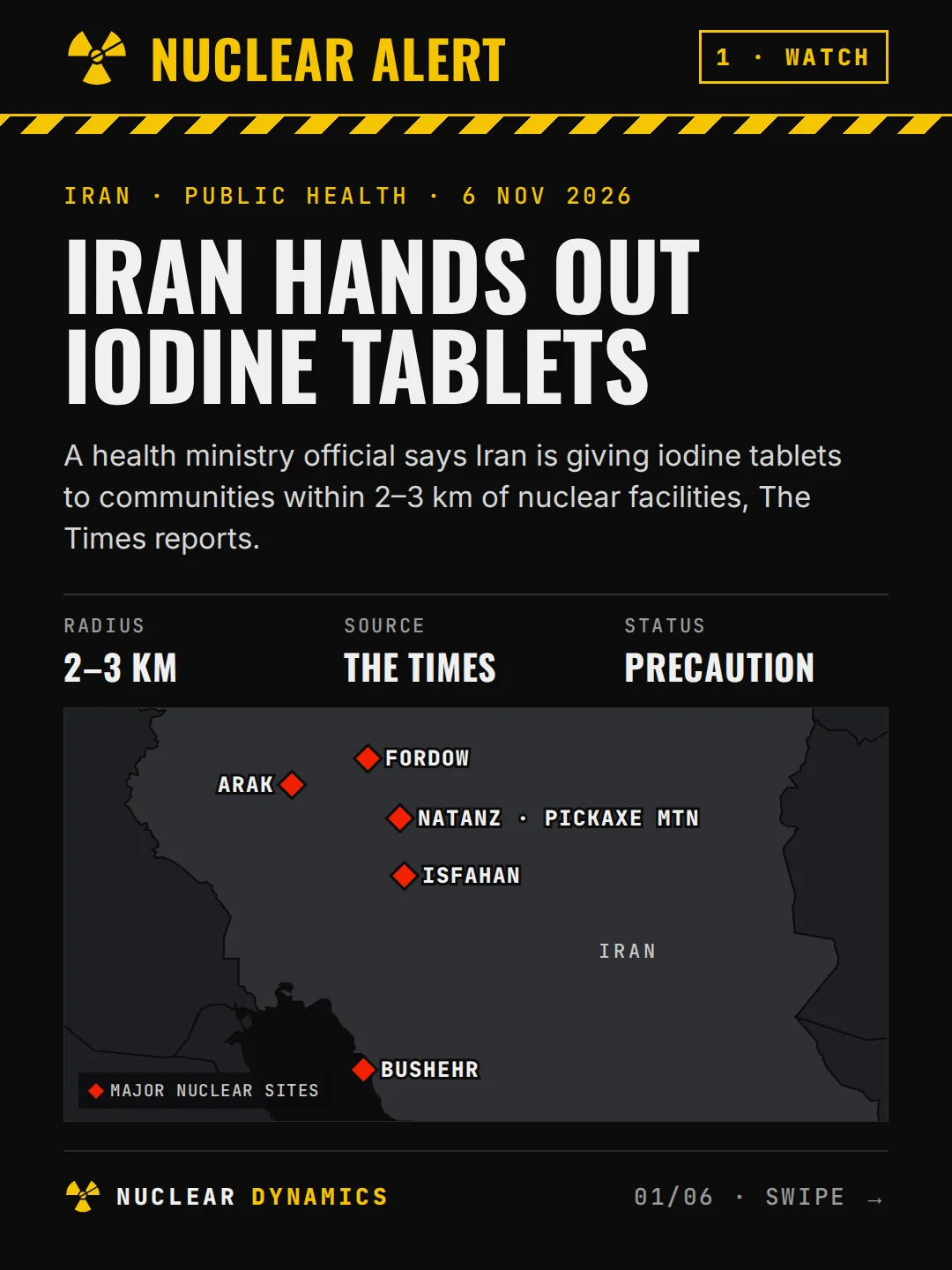
Iran is giving iodine tablets to communities living close to its nuclear facilities, an Iranian health ministry official told The Times, in a report published on 6 November 2026. "During every war, we have tried to distribute it within a two-to-three-kilometre radius of nuclear facilities," the official said, according to The Times. The step is a precaution: no strike, explosion or radiation release has been reported. It comes days after an Iranian civil-defence video on surviving a nuclear explosion near the Pickaxe Mountain site spread online, and more than a year after a health ministry official said iodine was not needed near Iran's enrichment sites.
Key takeaways
- The report: a health ministry official told The Times that Iran hands out iodine tablets within 2–3 km of nuclear facilities in wartime.
- Not confirmed: which sites are covered, and whether the 2–3 km radius is being applied now.
- Already done once: Bushehr, home to Iran's only nuclear power plant, reported in April 2026 that it had handed out 180,000 tablets.
- The video: an Iranian civil-defence film describes surviving a nuclear blast near Pickaxe Mountain, close to Natanz. Its framing as a warning of an imminent attack has been disputed.
- No incident: no strike, explosion or radiation release has been reported.
Alert level: WATCH. Confidence: REPORTED. The distribution rests on one official quoted by The Times; RAGE X has not seen the original article and is relying on reports of it. The Bushehr distribution is confirmed by several outlets.
What was reported#
The Times, as reported by Israel Hayom and Clash Report, said Iran is distributing iodine tablets to communities near its nuclear facilities. A health ministry official told the paper: "During every war, we have tried to distribute it within a two-to-three-kilometre radius of nuclear facilities."
The report does not say which facilities are covered, how many tablets have been handed out this time, or when the distribution began. The official's words describe a wartime practice; they do not, on their own, show that the 2–3 km radius is being applied at every site now.
What iodine does, and what it does not#
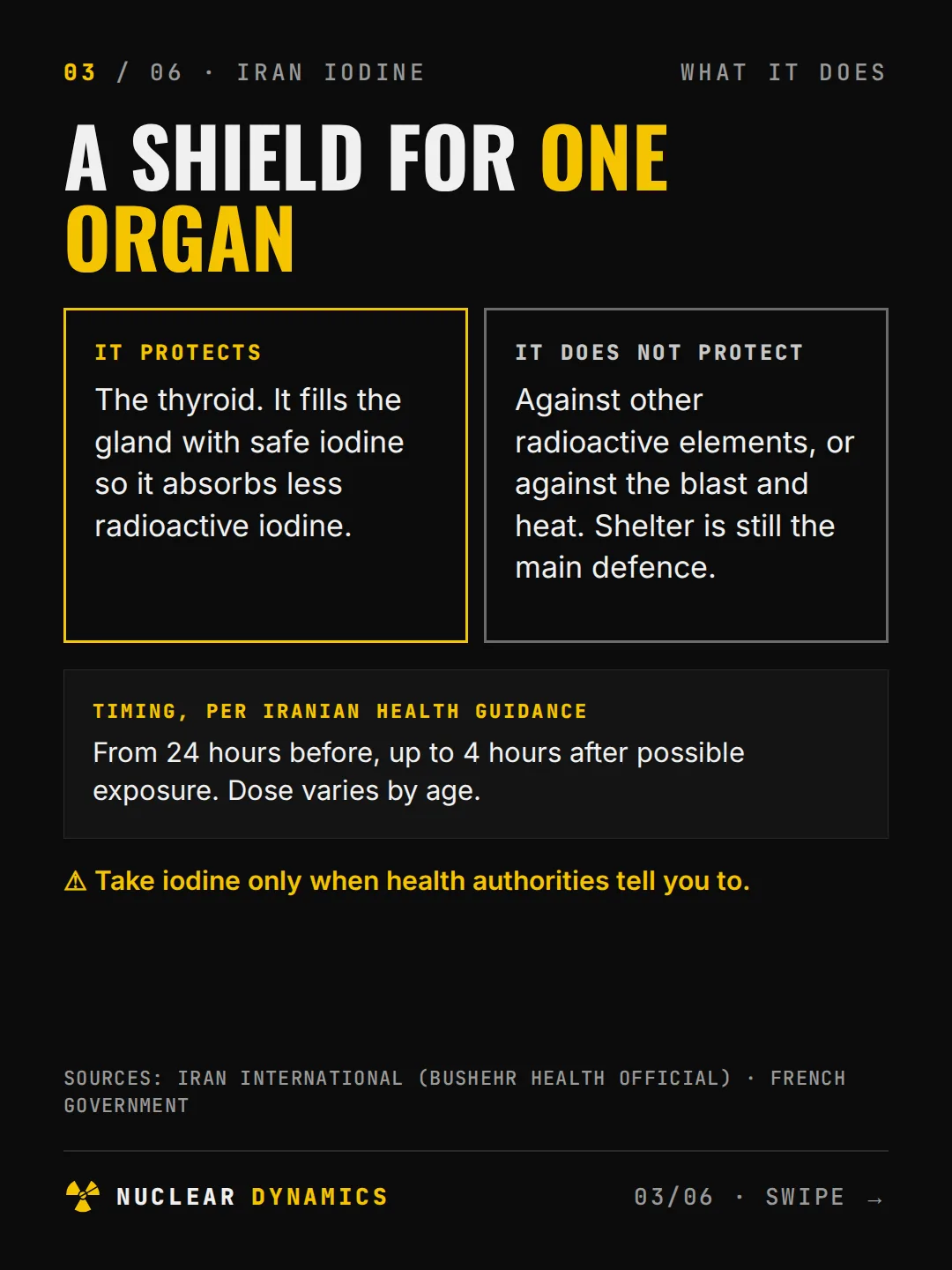
Potassium iodide protects one organ: the thyroid. Taken at the right time, it fills the gland with stable iodine, so it absorbs less of the radioactive iodine released in a reactor accident or a nuclear explosion.
It does not protect against other radioactive elements, and it does nothing against the blast or the heat. Shelter remains the main protection.
Iranian health guidance issued with the Bushehr distribution says the tablets should be taken from 24 hours before up to 4 hours after possible exposure, with the dose depending on age. The tablets should be taken only when health authorities say so.
How small is 3 km?#
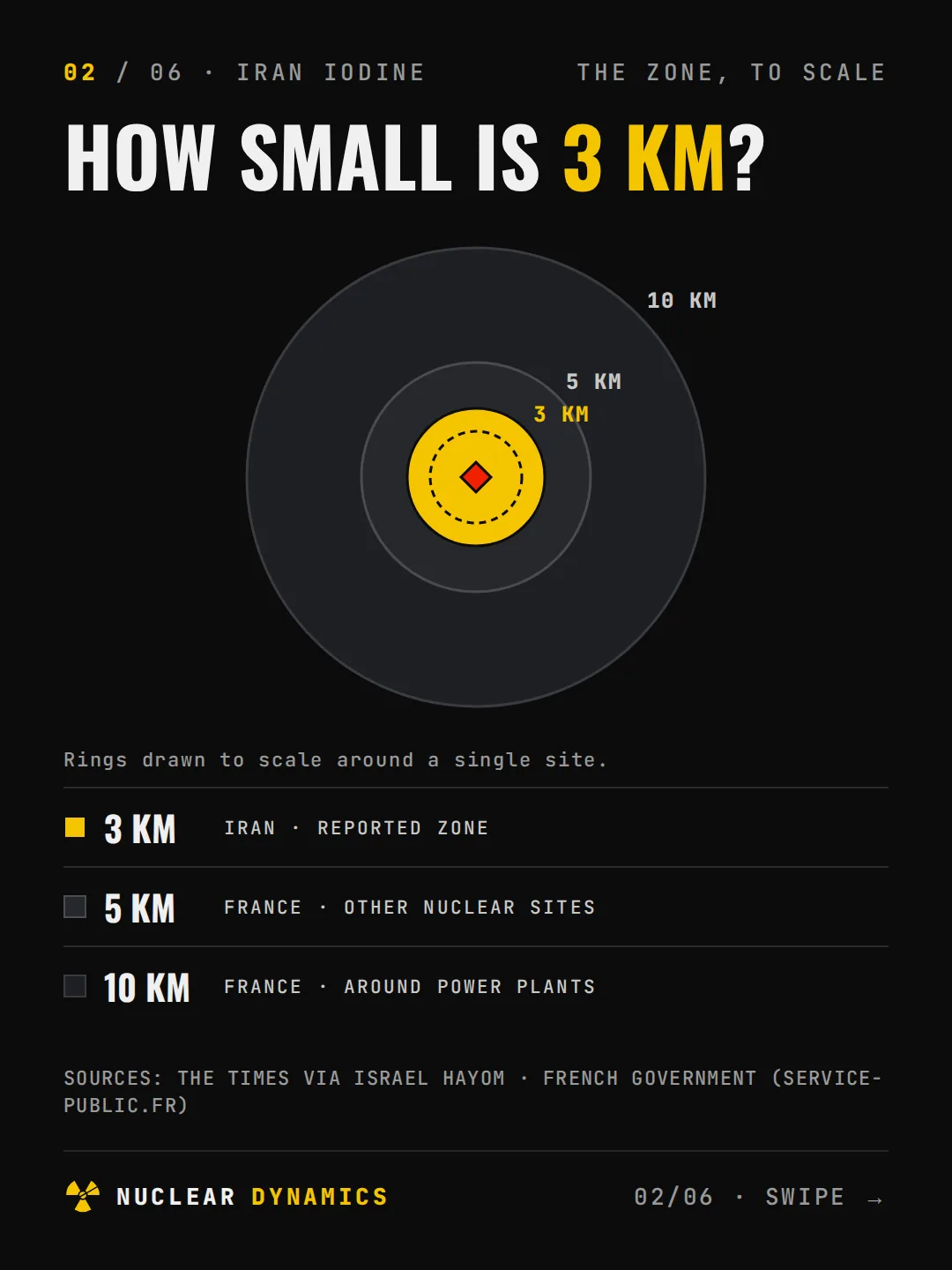
A 2–3 km zone is small by international standards. France, which runs regular iodine campaigns around its nuclear power plants, covers residents within 20 km of each plant: a campaign for people living 0–10 km away began in 2024, and the next one, for those living 10–20 km away, is scheduled for 2026, according to French authorities.
The video and Pickaxe Mountain#
Pickaxe Mountain (Kuh-e Kolang Gaz La) is a tunnelled site about a mile south of the Natanz enrichment complex in central Iran.
An eight-minute civil-defence video on surviving a nuclear explosion was released in late October by emergency services in Isfahan province, which includes Natanz, and was carried by the state news agency IRNA, according to reports. It advises people not to look at the flash, to shelter inside buildings and basements, to stay away from windows and to close ventilation.
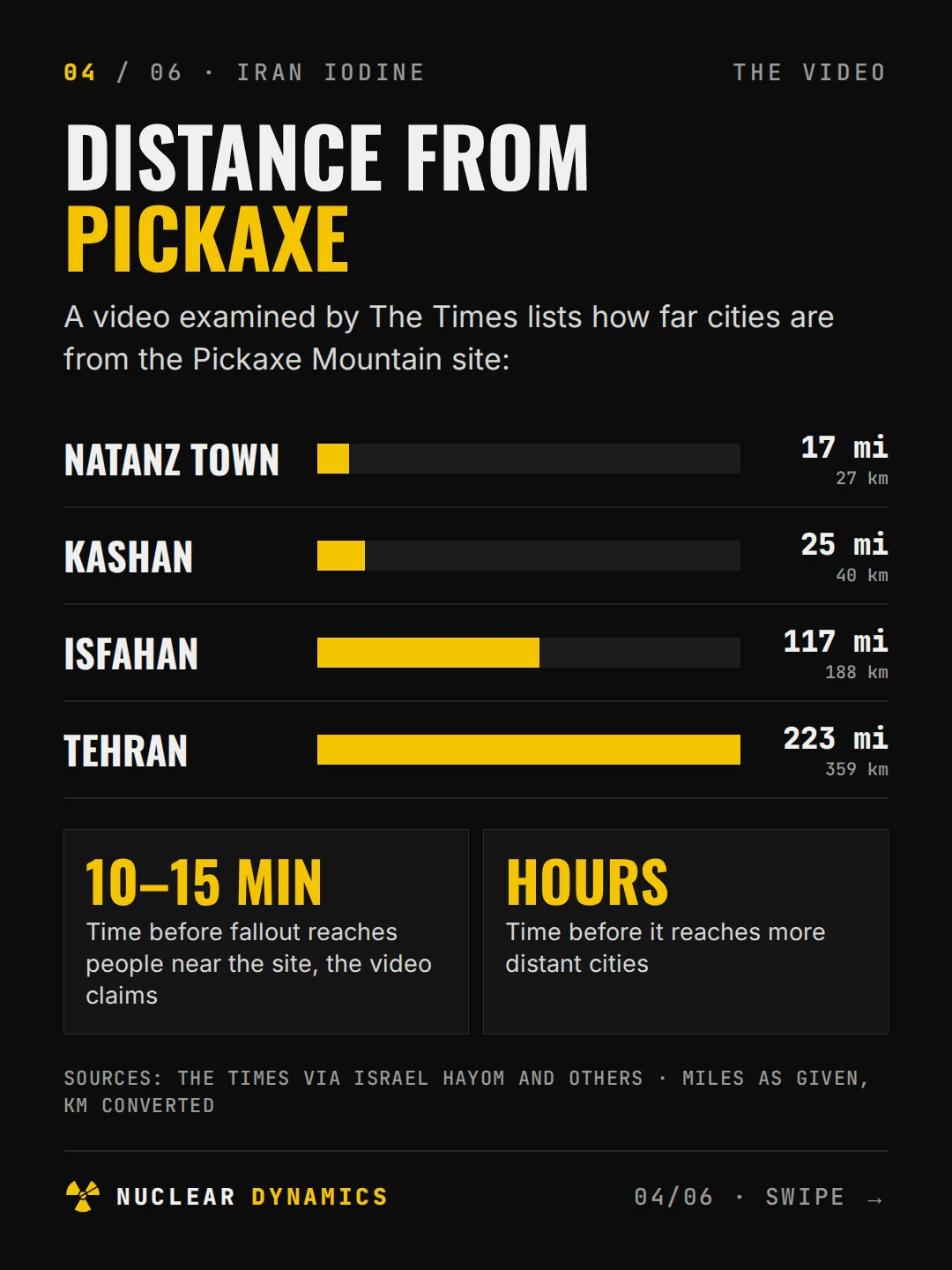
A clip examined by The Times lists the distances from the Pickaxe Mountain site to nearby cities:
| City | Distance (as given) | In km |
|---|---|---|
| Natanz town | 17 miles | 27 km |
| Kashan | 25 miles | 40 km |
| Isfahan | 117 miles | 188 km |
| Tehran | 223 miles | 359 km |
The clip claims fallout could reach people near the site within 10–15 minutes, and more distant cities within hours.
How alarming the video is remains disputed. Al Jazeera reported that it found no Iranian state or official media report warning citizens of an imminent nuclear attack, and called the way the clip was framed online misleading.
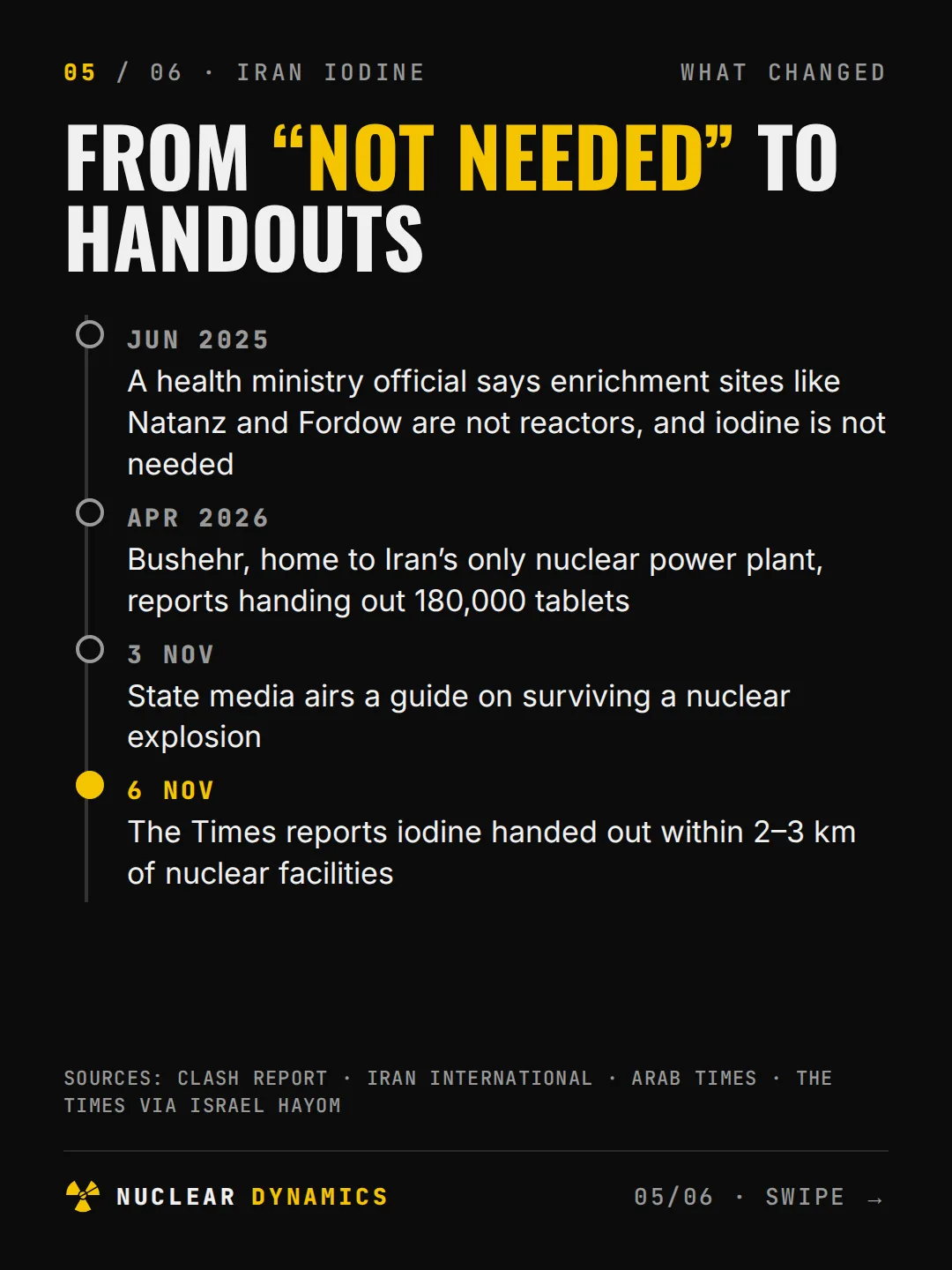
From "not needed" to handouts#
| Date | What happened |
|---|---|
| June 2025 | After the strikes on Iran's nuclear sites, a deputy health minister says people near Natanz and Fordow do not need iodine tablets, because enrichment sites are not reactors |
| April 2026 | Bushehr health officials say 180,000 tablets have been handed out, first around the power plant and then across the city; the distribution began before the June 2025 war |
| Late Oct–3 Nov 2026 | An Iranian civil-defence video on surviving a nuclear explosion circulates widely |
| 6 Nov 2026 | The Times reports iodine being handed out within 2–3 km of nuclear facilities |
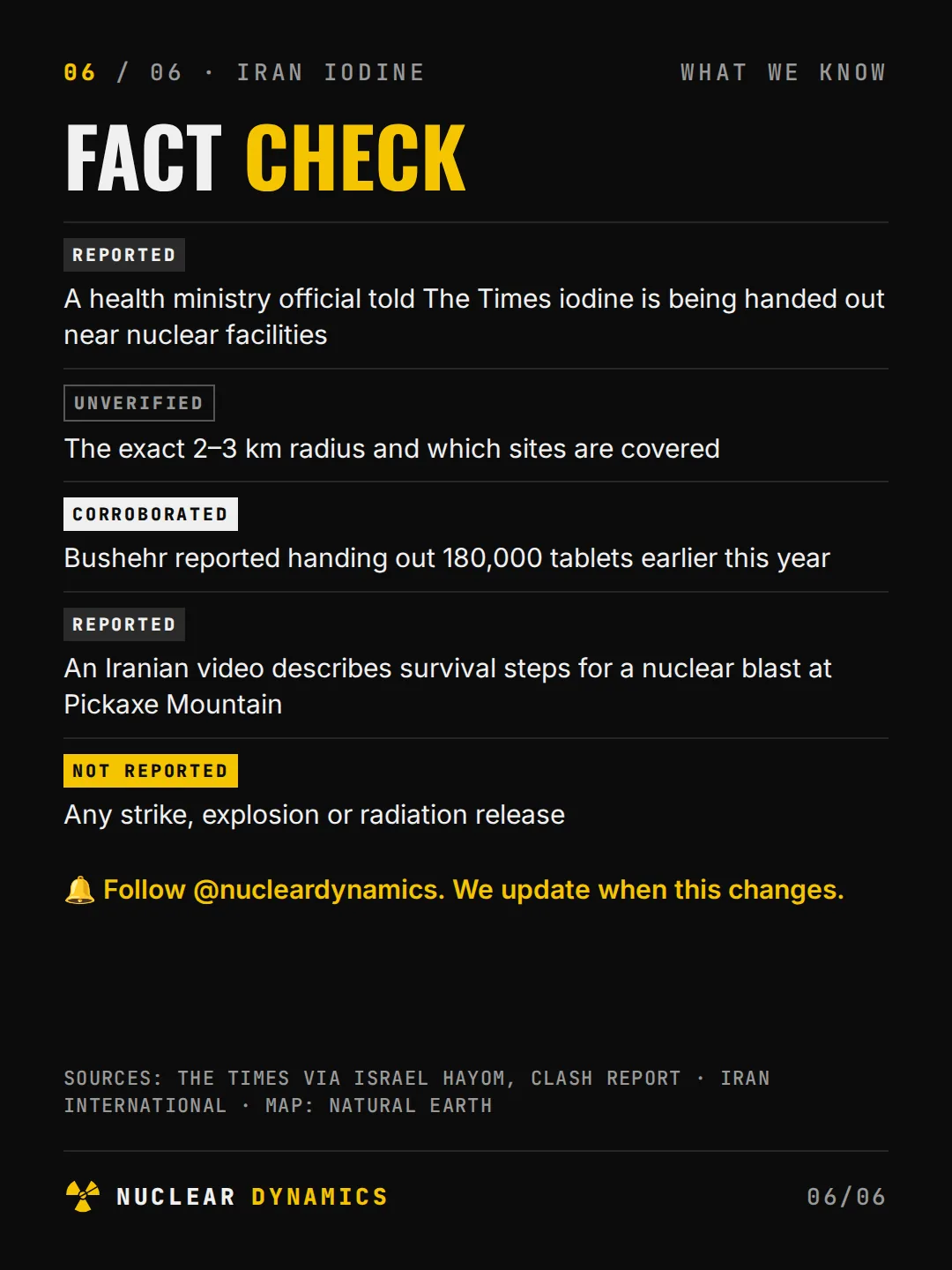
What we know#
| Claim | Status |
|---|---|
| A health official told The Times iodine is handed out near nuclear facilities | Reported |
| The exact 2–3 km radius, and which sites are covered | Unverified |
| Bushehr handed out 180,000 tablets earlier this year | Corroborated |
| An Iranian video describes surviving a nuclear blast at Pickaxe Mountain | Reported |
| Any strike, explosion or radiation release | Not reported |
Our read · RAGE Intel assessment
This is preparation, not a sign that an attack has happened. Handing out iodine near nuclear sites is a standard civil-protection step, and Iran had already done it at Bushehr. What has changed is the message: officials who said in 2025 that iodine was not needed near Natanz and Fordow are now describing handouts near nuclear facilities, days after a civil-defence video on surviving a nuclear blast.
That shift suggests the authorities are preparing the public for further strikes on nuclear sites, or want to be seen doing so. It is not evidence that a nuclear strike is expected.
This is an assessment, not a finding. It will change if Iranian authorities confirm the scale of the distribution, or if any nuclear site is struck.
This story is developing. RAGE X will update it as new information is confirmed.
Sources#
- Israel Hayom, Iranian officials distribute iodine pills anticipating American nuclear bombardment, 6 November 2026, reporting The Times
- Clash Report, Iran reportedly distributes iodine tablets near nuclear facilities, November 2026
- Iran International, Iran distributes 180,000 iodine tablets to Bushehr residents, 7 April 2026
- Arab Times, Iran distributes 180,000 iodine tablets in Bushehr nuclear preparedness plan, April 2026
- Mehr News Agency, Iran's Health Ministry rejects radiation risk after attacks, June 2025
- Sahara Reporters, Iran issues rare nuclear attack advisory to citizens, 3 November 2026
- Newscord, Iranian state TV broadcasts nuclear strike survival instructions; Al Jazeera says clip misleading, 4 November 2026
- PBS Frontline, Iran's suspected nuclear site at Pickaxe Mountain
- French government, Service-Public.fr: iodine tablet distribution; Ordre des pharmaciens, campagne de distribution d'iode
- Map: Natural Earth
Continue the assessment
Related Intelligence
Where the US–Iran War Actually Stands, Six Months In
Six months after the strikes that killed Iran's Supreme Leader, the ceasefire is fragile, the nuclear question is unresolved, and Hormuz is still contested.
2026-08-02 · 12 min read
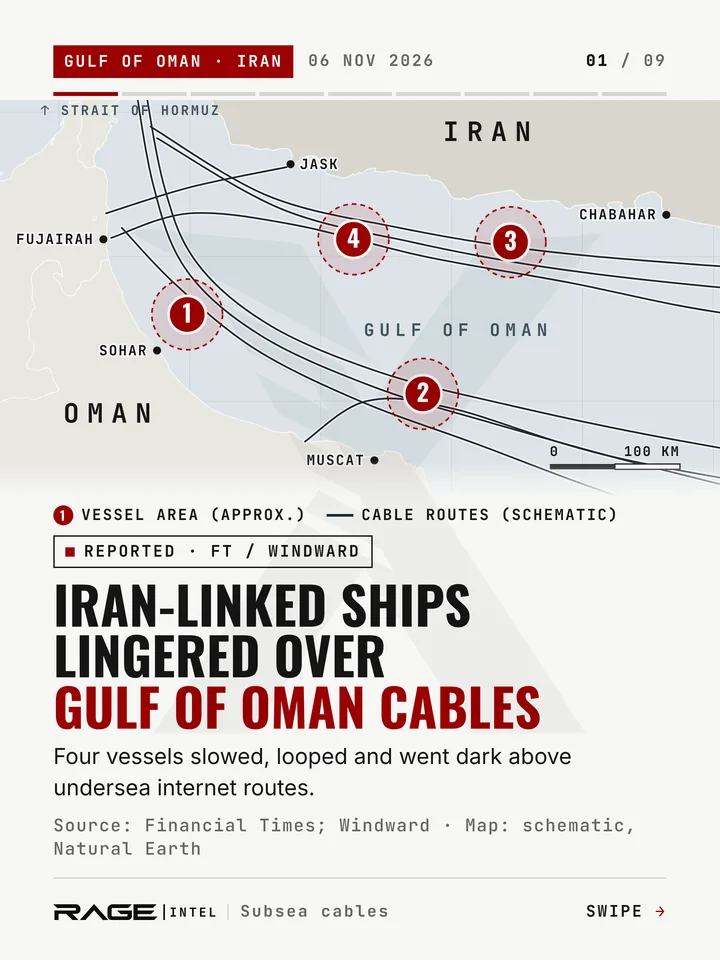
Iran-Linked Ships Lingered Over Gulf of Oman Internet Cables as Tehran Threatened Them
Four Iran-linked ships slowed, looped and went dark over Gulf of Oman internet cables in October, Windward data shows, as Iran named the cables as targets.
2026-11-06 · 7 min read
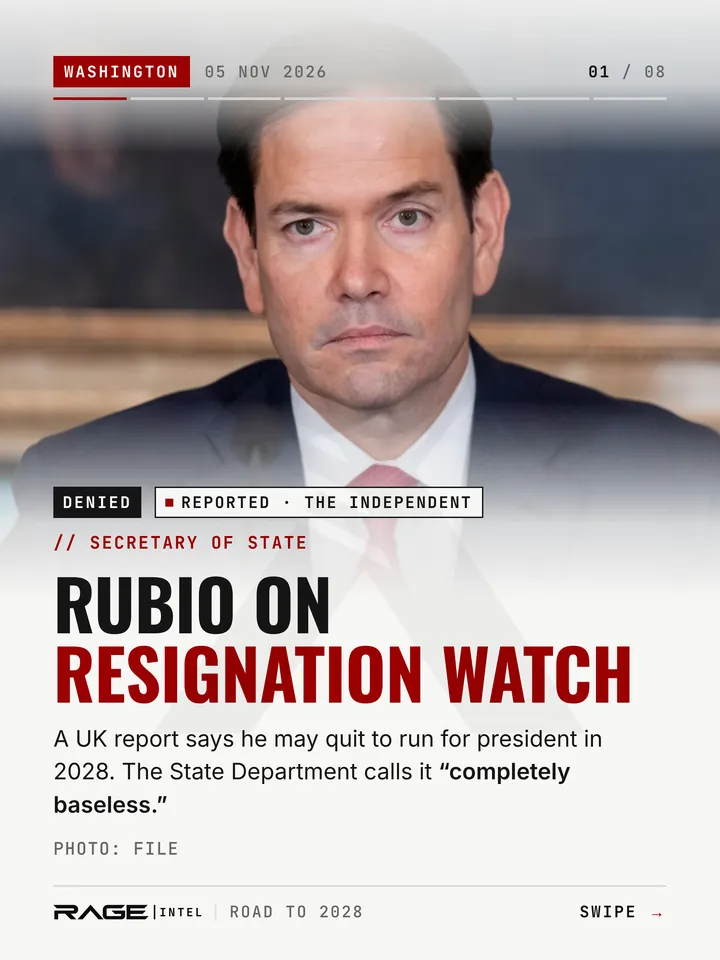
Is Marco Rubio About to Quit? The Resignation Report, the Denials and the Race for 2028
A UK report says Rubio may quit to run in 2028; the State Department calls it "completely baseless". What the polls, the markets and the denials show.
2026-11-05 · 7 min read
Today's conflict risk
The daily RAGE INDEX scores global conflict risk across six theaters, with sources and forecasts.
Read the RAGE INDEXReach readers like these
RAGE X sells sponsored content across RAGE Intel, RAGE War and RAGE Global by proposal, always labelled as sponsored.
Request a campaign proposal