Iran-Linked Ships Lingered Over Gulf of Oman Internet Cables as Tehran Threatened Them
RAGE Global · Gulf of Oman · Subsea cables · Reported · 7 min read
Instagram carousel
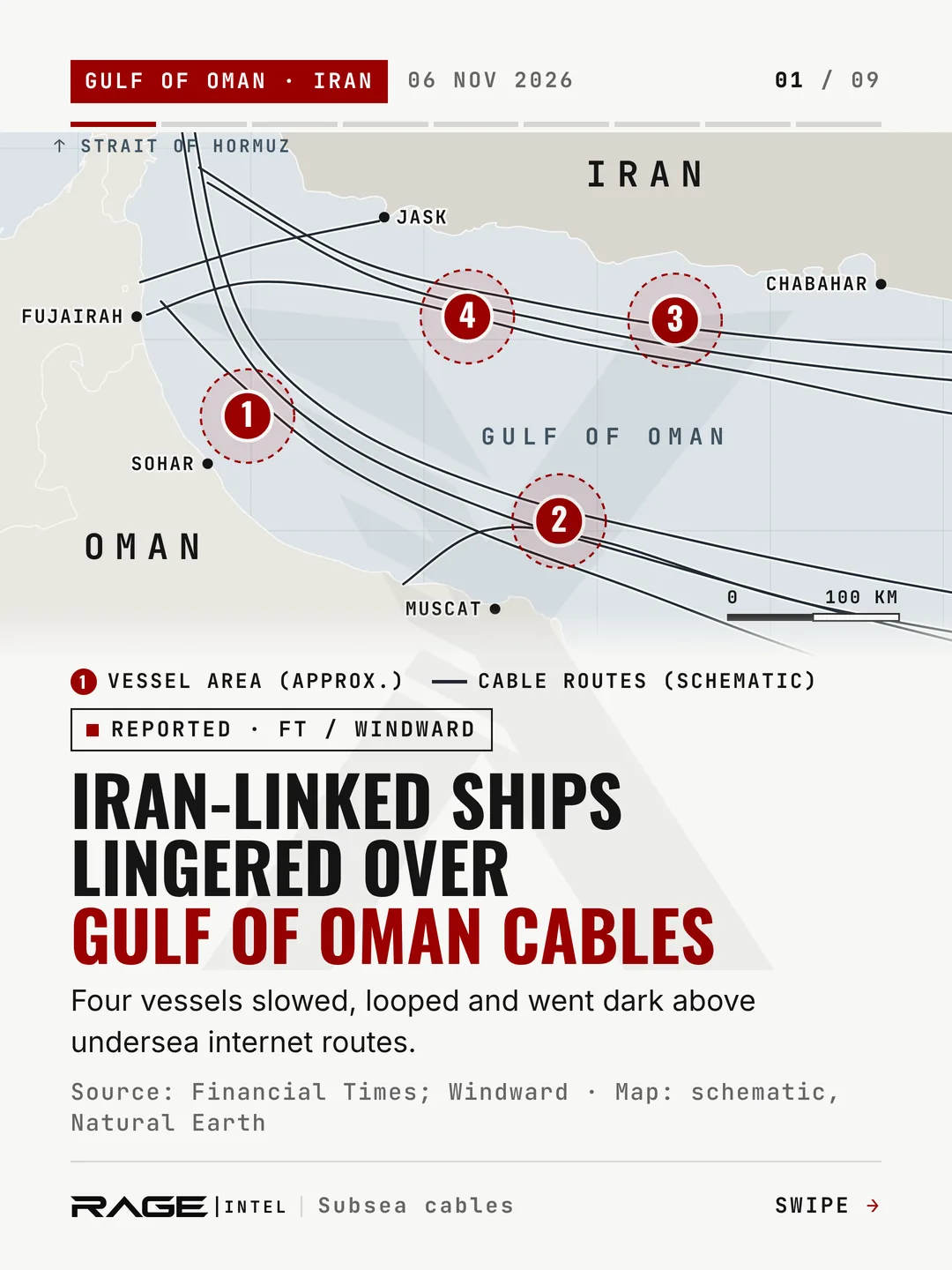
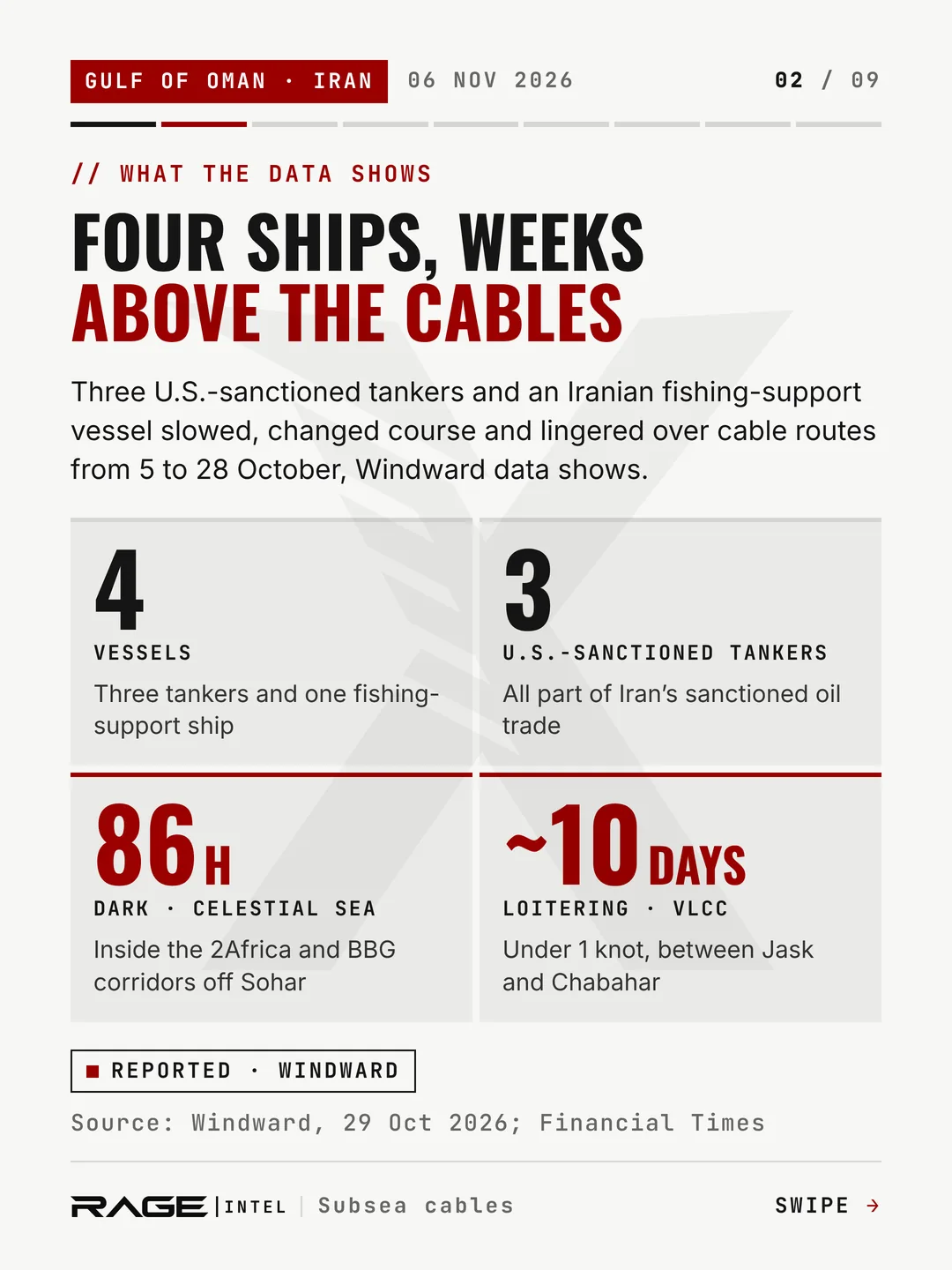
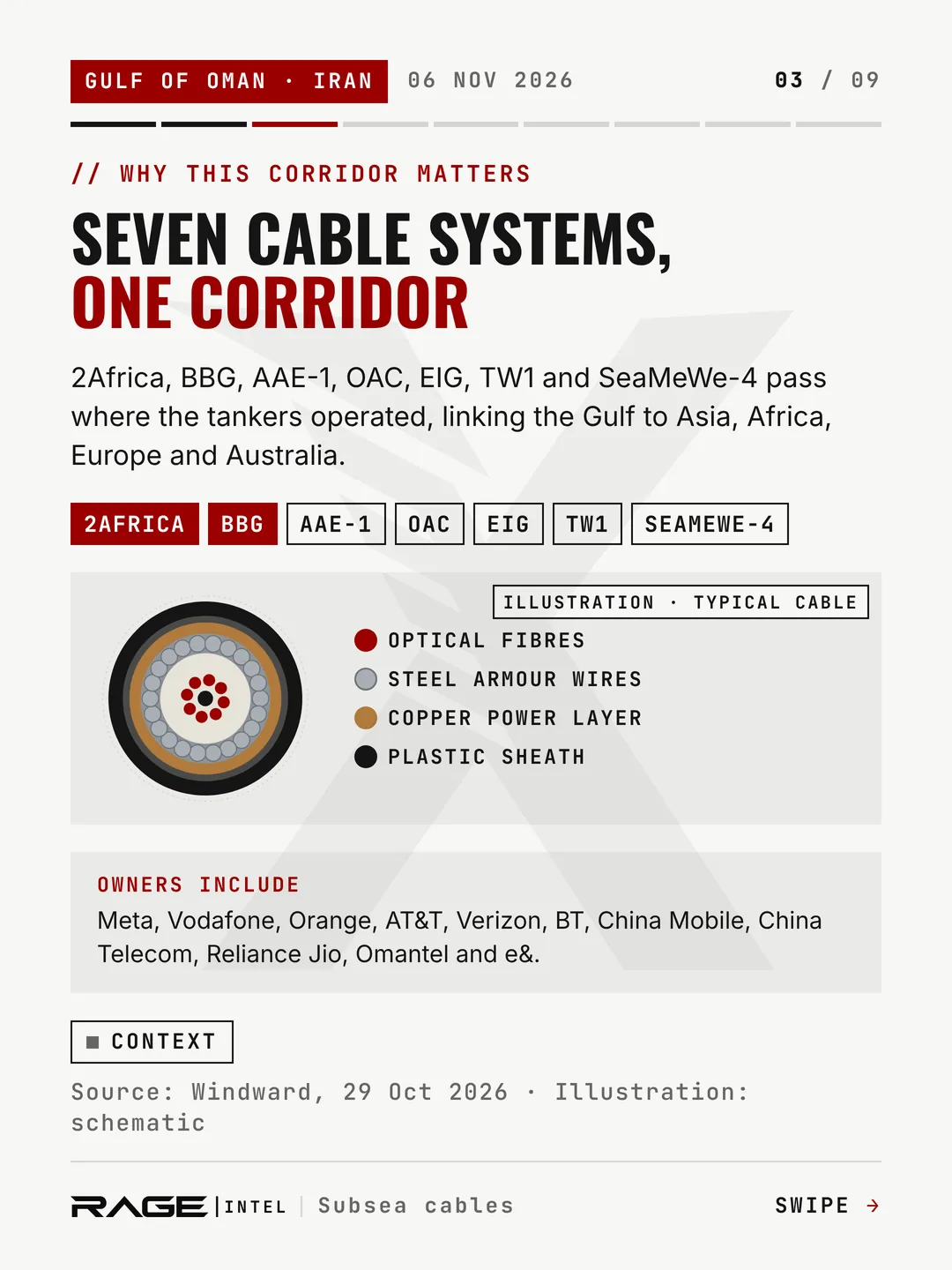
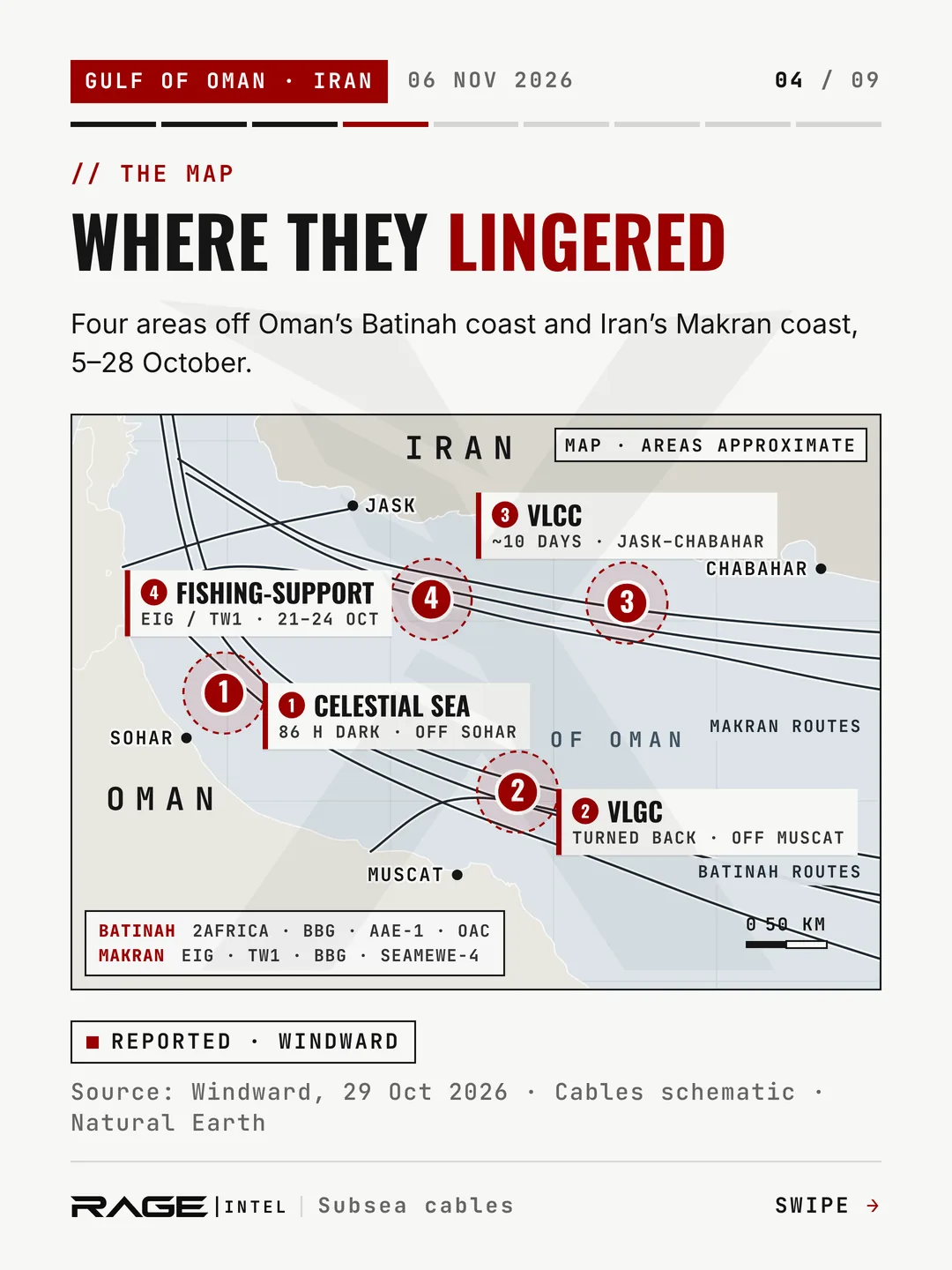
Published on Instagram with this story · swipe or use the arrow keys
Four Iran-linked vessels slowed, looped and switched off their tracking signals above undersea internet cables in the Gulf of Oman between 5 and 28 October 2026, according to the Financial Times, citing data from the maritime intelligence firm Windward. Three are U.S.-sanctioned tankers. One of them, CELESTIAL SEA, went dark for 86 hours inside the 2Africa and BBG cable corridors off Sohar, Oman. The activity overlapped with a run of Iranian warnings that Gulf cables could be hit if the war resumes. Windward says the movements fit the profile of mapping the cable routes or placing charges on them, but that tracking data alone cannot show what the ships did.
Key takeaways
- Four vessels, one corridor: three U.S.-sanctioned tankers and an Iran-flagged fishing-support ship lingered over cable routes off Oman's Batinah coast and Iran's Makran coast, 5–28 October, Windward data shows.
- 86 hours dark: CELESTIAL SEA switched off its tracking signal inside the 2Africa and BBG corridors off Sohar, 15–19 October.
- Seven cable systems run through these waters, linking the Gulf to Asia, Africa, Europe and Australia.
- The threats: an Iranian official warned on 12 October that cables could be hit; the IRGC spokesman named "seven major internet cables" under Hormuz on 19 October; two Iranian officials told Reuters on 23 October that Tehran has detailed plans to hit them if war resumes.
- The limit: Windward says ship-tracking data cannot show whether any vessel surveyed the seabed or deployed equipment.
Confidence: REPORTED. The vessel movements come from Windward's analysis of ship-tracking (AIS) data, reported by the Financial Times. RAGE X has not independently examined the tracking data. The Iranian statements are reported as statements.
What the data shows#
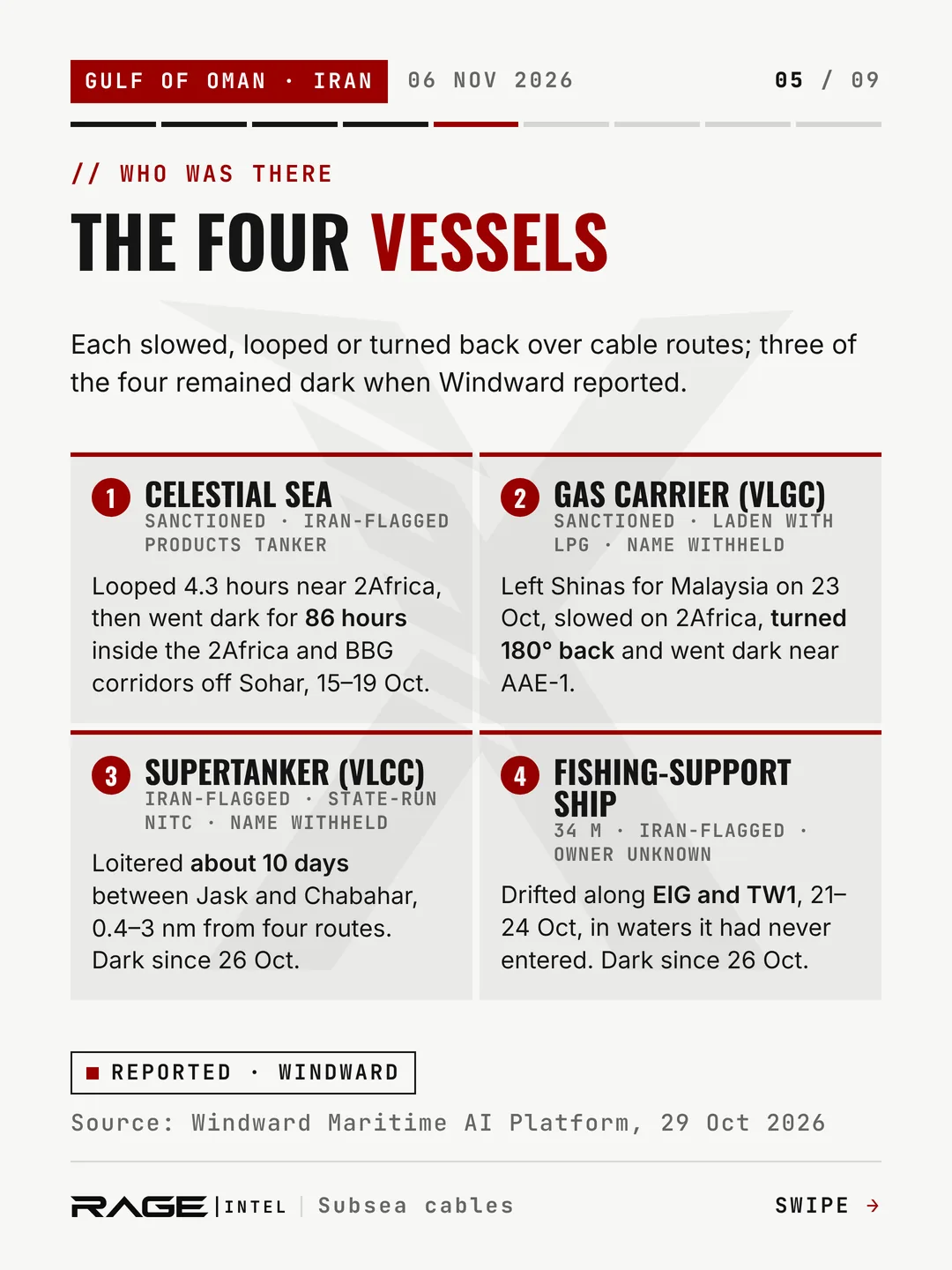
Windward tracked four vessels that slowed, changed course or stopped over cable routes in the Gulf of Oman from 5 to 28 October. Three of them remained dark, with their Automatic Identification System (AIS) transponders off, when Windward published its analysis on 29 October.
| Vessel | Type | What Windward reports |
|---|---|---|
| CELESTIAL SEA | Sanctioned products tanker | Looped for 4.3 hours about 0.65 nautical miles from 2Africa on 14 October, then went dark for 86 hours inside the 2Africa and BBG corridors off Sohar, 15–19 October |
| Gas carrier (VLGC) | Sanctioned, laden with LPG; name withheld | Left Shinas for Malaysia on 23 October, slowed over 2Africa, turned 180 degrees back toward Oman and went dark about 2 nautical miles from AAE-1 |
| Supertanker (VLCC) | Iran-flagged, operated by the state-run NITC; name withheld | Loitered at under 1 knot for about 10 days in Iran's exclusive economic zone between Jask and Chabahar, 0.4–3 nautical miles from four cable routes; dark since 26 October |
| Fishing-support ship | 34 m, Iran-flagged; owner unknown | Drifted along the EIG and TW1 routes on 21–24 October, in waters Windward says it had not entered before; dark in Iranian waters since 26 October |
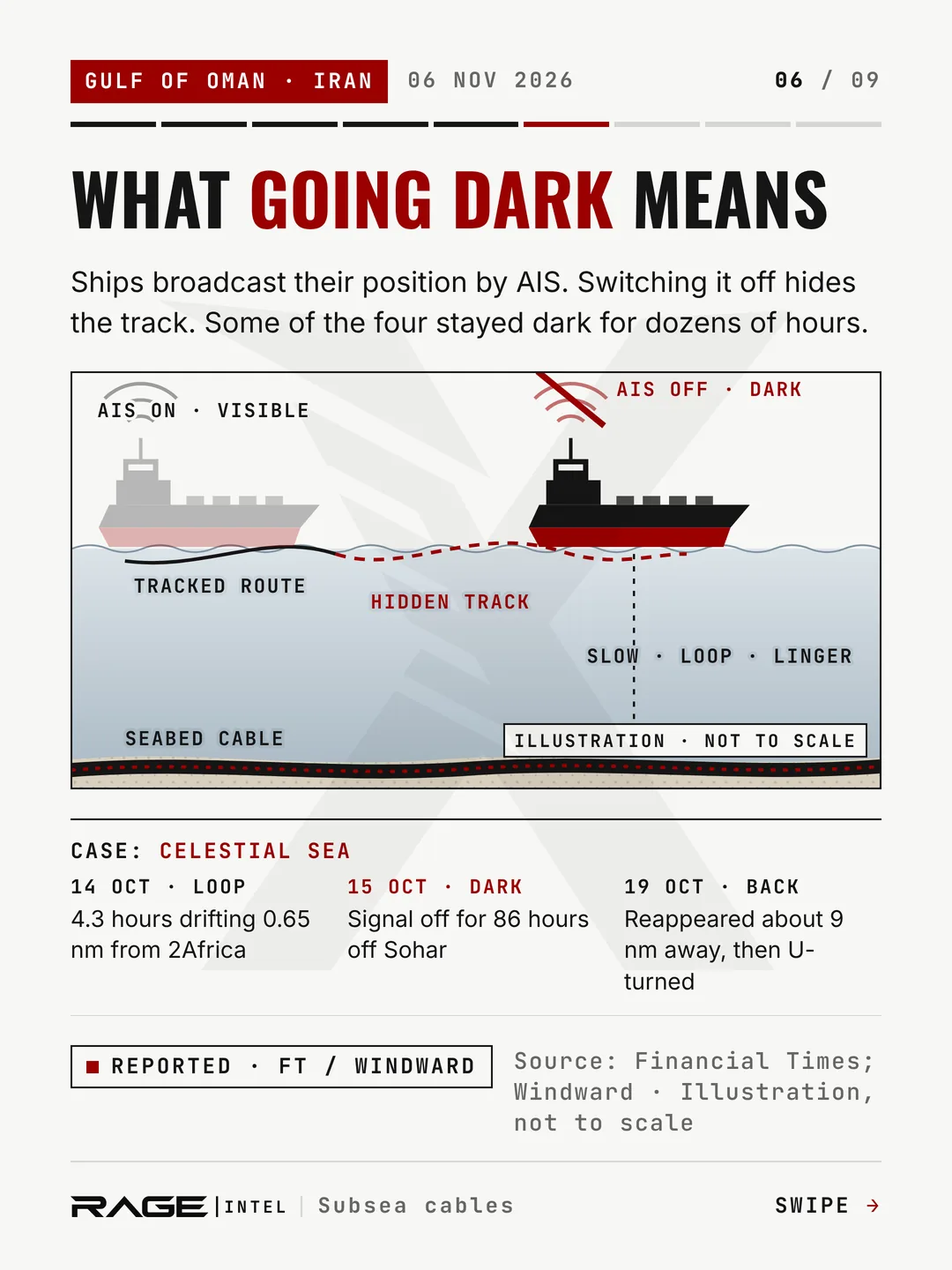
According to Windward, CELESTIAL SEA came back on air about 9 nautical miles from where it disappeared, then made a U-turn, instead of waiting at an anchorage as a tanker normally would. Windward links the ship to a UAE-based operator that, according to the U.S. Treasury, moved oil for the National Iranian Oil Company and, in 2023, for the Iranian military.
Windward also reports that the fishing-support ship crossed the FALCON and UAE–Iran cables on 25 October, the day before it went dark.
Why this corridor matters#
Seven cable systems pass through the waters where the vessels operated: 2Africa, BBG (Bay of Bengal Gateway), AAE-1, OAC, EIG, TW1 and SeaMeWe-4. Together they link the Gulf states to Asia, Africa, Europe and Australia. Their owners include Meta, Vodafone, Orange, AT&T, Verizon, BT, China Mobile, China Telecom, Reliance Jio, Omantel and e&.
The Batinah routes off Oman carry 2Africa, BBG, AAE-1 and OAC. The Makran routes off Iran carry EIG, TW1, BBG and SeaMeWe-4.
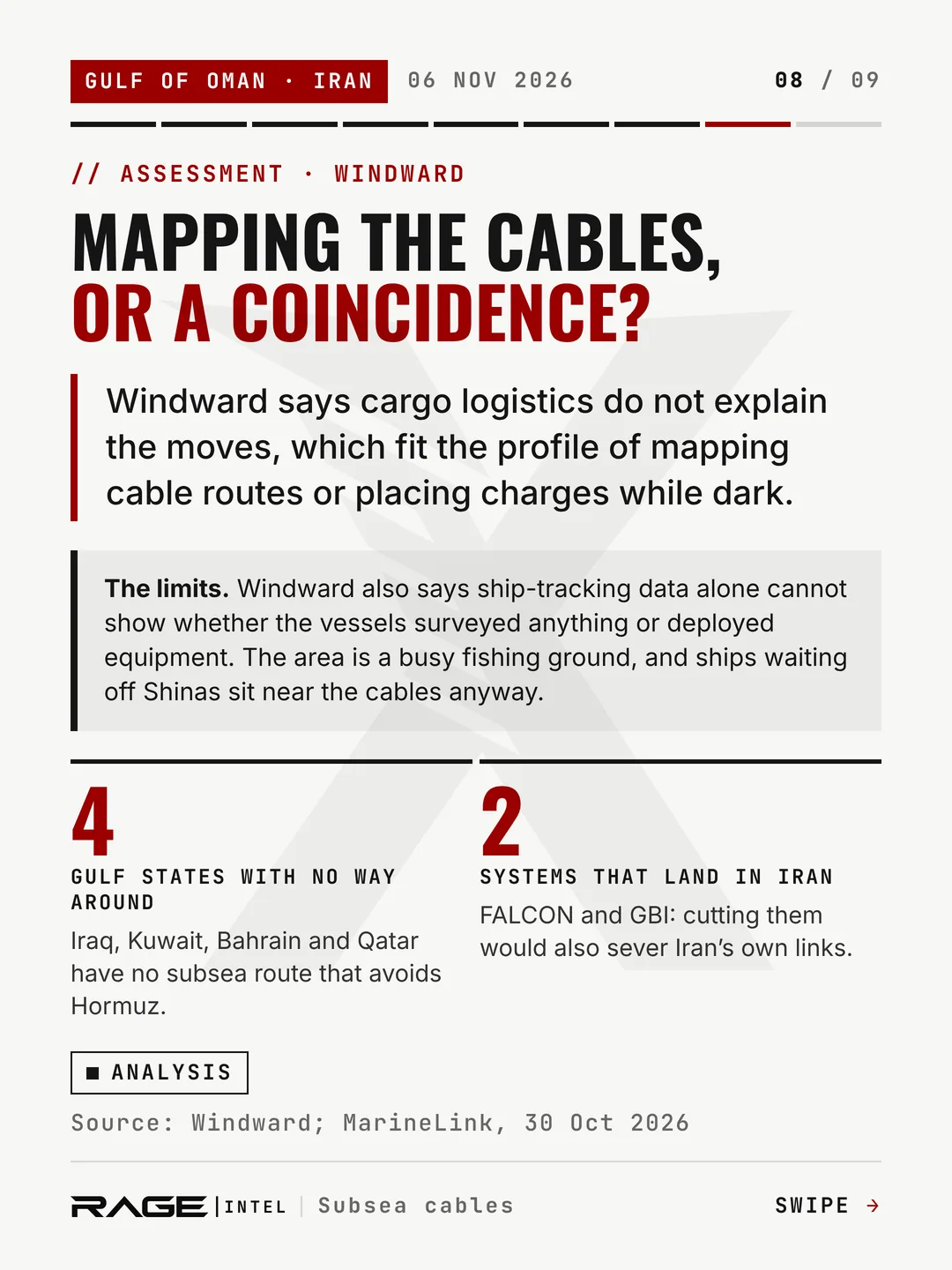
Windward's wider analysis of the Strait of Hormuz finds that Iraq, Kuwait, Bahrain and Qatar have no subsea route to the outside world that avoids the strait, because every cable they use lands inside the Gulf. Windward counts six live systems crossing Hormuz itself, with two more due in 2027. Two of them, FALCON and GBI, also land in Iran, according to Windward, so cutting them would also sever Iran's own links.
What "going dark" means#
Large ships broadcast their position, course and speed by AIS. Switching the transponder off hides the track: the ship's last known position is all an observer has until it transmits again. Sanctioned tankers often go dark to hide cargo transfers. Over a cable route, a ship that slows, loops and lingers with its AIS off could, in principle, be surveying the seabed or deploying equipment without being seen.
The moves and the threats#
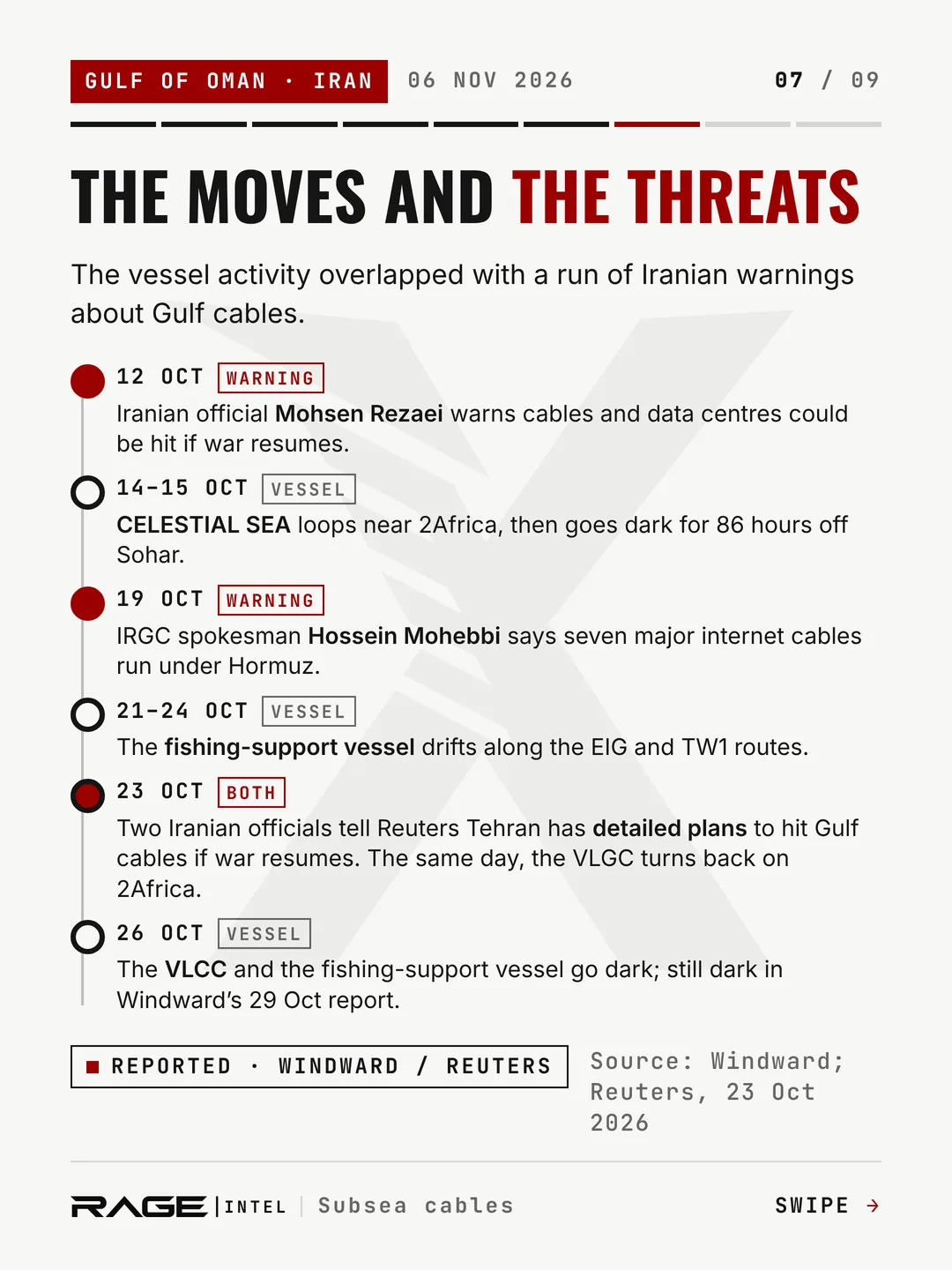
| Date | Event | Type |
|---|---|---|
| 12 Oct | Iranian official Mohsen Rezaei warns that cables and data centres across the region could be hit if the war resumes | Warning |
| 14–15 Oct | CELESTIAL SEA loops near 2Africa, then goes dark for 86 hours off Sohar | Vessel |
| 19 Oct | IRGC spokesman Hossein Mohebbi says seven major internet cables run under the Strait of Hormuz and warns of "new targets" | Warning |
| 21–24 Oct | The fishing-support ship drifts along the EIG and TW1 routes | Vessel |
| 23 Oct | Two senior Iranian security officials tell Reuters that Tehran has detailed plans to hit Gulf undersea cables if the U.S. and Israel attack Iran again. The same day, the gas carrier turns back over 2Africa | Both |
| 26 Oct | The VLCC and the fishing-support ship go dark; both are still dark in Windward's 29 October report | Vessel |
The officials who spoke to Reuters gave few specifics and did not say how or where Iran would strike. One said that if Iran were attacked "there will be no more red lines," and that Tehran would also try to block repairs to damaged cables. Neither Iran's Foreign Ministry nor the U.S. State Department responded to Reuters' requests for comment.
Mapping the cables, or a coincidence?#
Windward says cargo logistics do not explain the vessels' moves, which fit the profile of mapping cable routes or placing charges while dark.
It is equally clear about the limits. Ship-tracking data alone cannot show whether any of the vessels surveyed the seabed or deployed equipment. The area is a busy fishing ground, and ships waiting off Shinas sit near the cables anyway. Windward says further loitering of the same kind would be needed to show a pattern rather than a coincidence.
No cable in the Gulf of Oman has been reported damaged, and no government has accused Iran of tampering with one.
Our read · RAGE Intel assessment
The movements are unexplained, not proven hostile. Four Iran-linked ships behaving this way over the same cables, in the same weeks that Tehran named those cables as targets, is a pattern worth watching closely. But tracking data shows where ships were, not what they did, and the most important question, whether anything was surveyed or placed on the seabed, cannot be answered from it.
The threats themselves read as deterrence aimed at the Gulf states and at Washington: raising the cost of renewed strikes on Iran by putting the region's internet and the investments that depend on it on the table. Two of the systems that cross Hormuz also serve Iran, which limits how freely it could cut them.
This is an assessment, not a finding. It will change if a cable is damaged, if the dark ships reappear in the same corridors, or if a government makes a formal accusation.
What to watch#
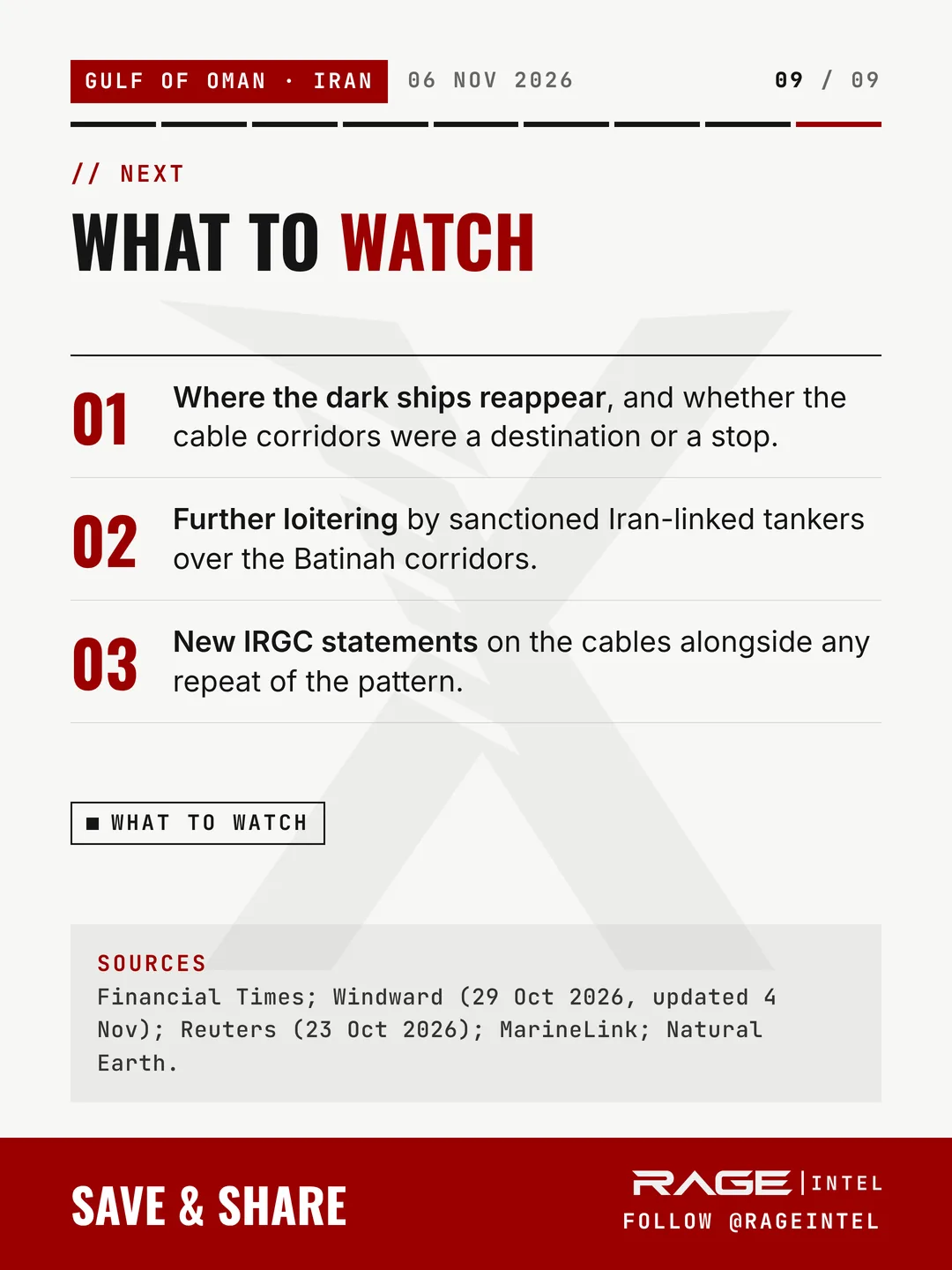
- Where the dark ships reappear, and whether the cable corridors were a destination or a stop on the way.
- Further loitering by sanctioned Iran-linked tankers over the Batinah corridors.
- New IRGC statements on the cables, alongside any repeat of the pattern.
This story is developing. RAGE X will update it as new information is confirmed.
Sources#
- Windward, Sanctioned Iran-Linked Tankers Went Dark Over Gulf of Oman Cables as the IRGC Threatened Them, 29 October 2026, updated 4 November 2026
- Windward, Iran Threatens the Hormuz Internet Cables: Four Gulf States Have No Subsea Route That Avoids the Strait, October 2026
- Financial Times, Iran-linked vessels over Gulf of Oman cables, as summarised by Breaking The News, November 2026
- Reuters via U.S. News, Iran Has Detailed Plans to Hit Gulf Undersea Cables if War Resumes, Officials Say, 23 October 2026
- Bernama, IRGC Cites Seven Internet Cables Under Strait of Hormuz, Warns of 'New Targets', 19 October 2026
- SAFETY4SEA, Iran's subsea cable threats put unusual tanker movements under scrutiny, October 2026
- Map: cable routes schematic; coastlines from Natural Earth
Continue the assessment
Related Intelligence
The Strikes Paused. The Risk Premium Didn't
Trump says a deal reopening the Strait of Hormuz is close. Oil prices, travel advisories, and Tehran's crackdown say the war isn't actually over.
2026-08-02 · 6 min read
Two Chokepoints, One War: What the Houthi Blockade on Saudi Arabia Really Signals
The Houthis have opened a second maritime front against Saudi Arabia while Iran keeps attacking tankers in Hormuz. What it means for oil, Gulf politics, and the war's endgame.
2026-07-29 · 7 min read
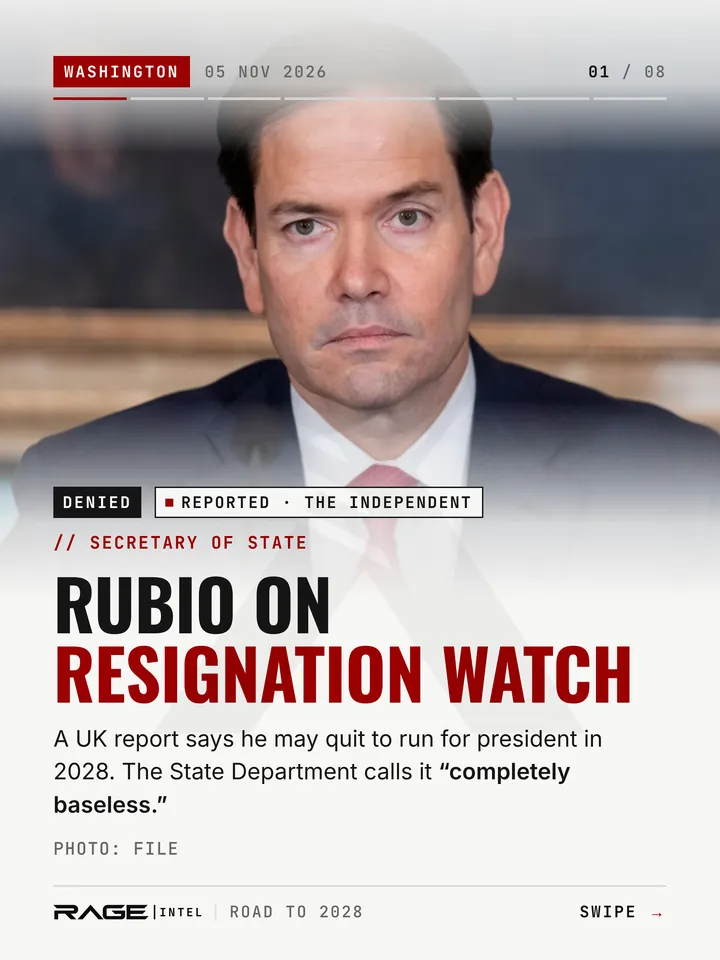
Is Marco Rubio About to Quit? The Resignation Report, the Denials and the Race for 2028
A UK report says Rubio may quit to run in 2028; the State Department calls it "completely baseless". What the polls, the markets and the denials show.
2026-11-05 · 7 min read
Today's conflict risk
The daily RAGE INDEX scores global conflict risk across six theaters, with sources and forecasts.
Read the RAGE INDEXReach readers like these
RAGE X sells sponsored content across RAGE Intel, RAGE War and RAGE Global by proposal, always labelled as sponsored.
Request a campaign proposal