Microsoft Declares an Internal "Code Red" After Its Historic 24-Hour Outage
RAGE Global · Tech · Outage · Developing · 5 min read
Instagram carousel
Published on Instagram with this story · swipe or use the arrow keys
Microsoft has declared an internal "Code Red" after a 24-hour outage on 12–13 November 2026 knocked out Exchange Online, Outlook, Teams and Copilot for governments and businesses around the world, according to internal memos reviewed by Reuters. Jason Henderson, president of Microsoft's M365 Core, called it the most customer-impacting incident in the history of Exchange Online. Microsoft has blamed an undetected Windows defect introduced in July, and says it was not a cyberattack. The new goal is to restore service worldwide within an hour of any disruption, and to ship urgent patches globally in an hour rather than the five to six days they have taken.
Key takeaways
- The declaration: Microsoft has called a "Code Red" over the outage, making fixing it the highest-priority work for the team, per Reuters' reading of internal memos.
- The verdict: Henderson: the most customer-impacting incident in Exchange Online's history.
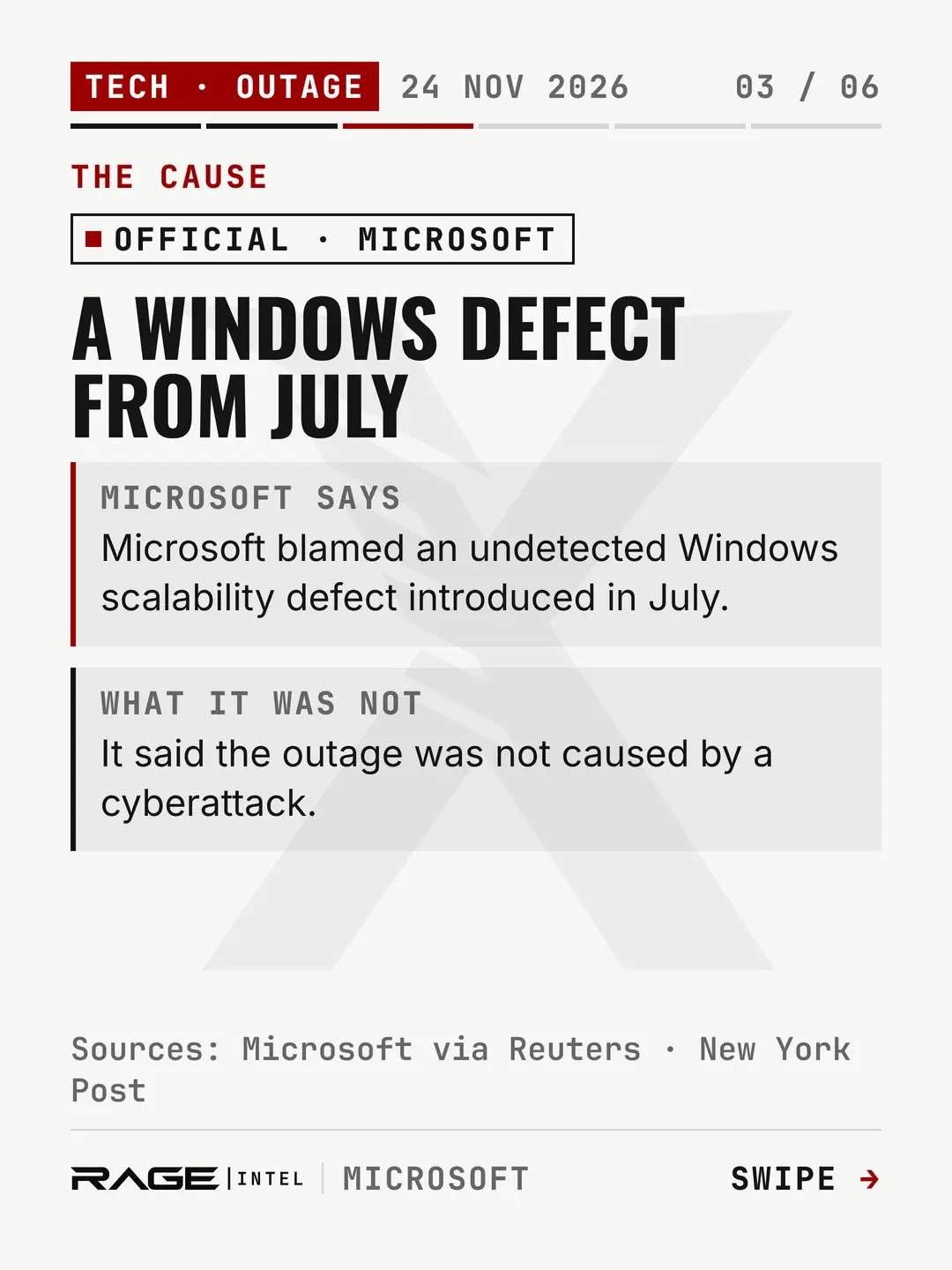
- The cause, per Microsoft: An undetected Windows scalability defect introduced in July. Microsoft says it was not a cyberattack and not caused by AI agents.
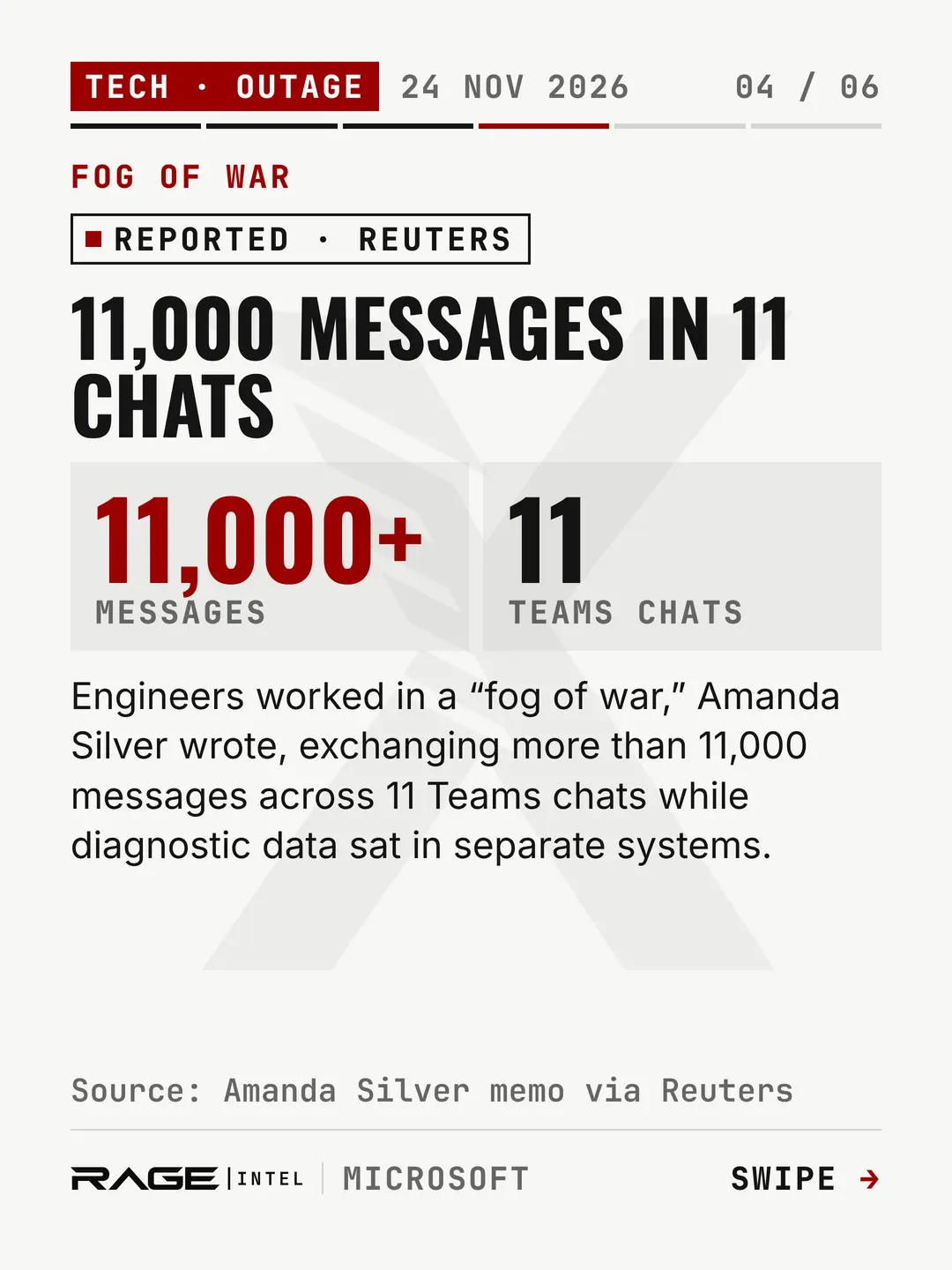
- The chaos: Engineers exchanged more than 11,000 messages across 11 Teams chats while diagnostic data sat in separate systems, a "fog of war," according to a memo by Amanda Silver.
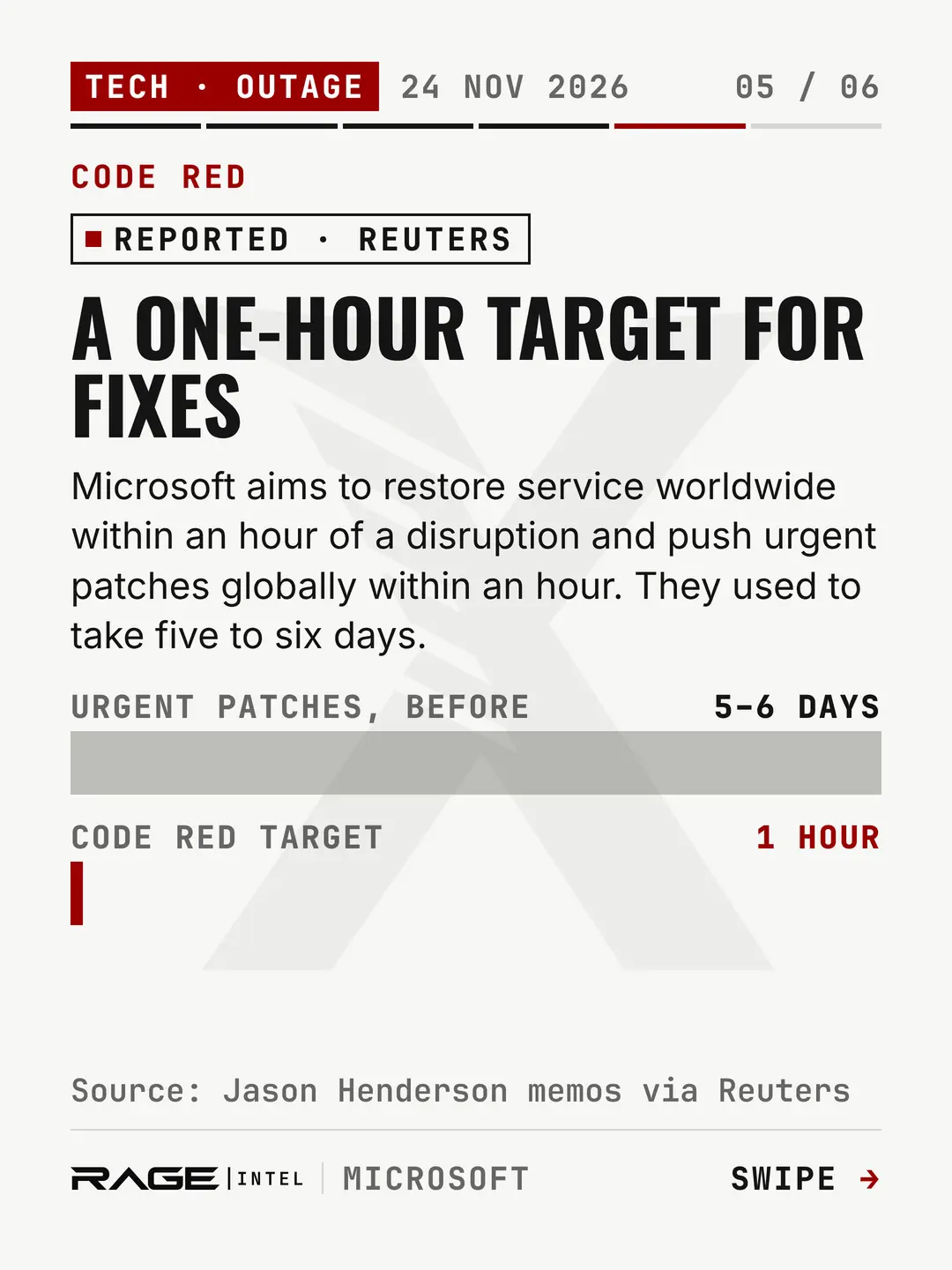
- The new target: Restore service worldwide within an hour of a disruption, and push urgent patches globally within an hour, instead of five to six days.
Confidence: REPORTED for the memos, which come from Reuters' review of internal documents that we have not seen; OFFICIAL for Microsoft's public statements on the cause. This article reflects reporting on Tuesday 24 November 2026.
What the memos say#
Reuters reported on 24 November that Microsoft has declared an internal Code Red after the outage of 12–13 November. A Code Red is the company's top-priority mobilization for a critical crisis.
- The assessment. Henderson wrote in a memo to staff on Friday 20 November that it was the most customer-impacting incident in the history of Exchange Online. "Never before had so many customers been without email for so long," he wrote, as quoted by outlets reporting on the memo. He also wrote that Code Red means this is the highest priority work for the team.
- The oversight. Henderson reportedly holds daily meetings with the leadership of Microsoft's Substrate platform and weekly executive reviews.
- The history. Charles Lamanna, an executive vice president, reportedly told a Code Red review that the failed component had seen "roughly ten years' worth of acceptable failures."
What went down#
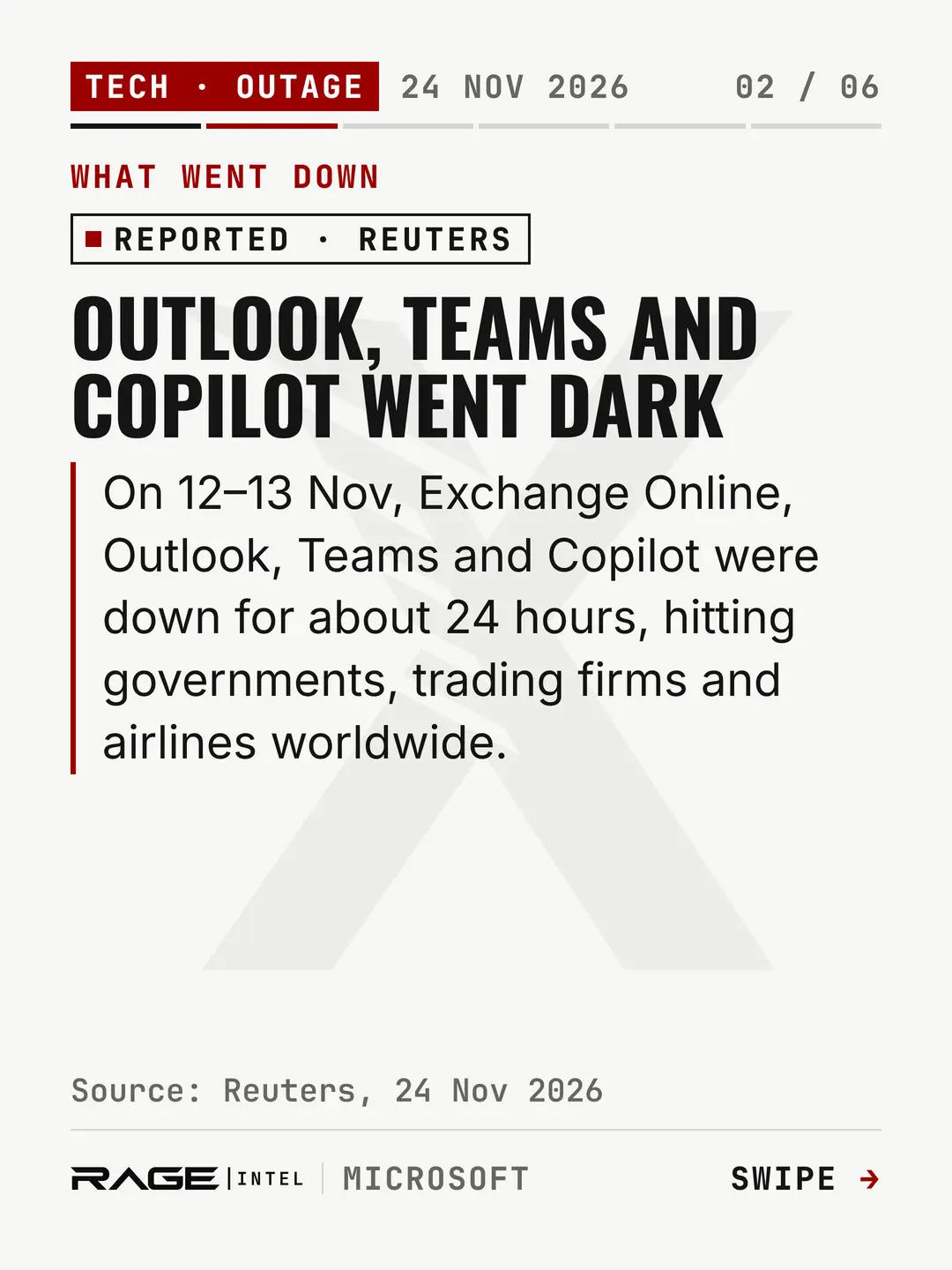
On 12–13 November, Exchange Online, Outlook, Teams and Copilot were down for about 24 hours. They hit governments, trading firms and airlines worldwide, according to Reuters. For our reporting from the time, see our first report on the outage and our report on its effect on hospitals, police and the UN climate talks.
The cause#
| What Microsoft says | |
|---|---|
| The defect | An undetected Windows scalability defect, introduced in July and dormant until heavy traffic exposed it |
| Not a cyberattack | Microsoft says the outage was not caused by cyber activity |
| Not AI agents | Microsoft says it was not related to AI agents |
This goes further than Microsoft's first explanation, which described servers becoming unavailable and a faulty network change. The company has not published a full root-cause report.
"Fog of war"#
Amanda Silver, a corporate vice president who oversees M365 Core, wrote in a memo on Monday 23 November that responders worked in a "fog of war."
- Even with top engineers deployed, responders exchanged more than 11,000 messages across 11 Teams chats.
- Diagnostic data sat in separate internal tracking systems, so it was hard to keep one clear view of the theories being tested and the decisions made.
- Silver's memo set out five workstreams, including shedding load, splitting traffic by region, and recovering faster.
The memo is a view from inside the response, as reported by Reuters. We have not seen it.
A one-hour target#
A separate memo from Henderson said urgent patches to M365 Core services took too long to reach every region. In one recent case, an urgent production fix needed five to six days to spread worldwide.
| Time | |
|---|---|
| Urgent patches worldwide, before | 5–6 days |
| Code Red target | 1 hour |
Henderson wants critical fixes to go from detection to global rollout within an hour, and service to be restored worldwide within an hour of a disruption. Microsoft has not yet reached that mark. A Microsoft spokesperson said, "Our work doesn't end when service is restored." Part of the plan reportedly uses AI agents to comb through system data and find problems faster.
Not the only outage that week#
Microsoft's outage was one of several in the same days. By RAGE Intel's count there were six major failures in eight days. See our reports on Apple and the NSA's classified network.
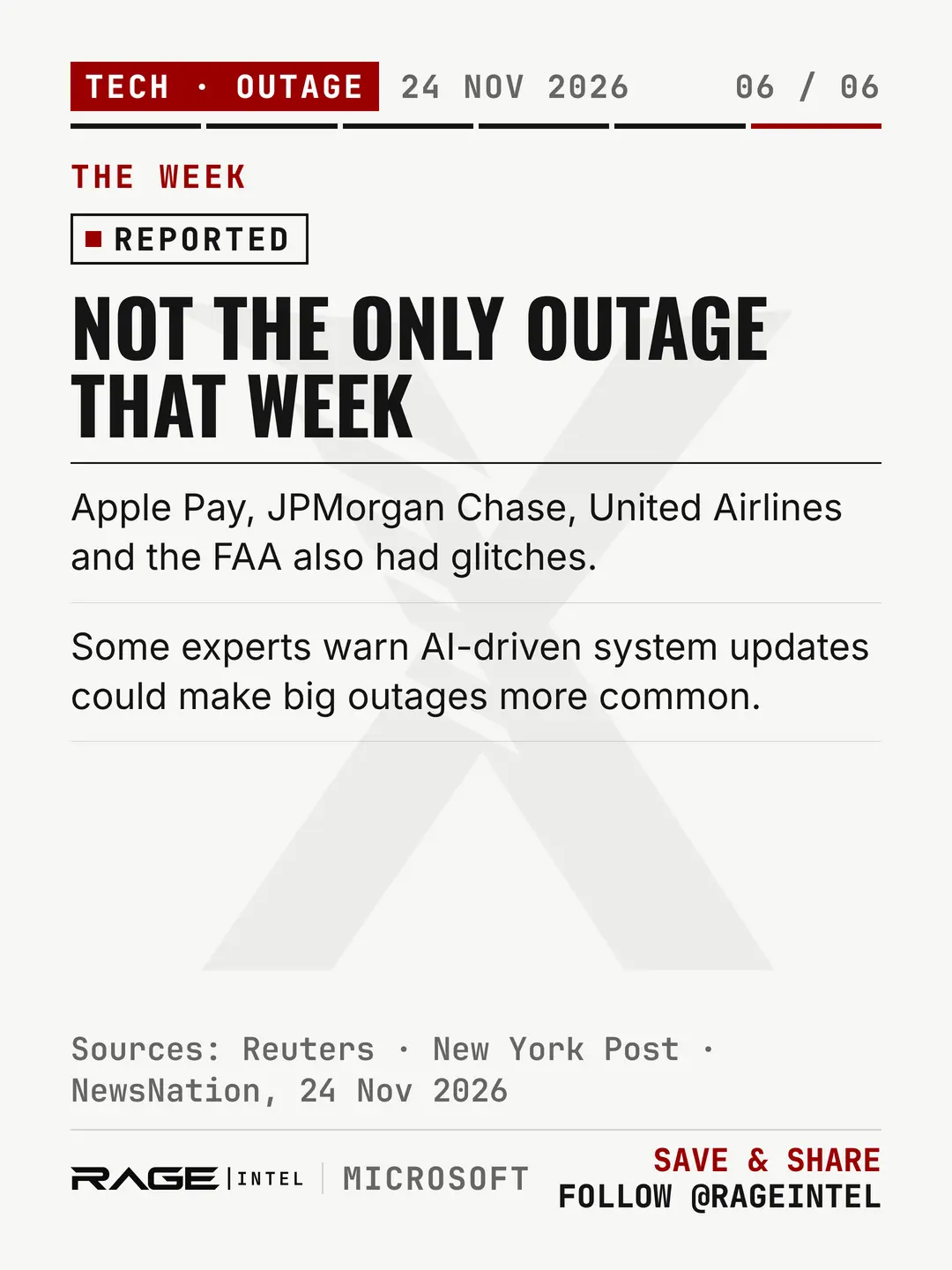
- Apple Pay, JPMorgan Chase, United Airlines and the FAA also had disruptions. The FAA blamed a flood of data on legacy equipment, and Chase a software bug.
- Experts and executives link the wave to AI pressure on updates, not to an attack. Microsoft's July and August security update releases, of 622 and 419 fixes, were the largest in the program's history, and Microsoft credited AI-assisted discovery. Microsoft's chief executive, Satya Nadella, warned that AI could contribute to more outages as companies race to fix security problems, and Steven Murdoch of University College London argued that AI may push engineers to rush fixes.
- Others disagree. One commentator said the outages say more about new technology added to ageing infrastructure than about AI. No company has blamed AI for its own outage, and no link between the incidents has been shown.
What to watch#
- A full root-cause report from Microsoft.
- Whether the one-hour targets are met, and how Microsoft tests them.
- More changes to how Microsoft ships patches, if the pace of AI-found flaws keeps rising.
- Customers' response: credits, contract changes and any moves to a second email provider.
Our read · RAGE Intel assessment
A company that declares a Code Red over an outage is admitting that this was not a one-off. Two things stand out in the memos: the fix was slow to spread, and the people fixing it could not see one clear picture. Neither is a security failure. Both are about how a very large system is run.
This is an assessment, not a finding. The memos come through Reuters, and Microsoft has not published its own account of the changes.
This story is developing. RAGE X will update it as new information is confirmed.
Sources#
- Reuters, Exclusive: Microsoft declares "Code Red" after historic outage, internal memos show, 24 November 2026 (via The Star)
- Reuters via Investing.com, Microsoft declares internal "Code Red" after historic 24-hour outage, 24 November 2026
- Reuters via CTV News, Microsoft declares "Code Red" after historic outage, internal memos show, November 2026
- Quartz, Microsoft declared Code Red after its worst-ever email outage, November 2026
- The Next Web, Microsoft declares "Code Red" after its worst email outage, Reuters reports, November 2026
- Seeking Alpha, Microsoft engineers faced "fog of war" during 24-hour outage: report, November 2026
- Newsweek, Historic Microsoft outage prompts "Code Red" outage response, November 2026
- Deccan Herald, Microsoft declares "Code Red" after historic outage, internal memos show, November 2026
- Korea Times, Microsoft declares "Code Red" after historic outage, internal memos show, 25 November 2026
- ITV News, Tech outages are piling up, and AI is raising the stakes, 19 November 2026
- IBTimes UK, Is AI making the internet less safe? Race to stop hackers may be behind wave of global tech outages, November 2026
- The New York Post and NewsNation also covered the story; we did not review their full text.
Cover image: illustration. Graphics in the carousel: RAGE Intel.
Continue the assessment
Related Intelligence
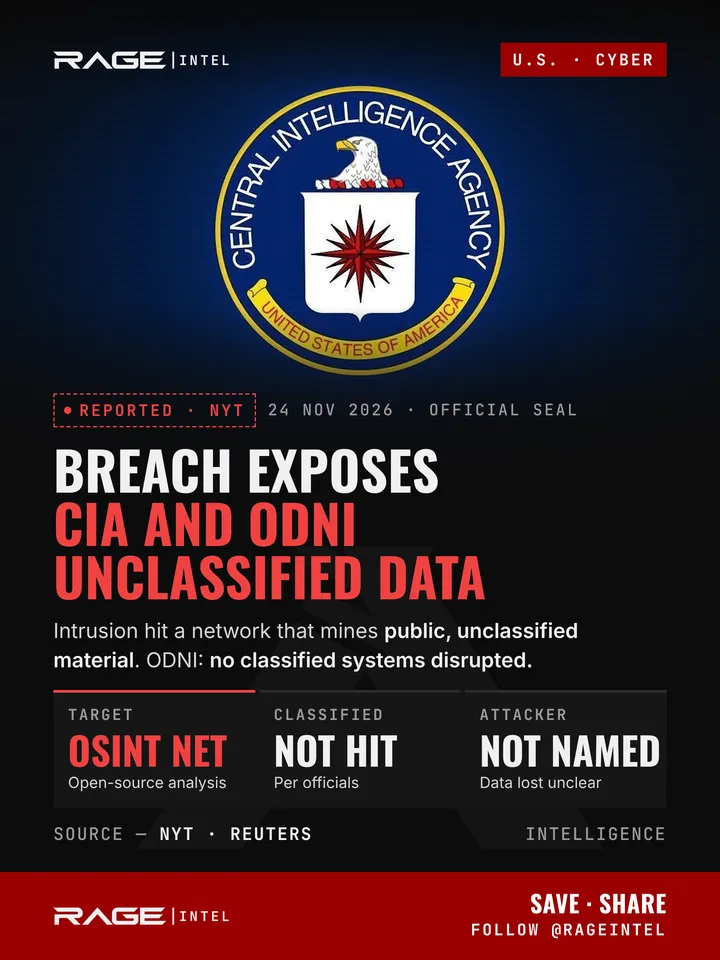
Breach Exposes CIA and ODNI Unclassified Data, New York Times Reports
A cyber intrusion exposed unclassified CIA and ODNI data, the New York Times reports. ODNI says classified systems were not disrupted. No attacker has been named.
2026-11-24 · 4 min read
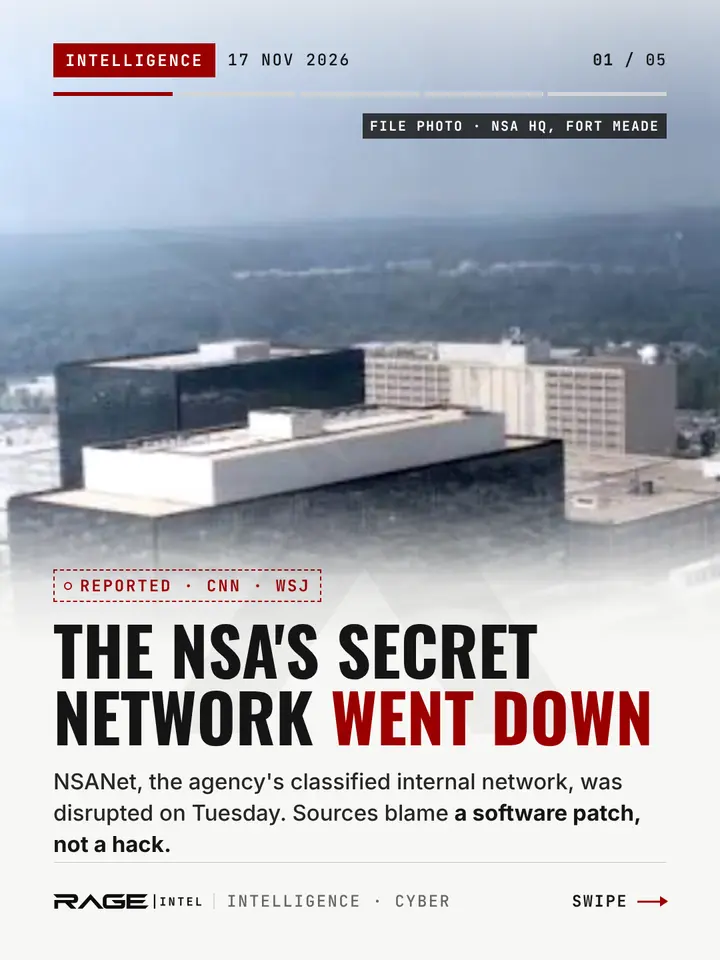
NSA's Classified Internal Network Goes Down: Sources Blame a Software Patch, Not a Cyberattack
The NSA's classified network NSANet went down. Sources say a software patch, with no evidence of a cyberattack. The sixth major outage in eight days.
2026-11-17 · 5 min read
Apple Blames an "Internal Update" for Tuesday's Outages and Says It Was Not a Cyberattack
Apple says an internal update caused Tuesday's iCloud and App Store outages, not a cyberattack. iCloud sign-in was still down. The fourth software failure this week.
2026-11-17 · 5 min read
Today's conflict risk
The daily RAGE INDEX scores global conflict risk across six theaters, with sources and forecasts.
Read the RAGE INDEXReach readers like these
RAGE X sells sponsored content across RAGE Intel, RAGE War and RAGE Global by proposal, always labelled as sponsored.
Request a campaign proposal