Cyber Breach Hits CIA, ODNI and NGA as Sources Point to AI Tool Artex and Possibly China
RAGE Global · United States · Cyber · Developing · 6 min read
Instagram carousel
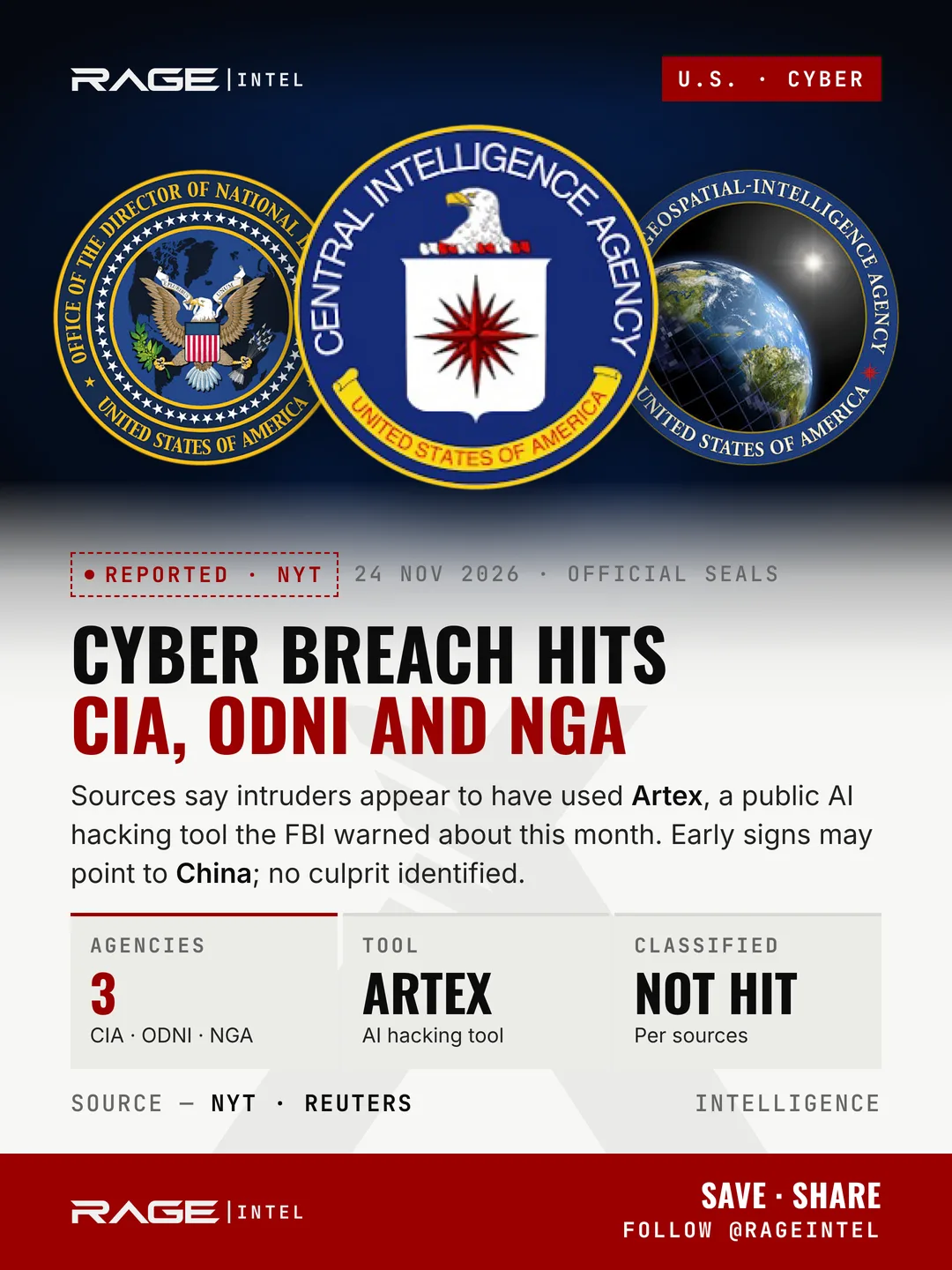
Published on Instagram with this story · swipe or use the arrow keys
The Central Intelligence Agency, the Office of the Director of National Intelligence (ODNI) and the National Geospatial-Intelligence Agency (NGA) recently discovered a breach that exposed some unclassified information, The New York Times reported on Tuesday 24 November 2026, citing U.S. officials and others familiar with the matter. Some sources said the intruders appear to have used Artex, a publicly available AI hacking tool that the FBI warned about this month. Two sources said early signs suggest China may be behind the intrusion. Investigators have not identified who is responsible, and the attribution is unconfirmed. This report updates our earlier story on the CIA and ODNI breach, which named two agencies; the Times now says three.
Key takeaways
- Three agencies: the CIA, ODNI and NGA. The NGA's inclusion is reported by the Times, and some outlets treat it as less settled than the CIA and ODNI findings.
- The target: an open-source intelligence analysis system that searches public material. Coverage describes it as a system for analysing public and commercial data.
- Classified material: not compromised, according to the Times' sources. An ODNI official told CNN there were no disruptions to critical capabilities or classified systems. What information was exposed is not clear.
- The tool: some sources said the hackers appear to have used Artex, an AI hacking framework the FBI warned about on 13 November. That assessment is unconfirmed.
- The attribution: no culprit is identified. Two sources said early signs suggest China may be behind it.
Confidence: REPORTED, from The New York Times and Reuters on anonymous sources; OFFICIAL only for the ODNI statement; CLAIM for the use of Artex and for any link to China, which are early indications that investigators have not confirmed. RAGE X has not independently confirmed the breach, the agencies involved, the tool or the attacker.
What was reported#
According to the Times, as carried by Reuters, the CIA, ODNI and NGA found an intrusion into a system that searches and analyses public material for intelligence value. The exposed information was unclassified. Sources told the Times that classified material was not compromised, and it is not clear what was taken. One anonymous source told the Times the breach has been resolved.
| Item | What is reported | Status |
|---|---|---|
| Agencies | CIA, ODNI and NGA | Reported |
| System | Open-source analysis system searching public and commercial material | Reported |
| Classified material | Not compromised, per the Times' sources | Reported |
| ODNI statement | No disruptions to critical capabilities or classified systems | Official (via CNN) |
| What was exposed | Unclear | Unknown |
| Tool used | Artex, per some sources | Claim |
| Attacker | Not identified; two sources say early signs point to China | Unconfirmed |
| Status | Resolved, per one anonymous source | Unconfirmed |
What Artex is#
Artex is an open-source AI framework that was built for penetration testing, the authorised testing of a network's defences. The FBI says criminals have repurposed it. According to the FBI's flash alert of 13 November, as described in secondary coverage by TechCrunch, The Record and others, it lets attackers automate parts of an intrusion, from reconnaissance through to data theft, and can break into some networks in under three hours.
Coverage of the alert says the FBI documented malicious use by multiple actors since at least August 2026, including campaigns against government and financial organisations. Reports cite incidents involving an IT management software company and South Korean banks, and say well over 1,000 public deployments of the tool exist. RAGE X has not seen the FBI alert itself and relies on that coverage for the details. The key point for this story is that Artex is not tied to one group. Because it is publicly available, evidence that it was used does not show who used it.
China: what is and is not said#
Two sources told the Times that early signs suggest China may be behind the breach. That is a statement about early indications, not a finding. Other coverage says some indicators point toward China but that investigators do not know who is responsible, and that it has not been established whether the Chinese government was involved. RAGE X has seen no official attribution. A publicly available tool that many actors can use makes attribution harder, not easier, and RAGE X draws no conclusion about China from the reporting so far.
What the agencies said#
- ODNI: an official told CNN there had been no disruptions to critical capabilities or classified systems. That addresses disruption and classified systems. It does not say what data was copied from the unclassified network.
- CIA: declined to comment on the earlier report.
- NGA: RAGE X found no on-the-record NGA statement in the coverage it reviewed.
The wider context#
The report comes after a week of U.S. government outages, including one affecting the NSA's classified network. Officials have said those outages were not cyberattacks. RAGE X covered the NSA network outage separately. Nothing in the reporting ties the outages to this breach.
It also follows the FBI's reported investigation into a suspected breach of its National Crime Information Center (NCIC) database. Sources cited by CNN say that NCIC breach does not appear to be connected to the CIA and ODNI intrusion. RAGE X has not been able to confirm the NCIC investigation from the sources it could check.
Why it matters#
- Unclassified is not harmless. The material on an open-source system is public, but what an analyst searches for, saves and annotates shows what U.S. agencies are watching. The reporting does not say whether any such data was taken.
- Three agencies, one tool. If the breach did reach three agencies through one analysis system, it shows how a shared unclassified platform can widen the exposure of the agencies that use it.
- AI-assisted intrusion. If Artex was used, it is an example of the FBI's warning in practice: an automated, publicly available tool lowering the effort needed to attack a government network.
What is known and not known#
| Question | Status |
|---|---|
| Were the CIA, ODNI and NGA hit? | Reported by the Times; not independently confirmed |
| Was classified material compromised? | Not, according to the Times' sources; ODNI says classified systems were not disrupted |
| What was exposed? | Unknown |
| Was Artex used? | Claim (some sources) |
| Is China responsible? | Unconfirmed; two sources cite early signs |
| Is the breach over? | Unconfirmed; one source says resolved |
| Is it linked to the FBI NCIC breach or the NSA outage? | No link established |
Questions answered#
Which agencies were breached? The CIA, ODNI and NGA, according to The New York Times. The NGA's inclusion is the newest part of the reporting.
Was classified information stolen? The Times' sources say classified material was not compromised. What was exposed from the unclassified system is not clear.
What is Artex? An open-source AI framework originally built for penetration testing that the FBI says criminals have repurposed to automate intrusions. It was the subject of an FBI flash alert on 13 November.
Did China do it? That is not established. Two sources said early signs suggest China may be behind it, and investigators have not identified who is responsible.
Is it connected to the NSA outage or the FBI breach? No link has been established. Officials have said the outages were not cyberattacks, and sources cited by CNN say the NCIC breach does not appear to be connected.
Our read · RAGE Intel assessment
The reporting has widened in a day, from two agencies to three and from an unnamed intruder to an unnamed intruder using a named tool. That is how early breach stories move, and each addition rests on anonymous sources. The part with the least weight is the attribution: early signs, from two sources, about an attack carried out with a tool that anyone can download.
What would change this reading is an official attribution, a statement from the NGA, or a description of what was taken. Until then the safest description is the narrow one: an intrusion into an unclassified open-source system, reaching more than one agency, with classified systems reportedly untouched.
This is an assessment, not a finding. It will change when officials attribute the intrusion or say what was accessed.
What to watch#
- Official statements: from the CIA, ODNI and NGA on what was accessed.
- Attribution: whether U.S. officials name an actor, and whether any link to China is confirmed or dropped.
- Artex: whether investigators publish evidence that the tool was used.
- The FBI: any update to its Artex guidance and to the NCIC investigation.
- Congress: requests for briefings from the intelligence committees.
This story is developing. RAGE X will update it as new information is confirmed.
Sources#
- Outlook India, CIA hacked: US spy agencies face AI cyberattack as Artex tool raises China fears, November 2026
- Gizmodo, U.S. spying agencies reportedly hacked, November 2026
- GBHackers, CIA and ODNI suffer cyberattack targeting intelligence analysis systems, November 2026
- Digest AI, CIA, ODNI systems breached via AI tool Artex, sources say, November 2026
- Reuters, US CIA, ODNI suffer cybersecurity breach of some unclassified information, NYT reports, 24 November 2026
- TechCrunch, FBI says Artex AI open source hacking tool used to breach networks in under three hours, 16 November 2026
- The Record, Artex AI tool FBI flash alert, November 2026
- BleepingComputer, FBI warns Artex AI hacking tool is powering global cyberattacks, November 2026
- The New York Times report and CNN's reporting on ODNI's statement, as cited in the coverage above; RAGE X could not open the originals from this session
The images on the carousel are the official seals of the three agencies, used as illustrations. Source check 25 November 2026.
Continue the assessment
Related Intelligence

Chinese Military Researchers Fear U.S. AI Could Help Find and Destroy China's Nuclear Missiles
A New York Times review of 100+ Chinese studies finds PLA researchers fear U.S. AI could find and hit China's missiles and cut nuclear decision time to 90 seconds.
2026-11-24 · 6 min read

Nvidia Reinstates Jensen Huang as CEO 11 Days After He Resigned, With New National Security Guardrails
Nvidia's board unanimously reinstated Jensen Huang as CEO, 11 days after he resigned. The probe continues, a new national security committee is added, and shares jumped.
2026-11-23 · 7 min read

NVIDIA Opens Investigation Into CEO Jensen Huang After Reports He Was Targeted by Chinese Intelligence
Nvidia's board opened an independent probe after reports CEO Jensen Huang was targeted by Chinese intelligence. He admitted an affair; claims are unproven.
2026-11-08 · 5 min read
Today's conflict risk
The daily RAGE INDEX scores global conflict risk across six theaters, with sources and forecasts.
Read the RAGE INDEXReach readers like these
RAGE X sells sponsored content across RAGE Intel, RAGE War and RAGE Global by proposal, always labelled as sponsored.
Request a campaign proposal