Drone Warfare: How Unmanned Systems Changed Modern Conflict
RAGE Global · Guide · Updated 2026-10-21 · 15 min read
Drone warfare has moved from the margins of military planning to the center of how wars are fought. In little more than two decades, unmanned systems have evolved from a handful of expensive surveillance aircraft operated by a few advanced militaries into millions of cheap, expendable machines produced each year and used by states and armed groups alike. This guide traces that transformation, from the first armed Predator strike to the FPV drone war in Ukraine, and examines the defenses, laws and technologies that will shape what comes next.
Key takeaways
- The first combat missile fired by a Predator drone was launched on 7 October 2001, the opening night of the US-led war in Afghanistan.
- The 2020 Nagorno-Karabakh war showed that a mid-sized military using Turkish and Israeli drones and loitering munitions could defeat legacy air defenses and armor.
- In Ukraine, drones are now produced in the millions: Kyiv reported 2.2 million produced in 2024, and Moscow said it planned nearly 1.4 million that year.
- Counter-drone defense is shifting toward layered systems combining electronic warfare, guns, interceptor drones and lasers such as Israel's Iron Beam.
- Autonomy and swarming raise unresolved legal and ethical questions, with 166 states voting for a UN General Assembly resolution on lethal autonomous weapons in December 2024.
From target drones to the Predator#
Early experiments#
The idea of an unmanned aircraft is almost as old as powered flight. During the First World War, the United States developed the Kettering Bug, an early aerial torpedo designed to fly a preset distance and dive onto its target, though it never saw combat. In the 1930s, Britain's de Havilland Queen Bee, a radio-controlled target aircraft for anti-aircraft gunnery practice, is often credited with giving unmanned aircraft the name "drone." For decades afterward, unmanned aircraft served mainly as targets, decoys and reconnaissance platforms.
Reconnaissance comes of age#
The Cold War expanded their role. The United States flew jet-powered reconnaissance drones over Southeast Asia, and Israel used small unmanned aircraft during the 1982 Lebanon war to locate Syrian air defenses in the Bekaa Valley, an operation that became a model for using drones to find and suppress enemy radars. These programs demonstrated a lasting principle: drones are most valuable when they help other weapons find their targets.
Arming the Predator#
The General Atomics Predator entered US service in the mid-1990s as an unarmed surveillance aircraft. According to the Wilson Center's account of the program, CIA Predator flights over Afghanistan in the fall of 2000 spotted Osama bin Laden but had no means of striking. The aircraft was fitted with Hellfire missiles, and on 7 October 2001, the night the war in Afghanistan began, a Predator crew fired the first missile launched in combat by a Predator. That moment marked the start of armed drone warfare as a routine instrument of state power.
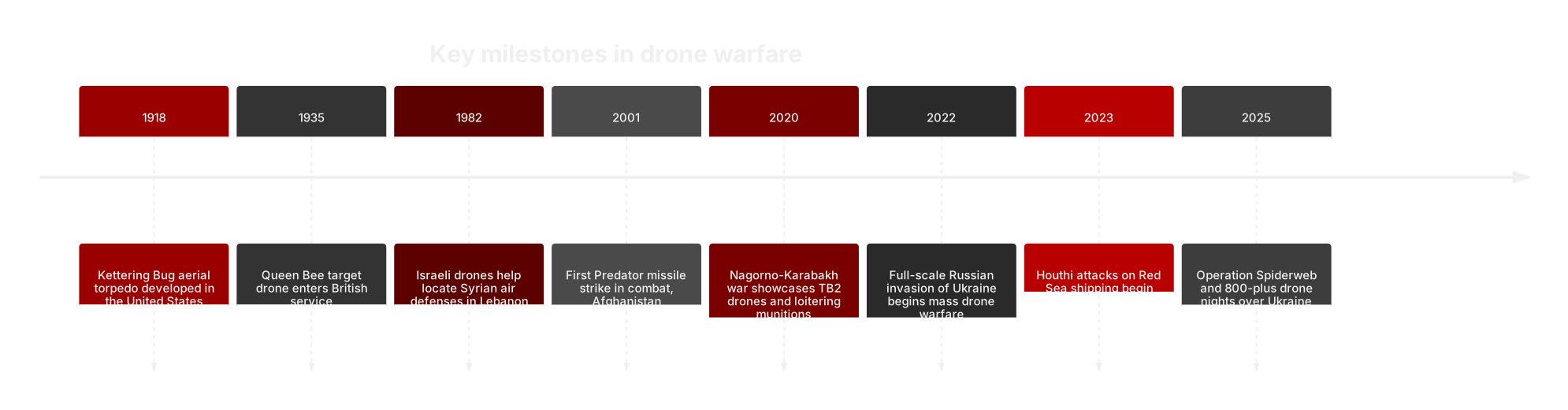
Chart: Selected milestones in the development of military drones. Sources: Wilson Center, CSIS, NPR, Baird Maritime; 2001–2025.
MALE drones and the remote war on terror#
What MALE means#
Medium-altitude long-endurance (MALE) drones, such as the US MQ-1 Predator and MQ-9 Reaper, the Turkish Bayraktar TB2 and the Chinese Wing Loong series, fly for many hours at medium altitude, carrying sensors and precision munitions. They are controlled by crews who may be thousands of kilometers away. Their defining strength is persistence: they can watch a target for long periods before a decision to strike is made.
Strengths and limits#
In Afghanistan, Iraq, Pakistan, Yemen, Somalia and Libya, MALE drones allowed the United States and its allies to conduct surveillance and targeted strikes without putting pilots at risk. That same convenience drew criticism over civilian casualties, transparency and the legal basis of strikes outside declared war zones. Militarily, MALE drones performed best in permissive airspace. Against modern air defenses they are vulnerable, a lesson reinforced when Houthi forces in Yemen shot down a number of US MQ-9s during the Red Sea crisis, according to US officials quoted in media reports.
Proliferation#
The Bayraktar TB2 changed the market. Cheaper than US systems and exported widely, it gave mid-sized militaries their own strike drone capability. Its use by Azerbaijan in 2020 and by Ukraine in the early weeks of the 2022 invasion made it one of the most recognized weapons of the decade.
Loitering munitions and Nagorno-Karabakh 2020#
The loitering munition#
A loitering munition combines a drone and a missile. It flies to an area, circles while searching for a target, then dives onto it and detonates. Systems such as Israel's Harop, the US Switchblade and Russia's Lancet sit between a reconnaissance drone and a guided missile in cost and capability. Iran's Shahed-136, a long-range one-way attack drone, follows a related logic: cheap enough to be launched in large numbers to saturate defenses.
The 44-day war#
The Second Nagorno-Karabakh War between Armenia and Azerbaijan began in late September 2020 and lasted 44 days, ending with a Russian-brokered truce on 10 November 2020. According to analysis by the Center for Strategic and International Studies (CSIS), Azerbaijan made extensive use of Turkish TB2 drones and Israeli loitering munitions, including the Harop, which were used early in the war against Armenian S-300 air defenses. Azerbaijan also reportedly converted Soviet-era An-2 biplanes to remote control and flew them toward the front to draw out Armenian air defenses.
Lessons for air defense#
CSIS concluded that the war's main lesson was the need for full-spectrum air defense. Armenia's older systems struggled to engage TB2s flying above their reach, and both sides lacked sufficient short-range air defense. Forces in the open, poorly camouflaged and massed together, were exposed to drone-directed strikes. The authors cautioned that no single system revolutionized warfare; rather, the coordinated use of drones, artillery and suppression of air defenses made the battlefield far more lethal. Open-source analysts, including those cited by CSIS, documented heavy Armenian losses of tanks, artillery and air-defense systems through drone footage, although precise totals remain contested.
| Drone category | Typical examples | Main role | Relative unit cost |
|---|---|---|---|
| MALE drone | MQ-9 Reaper, Bayraktar TB2, Wing Loong | Persistent surveillance and precision strike | High |
| Loitering munition | Harop, Switchblade, Lancet | Search and attack a target, then self-destruct | Medium |
| Long-range one-way attack drone | Shahed-136 / Geran-2 | Strike infrastructure and saturate defenses | Low to medium |
| FPV attack drone | Commercial-derived quadcopters with warheads | Tactical strikes on troops and vehicles | Very low |
| Small reconnaissance quadcopter | DJI Mavic and similar | Spotting, artillery correction, surveillance | Very low |
| Uncrewed surface vessel | Ukrainian naval drones, Houthi explosive boats | Attack ships and coastal targets | Low to medium |
Table: Main categories of military unmanned systems. Sources: CSIS, RUSI and open-source reporting; 2020–2025.
Ukraine: the first mass drone war#
FPV drones at the front#
The Russia–Ukraine war turned drone warfare from a specialist capability into a mass phenomenon. First-person-view (FPV) drones, small quadcopters often built from commercial components and flown by an operator wearing video goggles, became a standard infantry weapon. They are cheap enough to be expended by the thousand and precise enough to hit a vehicle hatch or a trench. Ukraine's Commander-in-Chief Oleksandr Syrskyi said in February 2025 that strike drones of various types were responsible for 66 percent of Russian equipment losses in January 2025, a claim that, while not independently verifiable, reflects how central drones have become to the fighting.
Electronic warfare and fiber-optic drones#
The scale of drone use triggered an intense contest in electronic warfare. Both sides deployed jammers to sever radio links between operators and drones, which in turn drove innovation in frequency-hopping, autonomous terminal guidance and fiber-optic control. Fiber-optic FPV drones trail a thin cable back to the operator, making them immune to radio jamming, at the cost of range and maneuverability. This cycle of measure and countermeasure now runs in weeks rather than years.
Long-range strikes and Operation Spiderweb#
Both sides also use drones for deep strikes. Russia has launched waves of Shahed-type drones, produced domestically as the Geran-2, at Ukrainian cities and energy infrastructure. On 7 September 2025, Ukraine's Air Force reported that Russia launched 805 drones and decoys and 13 missiles in a single night, at the time the largest aerial attack of the war, with 747 drones and 4 missiles reported intercepted. Ukraine, for its part, has struck refineries, airfields and military sites deep inside Russia. On 1 June 2025, the Security Service of Ukraine (SBU) carried out Operation Spiderweb, launching 117 small drones from trucks driven close to Russian air bases. The SBU claimed hits on 41 aircraft; independent assessments based on satellite imagery and US officials quoted by Reuters indicated a smaller but still significant number of strategic bombers destroyed or damaged. Russia's Ministry of Defense called the operation a terrorist attack and acknowledged damage to aircraft at some bases.
Production at industrial scale#
Both governments now report drone production in numbers once associated with artillery shells. The figures below are official claims or targets and should be read as such; independent verification of military production is rarely possible.
| Country | Year | Reported figure | Source of claim |
|---|---|---|---|
| Russia | 2023 | About 140,000 drones delivered to the armed forces | President Vladimir Putin, September 2024 |
| Russia | 2024 | Nearly 1.4 million drones planned | Putin, September 2024, as reported |
| Ukraine | 2024 | 2.2 million drones produced | President Volodymyr Zelensky, early 2025 |
| Ukraine | 2024 | Over 1.3 million drones delivered to front-line troops | Commander-in-Chief Oleksandr Syrskyi, early 2025 |
| Ukraine | 2025 | About 4 million robotic and autonomous systems (estimate) | Council on Foreign Relations, as cited by Defence Blog |
| Ukraine | 2026 | "10 million drones a year" production rate | Zelensky, July 2026 |
Table: Government-reported drone production figures and estimates. Sources: Kremlin statements via DroneXL, Business Insider, Defence Blog; 2024–2026.
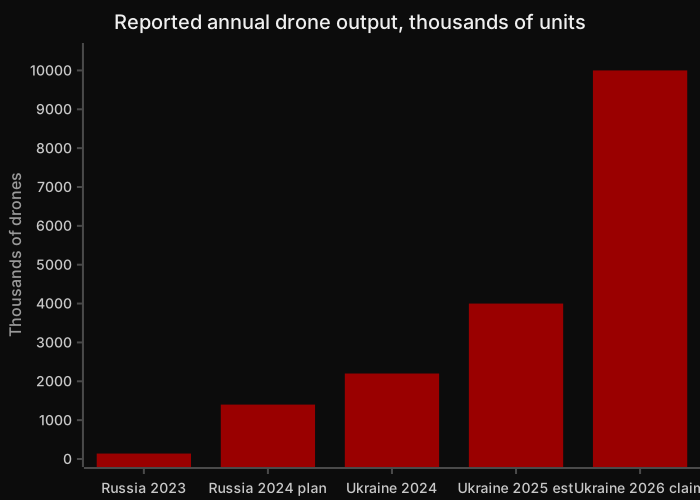
Chart: Reported drone production by Russia and Ukraine. Sources: Putin (September 2024), Zelensky (early 2025 and July 2026), CFR estimate cited by Defence Blog (2025); figures are official claims or estimates, not verified output.
The Red Sea and the spread of drones to non-state actors#
The Houthi campaign#
Drone warfare is not limited to states. Beginning in November 2023, Yemen's Houthi movement, which said it was acting in solidarity with Palestinians in Gaza, attacked commercial shipping in the Red Sea and Gulf of Aden with drones, missiles and remote-controlled explosive boats. The group seized the car carrier Galaxy Leader on 19 November 2023; its 25 crew were released in January 2025. According to a Baird Maritime summary of the campaign, the Houthis targeted more than 100 merchant ships, sank four vessels (the Rubymar in March 2024, the Tutor in June 2024, and the Magic Seas and Eternity C in July 2025) and killed at least eight seafarers.
The international response#
The United States launched Operation Prosperity Guardian in December 2023 to protect shipping, and US and UK forces conducted strikes on Houthi targets in 2024 and 2025. In May 2025, Oman announced a ceasefire between the United States and the Houthis covering attacks on US vessels, though the group continued to threaten other shipping and sank two ships in July 2025. The campaign showed how relatively cheap drones and missiles can disrupt a major global trade route and force navies to expend costly interceptors.
A wider pattern#
The Houthi case is part of a broader trend. Non-state groups across the Middle East, Africa and elsewhere use commercial quadcopters for surveillance and improvised attacks, and some have access to state-supplied long-range drones. The Institute for Economics and Peace reported in its 2026 Global Peace Index that drone attacks worldwide rose by more than 11,500 percent between 2018 and 2025, a measure of how quickly the technology has diffused.
Counter-drone systems#
The cost-exchange problem#
The central challenge of counter-drone defense is economic. Shooting down a drone that costs a few thousand or tens of thousands of dollars with a missile that costs hundreds of thousands or millions is unsustainable in a long war. Defenders therefore seek cheaper means of defeat, and attackers exploit the imbalance by launching decoys alongside real drones to drain interceptor stocks.
A layered approach#
Modern counter-drone defense is layered. Detection relies on radar, radio-frequency sensors, acoustic sensors and optical cameras. Defeat options include electronic warfare to jam or spoof control and navigation signals; guns, including mobile anti-aircraft cannon and machine guns with smart ammunition; surface-to-air missiles for larger threats; and interceptor drones designed to ram or explode near attackers. Ukraine has fielded mobile fire groups with machine guns and searchlights against Shahed-type drones and has invested heavily in interceptor drones.
Directed energy#
Lasers promise a very low cost per shot. On 17 September 2025, Israel's Ministry of Defense and Rafael announced that the high-power Iron Beam laser system had completed development and final testing, with delivery to the Israel Defense Forces expected by the end of 2025. Defense Minister Israel Katz described it as offering fast, precise interception at marginal cost. Lasers face limits in bad weather and against large salvos, but they point toward a future in which drone defense is powered by electricity rather than magazines.
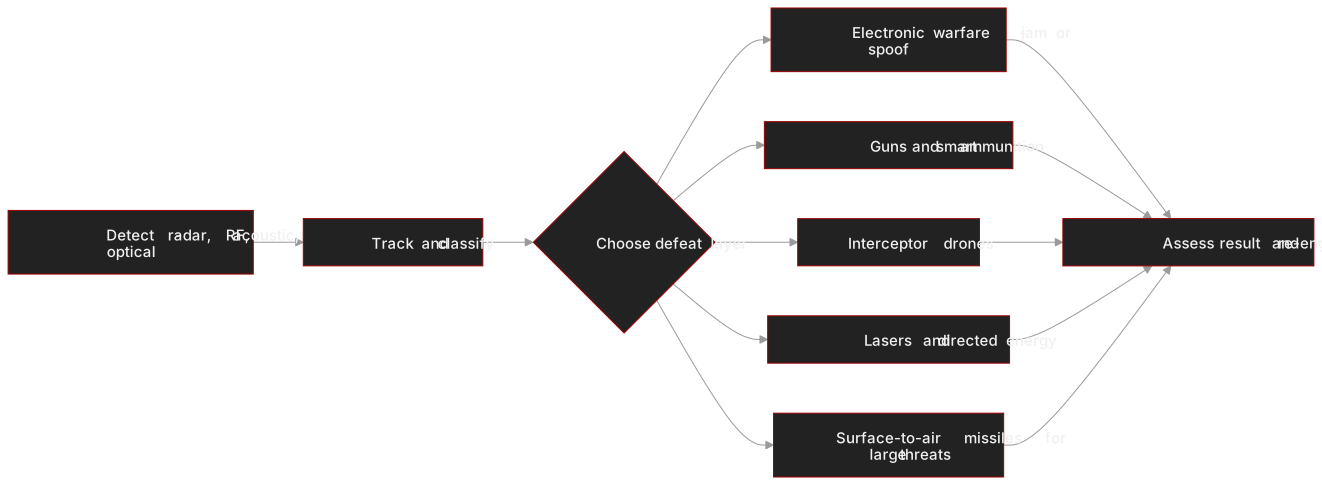
Chart: A layered counter-drone engagement chain. Sources: CSIS (2020), Israeli Ministry of Defense via Times of Israel (2025), RAGE X analysis.
Ethics, law and accountability#
International humanitarian law#
Drones are not illegal in themselves. Their use is governed by the same rules of international humanitarian law that apply to any weapon: distinction between combatants and civilians, proportionality in attack, and precautions to minimize civilian harm. Critics of the US targeted-killing program argued that strikes outside recognized battlefields stretched the legal basis for the use of force, while supporters argued that drones' precision and persistence could reduce civilian harm compared with other airpower when used carefully.
Autonomous weapons at the UN#
The more difficult debate concerns autonomy. As drones gain the ability to identify and engage targets without real-time human control, states are debating whether new rules are needed. Talks have taken place for years within the Convention on Certain Conventional Weapons in Geneva. In the UN General Assembly, a first resolution on lethal autonomous weapons systems passed in December 2023 with 152 votes in favor, 4 against and 11 abstentions. A follow-up resolution on 2 December 2024 drew 166 votes in favor, 3 against and 15 abstentions, according to Human Rights Watch. The UN Secretary-General has repeatedly called for negotiations on a legally binding instrument to be concluded urgently.
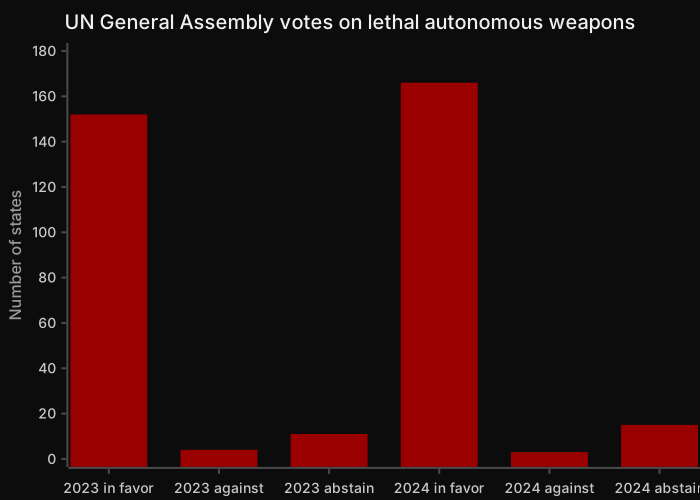
Chart: Votes on UN General Assembly resolutions on lethal autonomous weapons systems. Source: Human Rights Watch, December 2024.
Accountability and escalation#
Beyond law, drones raise questions of accountability and escalation. Remote and autonomous systems can lower the political cost of using force, making strikes more frequent. Attribution can be difficult when cheap drones are launched by proxies. And the compression of decision times, which the 2026 Global Peace Index described as AI cutting target identification and attack decisions from more than a day to seconds, leaves less room for human judgment and de-escalation.
The future: swarms, autonomy and AI#
Mass and attritable systems#
Militaries are drawing the conclusion that mass matters again. In August 2023, then US Deputy Secretary of Defense Kathleen Hicks announced the Replicator initiative, aiming to field thousands of small, cheap, autonomous systems across multiple domains within 18 to 24 months, explicitly to counter China's military advantages in mass. European militaries, Taiwan and others are pursuing similar programs, often learning directly from Ukraine's experience.
Swarming and autonomy#
A drone swarm is a group of unmanned systems that coordinate their behavior with limited human input, sharing information and dividing tasks. True large-scale autonomous swarms remain largely experimental, but elements are already appearing: autonomous terminal guidance that lets a drone complete an attack after losing its link, AI-assisted target recognition, and software that lets one operator control several drones. As jamming intensifies, the military incentive to give drones more autonomy will grow.
Beyond the air#
Unmanned systems are spreading to every domain. Ukraine's naval drones have struck Russian warships in the Black Sea, ground robots are being used for logistics and casualty evacuation, and underwater drones are being developed for surveillance of seabed infrastructure. The battlefield of the 2030s is likely to feature unmanned systems at every level, from the individual soldier's quadcopter to long-range autonomous strike aircraft.
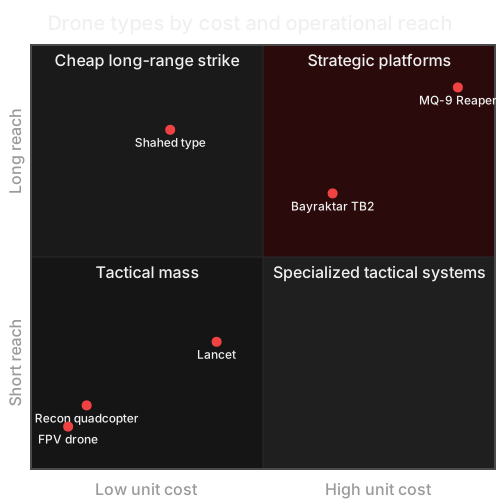
Chart: Approximate positioning of drone types by unit cost and range. Source: RAGE X analysis of open-source reporting, 2025–2026.
Frequently asked questions#
What is drone warfare?#
Drone warfare is the use of unmanned systems, mainly aircraft but increasingly also surface vessels and ground robots, for reconnaissance, targeting and attack in armed conflict. It ranges from long-endurance aircraft like the MQ-9 Reaper flown by crews far from the battlefield to small FPV quadcopters guided by soldiers at the front. Drones lower the risk to operators and can be far cheaper than manned aircraft, which is why both states and non-state armed groups have adopted them so widely since the early 2000s.
When was the first drone strike?#
Unmanned aircraft have been used in war since the twentieth century, mainly as targets, decoys and reconnaissance platforms. The first missile fired in combat by an armed Predator drone was launched on 7 October 2001, the night the US-led war in Afghanistan began, according to the Wilson Center. That strike is widely seen as the beginning of the modern era of armed drone warfare, which later expanded to Iraq, Pakistan, Yemen, Somalia and other theaters.
What is a loitering munition?#
A loitering munition is a weapon that combines features of a drone and a missile. After launch it flies to a target area, circles while searching with its sensors, and then dives onto a target and explodes. Examples include the Israeli Harop, the US Switchblade and the Russian Lancet. Loitering munitions were used extensively by Azerbaijan in the 2020 Nagorno-Karabakh war and by both sides in the Russia–Ukraine war, where they target artillery, air defenses and armored vehicles.
How many drones does Ukraine produce?#
Ukrainian officials have reported rapidly rising output. President Zelensky said Ukraine produced 2.2 million drones in 2024, and in July 2026 he said the country was making 10 million drones a year. The Council on Foreign Relations has estimated about 4 million robotic and autonomous systems in 2025. These figures are government claims or external estimates rather than independently audited production data, and they include many types, from small FPV drones to long-range strike drones.
How are drones shot down?#
Drones are defeated through a layered system. Sensors such as radar, radio-frequency detectors, acoustic arrays and cameras first detect and track them. Defenders then use electronic warfare to jam or spoof control and navigation signals, guns and smart ammunition for close-range kills, interceptor drones that ram or detonate near targets, and missiles for larger threats. Lasers such as Israel's Iron Beam, declared ready for service in September 2025, aim to cut the cost per interception dramatically.
Are autonomous killer drones legal?#
There is currently no specific treaty banning lethal autonomous weapons, so their use is governed by existing international humanitarian law, which requires distinction, proportionality and precautions in attack. Many states and civil society groups argue new rules are needed to ensure meaningful human control. In December 2024, 166 states voted for a UN General Assembly resolution on lethal autonomous weapons systems, and the UN Secretary-General has called for urgent negotiations on a legally binding instrument.
The RAGE X view#
Drone warfare has not made other weapons obsolete, but it has changed the arithmetic of modern conflict. Cheap, expendable systems now challenge expensive platforms, air defenses and navies; production capacity and software iteration speed have become strategic assets; and the line between state and non-state military power has blurred. The experience of Nagorno-Karabakh, Ukraine and the Red Sea points to a consistent conclusion: forces that cannot detect, defeat and field drones at scale will struggle against those that can.
The next phase will be defined by autonomy, electronic warfare and the economics of defense, and by whether international law can keep pace. RAGE X tracks these developments through daily coverage on RAGE Intel and monitors how drone-intensive conflicts shift overall violence levels through the live conflict-intensity reading of RAGE INDEX.
Sources#
- Wilson Center. "Armed Drones Revolutionized Airpower." https://www.wilsoncenter.org/article/armed-drones-revolutionized-airpower
- Shaikh, S. and Rumbaugh, W. "The Air and Missile War in Nagorno-Karabakh: Lessons for the Future of Strike and Defense." CSIS, 8 December 2020. https://www.csis.org/analysis/air-and-missile-war-nagorno-karabakh-lessons-future-strike-and-defense
- NPR. "Russia assaults Ukraine with over 800 drones and decoys, the largest such attack in the war." 7 September 2025. https://npr.org/2025/09/07/nx-s1-5533036/russia-assaults-ukraine-800-drones-largest-attack-war
- Ukrainska Pravda. "Drones caused 66% of Russian equipment losses in January, Ukraine's commander-in-chief says." 6 February 2025. https://www.pravda.com.ua/eng/news/2025/02/6/7496997/
- Operation Spiderweb overview with sourced damage assessments. https://en.wikipedia.org/wiki/Operation_Spiderweb
- DroneXL. "Russia Ramps Up Drone Production Tenfold for Ukraine War." 23 September 2024. https://dronexl.co/2024/09/23/russia-ramps-up-drone-production-tenfold-for-ukraine-war
- Business Insider via Yahoo News. "Ukraine says it's taken the top spot in the race to make combat drones." https://www.yahoo.com/news/ukraine-says-taken-top-spot-103649581.html
- Defence Blog. "Ukraine's drone output hits 10 million a year, Zelenskyy says." July 2026. https://defence-blog.com/?p=98411
- Baird Maritime. "Factbox: Summary of Houthi attacks on merchant ships in the Red Sea." https://www.bairdmaritime.com/security/incidents/piracy/factbox-summary-of-houthi-terror-attacks-on-merchant-ships-in-the-red-sea
- Arab News. "Oman announces US-Houthi ceasefire deal." May 2025. https://www.arabnews.com/node/2599767/middle-east
- Times of Israel. "Laser-based Iron Beam interception system declared operational." 17 September 2025. https://www.timesofisrael.com/laser-based-iron-beam-interception-system-declared-operational/
- Human Rights Watch. "Killer Robots: UN Vote Should Spur Treaty Negotiations." 5 December 2024. https://www.hrw.org/news/2024/12/05/killer-robots-un-vote-should-spur-treaty-negotiations
- DefenseScoop. "Hicks unveils DOD's new Replicator initiative to counter China via autonomous tech." 28 August 2023. https://defensescoop.com/2023/08/28/hicks-unveils-dods-new-replicator-initiative-to-counter-china-via-autonomous-tech/
- Institute for Economics and Peace. Global Peace Index 2026 Report. https://www.visionofhumanity.org/wp-content/uploads/2026/06/Global-Peace-Index-2026-Report.pdf
About RAGE X: RAGE X is a global media, intelligence and technology organization working across geopolitical intelligence, military and conflict analysis, OSINT, global news, security and software. Learn more at theragex.com.
Continue the assessment
Related Intelligence
Drone Swarms in 2026: Technology, Doctrine, and Programs
Military drone swarm technology in 2026 — Drone Crucible demonstrations, swarm autonomy architectures, the Chinese ATLAS system, and counter-swarm defense.
2026-08-05 · 12 min read
Drone Swarms and Autonomy: Where the Line Actually Is
Most "AI swarm" claims describe automation, not autonomy. CSIS found no verifiable evidence Russian swarming has been fielded. What has been, and what hasn't.
2026-08-29 · 12 min read
Counter-Drone Warfare: Why Nobody Has Solved It
Jammers, guns, missiles, lasers, nets. Every counter-drone layer fails somewhere, and the ones that work lose the cost exchange. The honest scorecard.
2026-08-22 · 13 min read
Today's conflict risk
The daily RAGE INDEX scores global conflict risk across six theaters, with sources and forecasts.
Read the RAGE INDEXReach readers like these
RAGE X sells sponsored content across RAGE Intel, RAGE War and RAGE Global by proposal, always labelled as sponsored.
Request a campaign proposal