Nuclear Weapons in 2026: Arsenals, Doctrines and the Future of Arms Control
RAGE Global · Guide · Updated 2026-10-21 · 16 min read
Any serious assessment of nuclear weapons by country in 2026 starts from a stark fact: for the first time in more than half a century, the two largest arsenals on earth are not bound by any treaty. The Stockholm International Peace Research Institute (SIPRI) estimates that nine states held about 12,187 warheads in January 2026, and that the number of warheads available for use is rising again. This analysis sets out who holds what, how each state says it would use its weapons, and what the collapse of the arms control architecture means for global security.
Key takeaways
- SIPRI estimates a global inventory of about 12,187 nuclear warheads in January 2026, of which 9,745 are in military stockpiles and roughly 4,012 are deployed with operational forces.
- Russia (5,420) and the United States (5,042) together hold almost 86 percent of all warheads, but China is the fastest-growing arsenal, at about 620 warheads.
- New START expired on 5 February 2026 with no replacement, ending legally binding limits and inspections on US and Russian strategic forces.
- The 2026 NPT Review Conference ended on 22 May without a consensus final document, the third consecutive review conference to fail.
- The main risks are a three-way arms race, crisis escalation in regional conflicts and the erosion of the testing moratorium.
How many nuclear weapons exist in 2026?#
The most widely cited open-source estimate comes from the SIPRI Yearbook 2026, released in June 2026, which assesses world nuclear forces as of January 2026. SIPRI counts about 12,187 warheads in total. Of these, 9,745 sit in military stockpiles available for potential use, and about 4,012 are deployed on missiles or at bases with operational forces. The remaining 2,442 are retired warheads, almost all of them American and Russian, awaiting dismantlement.
The headline total fell slightly compared with a year earlier, but that decline is misleading. According to SIPRI, the reduction came only because Russia and the United States continue to dismantle retired warheads. The military stockpile, the number that actually matters for war planning, rose by about 130 warheads, and the number of deployed warheads rose by about 100. In other words, the long post-Cold War drawdown has ended and the usable global arsenal is growing again.
Deployed, stored and retired: why the categories matter#
Counting nuclear weapons is not a single number exercise. A deployed warhead is mounted on a missile or stored at an operational base and can be used quickly. A stored warhead sits in central storage and would need to be mated with a delivery system, which can take hours to weeks. Retired warheads are intact but scheduled for dismantlement. When analysts compare nuclear weapons by country, the military stockpile, deployed plus stored, is usually the most meaningful figure because it represents the force a state could bring to bear in a crisis.
Uncertainty in the estimates#
Every state except the United States treats much of its stockpile data as secret, and even Washington has disclosed less in recent years. The United Kingdom has stopped publishing its stockpile figures, and Israel has never confirmed that it possesses nuclear weapons at all. SIPRI's figures therefore combine official statements, budget documents, satellite imagery and historical records, and SIPRI describes them as approximate. Its January 2026 Russian estimate, for example, is about 4,400 stockpiled warheads, lower than the 4,600 cited by US Strategic Command.
Nuclear weapons by country: the nine arsenals#
The table below sets out SIPRI's January 2026 estimates for all nine nuclear-armed states. A dash indicates nil or negligible numbers.
| State | Deployed warheads | Stored warheads | Military stockpile | Retired warheads | Total inventory |
|---|---|---|---|---|---|
| Russia | 1,796 | 2,604 | 4,400 | 1,020 | 5,420 |
| United States | 1,770 | 1,930 | 3,700 | 1,342 | 5,042 |
| China | 34 | 586 | 620 | – | 620 |
| France | 280 | 10 | 290 | 80 | 370 |
| United Kingdom | 120 | 105 | 225 | – | 225 |
| India | 12 | 178 | 190 | n/a | 190 |
| Pakistan | – | 170 | 170 | n/a | 170 |
| Israel | – | 90 | 90 | n/a | 90 |
| North Korea | – | 60 | 60 | n/a | 60 |
| Total | 4,012 | 5,733 | 9,745 | 2,442 | 12,187 |
Source: SIPRI Yearbook 2026, World Nuclear Forces, estimates as of January 2026.
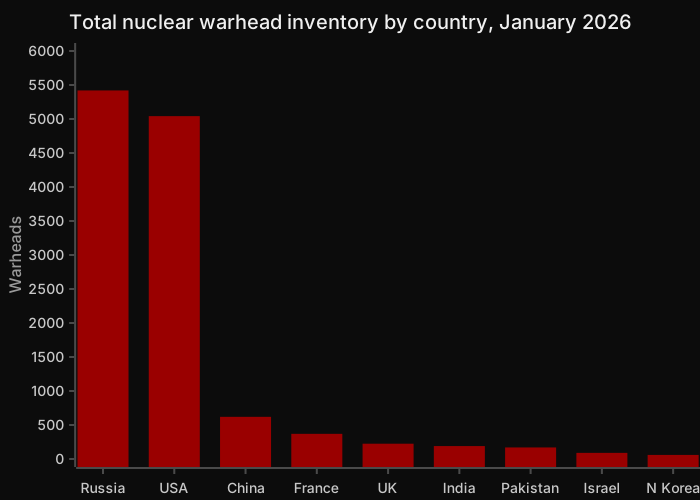
Chart: total warhead inventories of the nine nuclear-armed states. Data: SIPRI Yearbook 2026 (January 2026 estimates).
Russia and the United States#
Russia and the United States remain in a category of their own. SIPRI estimates that together they hold about 83 percent of stockpiled warheads and almost 86 percent of all warheads. Both maintain full nuclear triads of land-based intercontinental ballistic missiles (ICBMs), submarine-launched ballistic missiles and long-range bombers, and both are in the middle of expensive, multi-decade modernization programs. SIPRI assessed the US stockpile as relatively stable, while its higher Russian estimate reflects a reassessment rather than a confirmed surge in production.
The middle tier: China, France and the United Kingdom#
China, with about 620 warheads, now holds a larger arsenal than France and the United Kingdom combined. France's stockpile is stable at about 290, with up to 80 retired TN 75 warheads awaiting dismantlement, although SIPRI expects planned new Rafale squadrons by 2035 to push the number up. The United Kingdom's stockpile did not grow in 2025, but London has raised its cap to 260 warheads and no longer publishes stockpile figures, which makes any increase difficult to verify.
The regional powers: India, Pakistan, Israel and North Korea#
India's stockpile grew slightly to about 190, and SIPRI judges that India may have begun deploying around 12 warheads on a ballistic missile submarine, a step toward a more ready sea-based deterrent. Pakistan is stable at about 170 warheads but is developing a nascent triad and continuing fissile material production, which SIPRI expects to drive growth over the next decade. Israel, which maintains a policy of deliberate ambiguity, is estimated to hold about 90 warheads and to be modernizing its arsenal. North Korea has assembled about 60 warheads and, according to SIPRI, has enough fissile material for at least 90.
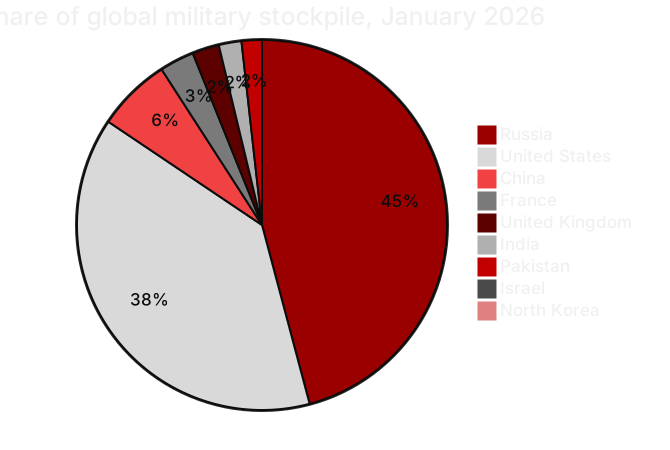
Chart: share of the 9,745 warheads in military stockpiles. Data: SIPRI Yearbook 2026 (January 2026 estimates).
Nuclear doctrines: how states say they would use the bomb#
Warhead counts describe capability. Doctrine describes intent, and in a crisis it is doctrine that shapes how an adversary reads signals and movements. The nine states differ sharply on whether they would ever use nuclear weapons first, what threats would justify use, and how ready their forces are kept.
| State | Declared posture | First-use policy | Notes |
|---|---|---|---|
| United States | Deterrence of nuclear and significant non-nuclear strategic attack | No no-first-use pledge | Extended deterrence to NATO, Japan, South Korea and Australia |
| Russia | Deterrence of aggression against Russia and allies | Retains first use | 2024 doctrine update widened conditions for use |
| China | Minimum deterrence, retaliation | No first use, declared since 1964 | Moving toward higher readiness and early warning |
| France | Protection of "vital interests" | Retains first use (final warning concept) | Has offered dialogue on a European dimension |
| United Kingdom | Minimum credible deterrence | Deliberate ambiguity | Single sea-based system, assigned to NATO |
| India | Credible minimum deterrence | No first use, with exceptions for chemical or biological attack | Massive retaliation pledge |
| Pakistan | Full-spectrum deterrence | Retains first use | Short-range systems to counter conventional threats |
| Israel | Opacity | Undeclared | Neither confirms nor denies |
| North Korea | Nuclear status enshrined in law and constitution | Retains first use | Preemptive use authorized under 2022 law |
Source: compiled by RAGE X from official doctrines and SIPRI Yearbook reporting; positions as publicly stated.
Russia's widened threshold#
Russia's November 2024 revision of its nuclear deterrence policy stated that aggression against Russia by a non-nuclear state with the participation or support of a nuclear state would be treated as a joint attack, and it extended nuclear protection to Belarus. Western governments read the update as a signal aimed at states supplying long-range weapons to Ukraine. Combined with repeated nuclear rhetoric since 2022, it has lowered confidence that Moscow's threshold is as high as its earlier doctrine implied.
China's no-first-use pledge under strain#
China remains the only nuclear-weapon state recognized under the Non-Proliferation Treaty (NPT) with an unconditional no-first-use pledge. Beijing argues that its expansion is consistent with that pledge because it aims only to secure a survivable second strike. Analysts in Washington counter that larger, more ready forces, including the early warning counterstrike capability described by the Pentagon, blur the line between retaliation and launch under attack.
South Asia's compressed escalation ladder#
India and Pakistan are the only two nuclear-armed neighbors that have fought repeated conventional clashes in the nuclear era, most recently in May 2025. Pakistan's emphasis on short-range systems to offset India's conventional advantage, set against India's pledge of massive retaliation, creates an escalation ladder with very few rungs. Each new crisis tests whether diplomatic intervention can arrive before either side feels compelled to escalate.
The end of New START and what followed#
The New Strategic Arms Reduction Treaty, signed in 2010 and extended once in 2021, expired on 5 February 2026. It had capped each side at 1,550 deployed strategic warheads and 700 deployed launchers, and its inspection and data-exchange regime gave both countries rare insight into the other's forces. Russia had already suspended its participation in February 2023, halting inspections, but until expiry both sides said they were observing the central limits.
Competing proposals#
In September 2025 President Vladimir Putin proposed that both sides voluntarily observe the treaty's central limits for one further year after expiry, provided Washington did the same. According to Reuters reporting from February 2026, President Donald Trump rejected that proposal, saying he wanted a "new and better" agreement and that any future deal should include China. Russia's Foreign Ministry called the US approach "erroneous and regrettable." China described the expiry as regrettable, and UN Secretary-General António Guterres called it a "grave moment" for international peace and security.
A self-declared moratorium#
On 11 February 2026, Foreign Minister Sergei Lavrov told the State Duma that Russia would continue to observe the treaty's warhead and launcher limits "only as long as the United States doesn't exceed the said limits." That leaves restraint dependent on unilateral, unverifiable declarations. In October 2026, Kremlin spokesman Dmitry Peskov described the absence of a treaty framework as "extremely dangerous" and said any future talks must account for British and French forces, according to Russian state media. President Trump has said he is open to discussing nuclear disarmament with Presidents Putin and Xi Jinping, and Secretary of State Marco Rubio has said Washington will press for trilateral talks. As of late October 2026, no formal negotiations had been announced.
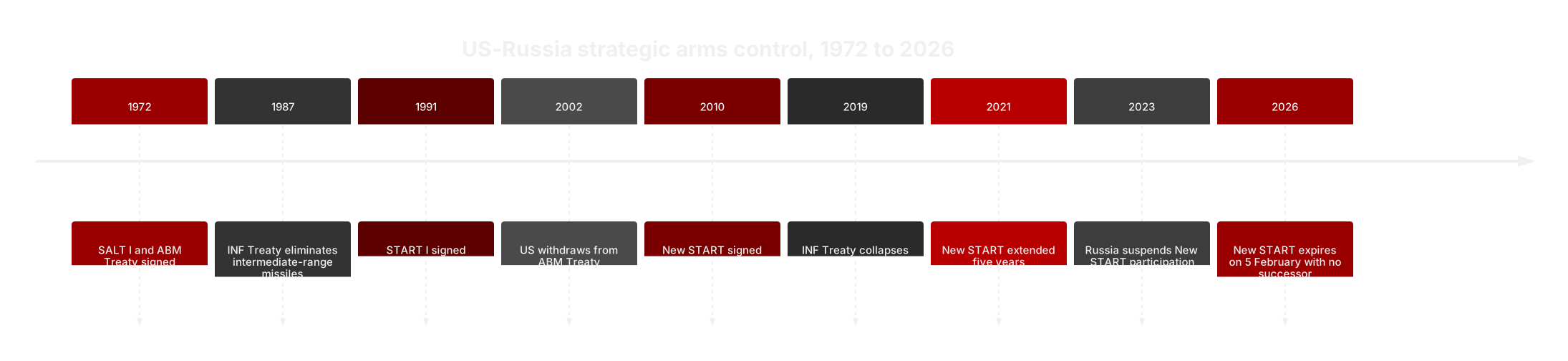
Chart: milestones in US-Russia strategic arms control. Data: US State Department and SIPRI records; New START expiry confirmed by Reuters, February 2026.
Why verification matters more than numbers#
The loss of numerical caps has not, at least yet, produced a sudden surge in deployed warheads. The larger loss is transparency. Without data exchanges and inspections, each side must rely on national technical means and worst-case planning. Both the United States and Russia retain large numbers of stored warheads that could be uploaded onto existing missiles, which means either could increase deployed forces faster than the other could confirm. That "upload potential" is likely to drive planning assumptions in both capitals for years.
China's nuclear buildup#
China is the most important variable in the nuclear balance. SIPRI estimates that its stockpile grew from about 600 to about 620 warheads in the year to January 2026, a slower increase than in previous years but part of a sustained expansion. SIPRI also notes that China now has more ICBM launchers than either Russia or the United States, and that it may have deployed up to 34 warheads with forces, although that figure is uncertain.
What the Pentagon reports#
The US Department of Defense's China Military Power Report, released on 23 December 2025, said China's stockpile "remained in the low 600s through 2024, reflecting a slower rate of production," but that China "remains on track to have over 1,000 warheads by 2030." The report stated that China has likely loaded more than 100 solid-propellant ICBM silos across its three silo fields. The Federation of American Scientists (FAS) noted that its own satellite analysis had not yet corroborated that silo-loading claim.
From minimum deterrent to near-peer#
The scale of China's investment matters for arms control as much as the number of warheads. A force of more than 1,000 warheads, a functioning triad, possible continuous ballistic missile submarine patrols and an early warning system able to detect launches within about 90 seconds, as described by the Pentagon, would put China in a different category from the minimum deterrent it maintained for decades. For Washington, this raises the problem of deterring two near-peer nuclear competitors at once. For Moscow, it complicates any bilateral deal that ignores Beijing. Beijing, for its part, has consistently declined trilateral talks, arguing that its arsenal remains a fraction of those of Russia and the United States.
The NPT, the TPNW and the multilateral regime#
The 1970 Treaty on the Non-Proliferation of Nuclear Weapons remains the foundation of the global nuclear order. It recognizes five nuclear-weapon states (the United States, Russia, China, France and the United Kingdom) and commits all parties to pursue disarmament in good faith. India, Pakistan and Israel never joined, and North Korea announced its withdrawal in 2003.
A third failed review conference#
The 2026 NPT Review Conference met at UN headquarters in New York for about four weeks and ended on 22 May 2026 without a consensus final document. The chair, Vietnam's UN ambassador Do Hung Viet, did not put the draft to a vote after weeks of revisions. According to Jiji Press reporting, a phrase urging Iran not to pursue nuclear weapons remained unresolved until the final day, as negotiations involving the United States and Iran continued. It was the third consecutive review conference, after 2015 and 2022, to end without agreement. The next is scheduled for 2031.
The Treaty on the Prohibition of Nuclear Weapons#
The Treaty on the Prohibition of Nuclear Weapons (TPNW) entered into force on 22 January 2021 and bans the development, possession and use of nuclear weapons outright. According to the International Campaign to Abolish Nuclear Weapons, it has 95 signatories and 74 states parties. No nuclear-armed state and no NATO member has joined. Supporters argue that the TPNW reinforces the norm against use and gives non-nuclear states a voice. Critics, including the nuclear powers, argue that it does not address the security conditions that sustain deterrence.
Iran and the proliferation question#
Iran has been the most acute proliferation challenge of the past two years. Following US and Israeli strikes on Iranian nuclear sites in 2025, the United States and Israel launched a wider air campaign against Iran on 28 February 2026, according to the UK House of Commons Library. A memorandum of understanding signed by Washington and Tehran on 17 June 2026 set out talks covering nuclear inspections and the disposal of enriched material. The fate of Iran's enriched uranium stockpile, and whether international inspectors regain full access, remains one of the most consequential open questions for the NPT.
Nuclear risks in 2026#
The risk picture combines old dangers with new ones. The most immediate is miscalculation in a conventional conflict involving a nuclear-armed state, whether in Ukraine, South Asia, the Korean Peninsula or the Taiwan Strait. Each of these theaters features forces in close contact, compressed decision times and adversaries with limited direct communication.
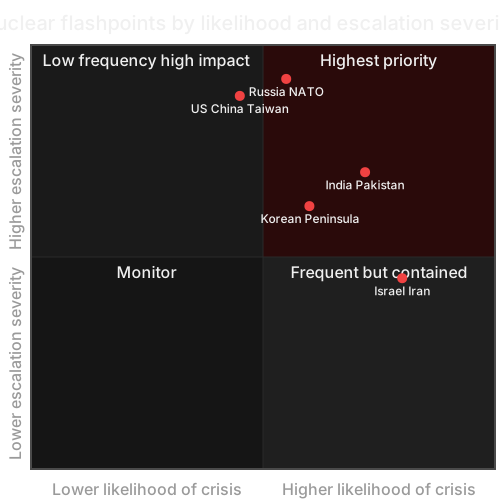
Chart: RAGE X Intelligence Desk qualitative assessment of nuclear flashpoints, October 2026; positions are analytical judgments, not measured data.
The testing question#
On 30 October 2025, President Trump said he had instructed the Department of Defense to begin testing US nuclear weapons "on an equal basis" with other countries. The United States has not conducted an explosive nuclear test since 1992 and has signed but not ratified the Comprehensive Nuclear-Test-Ban Treaty. US officials later indicated that planned activity would focus on non-explosive system testing, but the statement prompted Moscow to order preparations for possible tests of its own. A resumption of explosive testing by any major power would likely trigger reciprocal tests and undermine one of the most durable norms of the nuclear age.
Technology and the speed of war#
Hypersonic glide vehicles, new long-range cruise missiles, missile defense ambitions such as the US Golden Dome program, and the integration of artificial intelligence into early warning and command systems all compress the time leaders have to decide. Many experts argue that the greatest danger lies less in deliberate first strikes than in accidents, false warnings and escalation driven by entangled conventional and nuclear systems. These risks grow when there are fewer dialogues and fewer agreed rules.
The future of arms control#
The arms control system built since 1972 was bilateral, verifiable and centered on Washington and Moscow. That model is now exhausted. Any successor will need to address a world with at least three major nuclear powers, a growing role for non-strategic weapons, and technologies such as missile defense, space systems and cyber capabilities that earlier treaties did not cover.
Plausible paths forward#
Three scenarios stand out. The first is managed restraint, in which Washington and Moscow keep observing the old New START limits informally and pursue modest transparency measures while exploring a trilateral format. The second is a slow-motion arms race, in which both upload stored warheads in response to each other and to China, and Beijing continues its expansion toward 1,000 or more warheads. The third is a new risk-reduction framework that avoids numerical caps but agrees on launch notifications, crisis hotlines, limits on AI in nuclear command and control, and a reaffirmed testing moratorium.

Chart: RAGE X scenario framework for post-New START arms control, October 2026; based on positions reported by Reuters and SIPRI.
What to watch#
Key indicators over the next 12 months include any formal US-Russia strategic stability talks, the number of deployed warheads reported in SIPRI's 2027 Yearbook, Chinese silo-loading and submarine patrol activity, the trajectory of US-Iran nuclear talks, and whether any state conducts an explosive nuclear test. Monitoring these signals in real time is central to understanding where the nuclear balance is heading.
Frequently asked questions#
Which country has the most nuclear weapons in 2026?#
Russia has the largest nuclear arsenal. SIPRI estimates that it held about 5,420 warheads in January 2026, including about 4,400 in its military stockpile and 1,020 retired warheads awaiting dismantlement. The United States is a close second with about 5,042 warheads in total and 3,700 in its stockpile. Together the two countries account for almost 86 percent of the world's nuclear weapons. China ranks third with about 620 warheads and is the fastest-growing nuclear power, with the Pentagon projecting more than 1,000 warheads by 2030.
How many countries have nuclear weapons?#
Nine countries possess nuclear weapons: the United States, Russia, China, France, the United Kingdom, India, Pakistan, Israel and North Korea. The first five are recognized as nuclear-weapon states under the NPT. India, Pakistan and Israel never joined the treaty, and North Korea announced its withdrawal in 2003. Israel has never officially confirmed its arsenal, which SIPRI estimates at about 90 warheads. Several other countries, including Germany, Italy, Belgium, the Netherlands and Türkiye, host US nuclear weapons under NATO sharing arrangements but do not own or control them.
What happened when New START expired?#
New START expired on 5 February 2026 without an extension or replacement. For the first time since the early 1970s, the US and Russian strategic arsenals are not subject to any legally binding limits or inspections. Russia proposed observing the limits voluntarily for one more year, which President Trump rejected in favor of seeking a new deal including China. Russia has said it will keep to the old caps as long as the United States does. As of October 2026, both sides have discussed future talks but no negotiations have begun.
Is China's nuclear arsenal really growing?#
Yes. SIPRI estimates China's stockpile at about 620 warheads in January 2026, up from about 600 a year earlier and from roughly 300 at the start of the decade, according to earlier SIPRI editions. The Pentagon's December 2025 China Military Power Report said China remains on track to exceed 1,000 warheads by 2030 and has likely loaded more than 100 ICBM silos. China says its policy remains minimum deterrence with no first use, but its expanding silo fields, submarine force and early warning system indicate a significant change in posture.
What is the difference between the NPT and the TPNW?#
The NPT, in force since 1970, aims to stop the spread of nuclear weapons, allows five recognized states to keep them while pursuing disarmament, and guarantees access to peaceful nuclear technology. Almost every country is a member. The TPNW, in force since 2021, bans nuclear weapons outright for its members. It has 74 states parties, according to ICAN, but no nuclear-armed state or NATO member has joined. Supporters see the two treaties as complementary, while the nuclear powers argue that the TPNW undermines deterrence without reducing any arsenal.
Could nuclear testing resume?#
It is possible. The United States, Russia and China have not conducted explosive nuclear tests in decades, and North Korea is the only country to test this century, most recently in 2017. In October 2025, President Trump ordered the Pentagon to begin testing on an equal basis with other countries, and Russia responded by preparing options for its own tests. US officials signaled that the focus would be non-explosive system tests. A full explosive test by any major power would likely prompt reciprocal action and further weaken the Comprehensive Nuclear-Test-Ban Treaty, which has never entered into force.
The RAGE X view#
The nuclear landscape of 2026 is defined less by the number of warheads than by the disappearance of the rules that once constrained them. The global stockpile is growing modestly, China is building toward parity in some categories, and Washington and Moscow are relying on unverifiable promises of restraint. None of this makes nuclear use likely in the near term, but it removes the transparency and predictability that kept miscalculation in check through previous crises. The most realistic near-term goal is not a new grand treaty but a set of risk-reduction measures that keeps channels open while the three major powers decide whether they want a negotiated balance or an open competition.
For decision-makers, the practical lesson is to treat nuclear risk as a live variable in regional crises rather than a distant abstraction. RAGE X tracks escalation signals across nuclear-relevant theaters through RAGE INDEX, our global conflict intelligence platform, and reports developments on arms control, testing and deployments as they happen on RAGE Intel. More on our analytical work is available at theragex.com.
Sources#
- SIPRI Yearbook 2026, Chapter 8: World Nuclear Forces. https://www.sipri.org/sites/default/files/YB26%2008%20World%20Nuclear%20Forces.pdf
- SIPRI, Yearbook 2026 press materials. https://www.sipri.org/node/7895
- Business Standard, "US-Russia nuclear pact expires: why New START matters" (February 2026). https://www.business-standard.com/world-news/us-russia-nuclear-pact-expires-start-new-treaty-why-it-matters-126020900278_1.html
- Reuters via Internazionale, "Russia says it won't breach limits of expired nuclear treaty if US does the same" (11 February 2026). https://www.internazionale.it/ultime-notizie-reuters/2026/02/11/russia-says-it-won-t-breach-limits-of-expired-nuclear-treaty-if-us-does-the-same
- Federation of American Scientists, "The Pentagon's (Slimmed Down) 2025 China Military Power Report." https://fas.org/?p=40638
- Jiji Press via Adnkronos, "NPT Review Conference Ends without Final Document" (23 May 2026). https://english.adnkronos.com/2026/05/23/npt-review-conference-ends-without-final-document/
- ICAN, TPNW signature and ratification status. https://www.icanw.org/signature_and_ratification_status_v1
- The Standard, "Trump's order on nuclear testing: what we know" (30 October 2025). https://www.thestandard.ke/business/amp/world/article/2001533102/trumps-order-on-nuclear-testing-what-we-know
- UK House of Commons Library, "US-Iran ceasefire and nuclear talks in 2026." https://commonslibrary.parliament.uk/research-briefings/cbp-10637/
- RT, Kremlin comments on the arms control vacuum (20 October 2026), cited as a statement of the Russian government position.
- UN Office for Disarmament Affairs, Treaty on the Non-Proliferation of Nuclear Weapons. https://disarmament.unoda.org/wmd/nuclear/npt/
About RAGE X: RAGE X is a global media, intelligence and technology organization delivering geopolitical intelligence, military and conflict analysis, OSINT and security insight through RAGE Intel, RAGE INDEX and its wider ecosystem.
Continue the assessment
Related Intelligence
Russia's Nuclear Signalling: Reading the Actual Doctrine
New START expired in February 2026. The 2024 doctrine lowered the threshold. What the text actually says, what the signalling is for, and where the limits are.
2026-08-28 · 12 min read
Russia's Top Weapons in 2026: Capability, Production Reality, and Assessment
Detailed analysis of Russia's most significant weapons — Oreshnik, Kinzhal, Zircon, Poseidon, Su-57, T-14 Armata — and the gap between showcase and production.
2026-08-06 · 16 min read
The Ankara Decoy: How the Secret Service Flew Trump Out of Turkey While Air Force One Became Bait
A surface-to-air missile threat over Ankara triggered a rehearsed presidential deception — a catering truck, a C-32A, and a decoy 747 carrying Cabinet secretaries and the press pool.
2026-08-12 · 9 min read
Today's conflict risk
The daily RAGE INDEX scores global conflict risk across six theaters, with sources and forecasts.
Read the RAGE INDEXReach readers like these
RAGE X sells sponsored content across RAGE Intel, RAGE War and RAGE Global by proposal, always labelled as sponsored.
Request a campaign proposal