Hackers Breach the U.S. Air Force's Cloud One Platform, Reuters Reports
RAGE Global · United States · Cyber · Defense · Reported · 5 min read
Instagram carousel
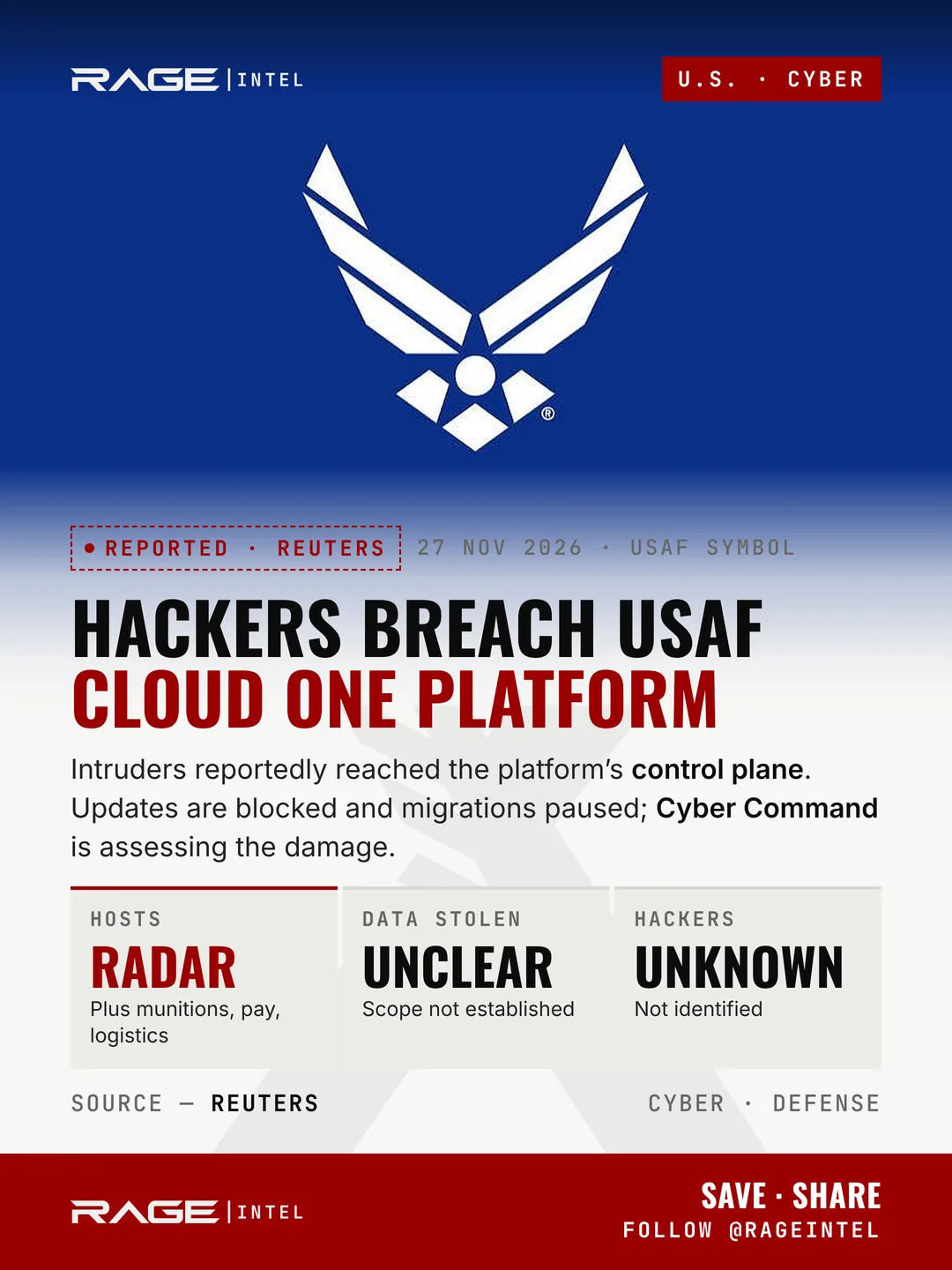
Published on Instagram with this story · swipe or use the arrow keys
Hackers have breached Cloud One, the U.S. Air Force's flagship cloud computing platform, Reuters reported on Friday 27 November 2026, citing three people familiar with the matter. The platform hosts systems for personnel, pay, logistics, air defence radar and munitions. The intruders reportedly reached the platform's control plane, the layer used to manage cloud resources, but what they accessed, who they are and whether any data was stolen has not been established. Software updates are blocked and application migrations are paused, and U.S. Cyber Command is assessing the damage. The Air Force declined to comment on specific networks.
Key takeaways
- The target: Cloud One, the Air Force's flagship cloud platform, which hosts personnel, pay, logistics, air defence radar and munitions systems.
- The entry: the intruders reportedly reached the control plane, according to one source. Reuters could not identify the vulnerability, and it is unclear what the intruders did once there.
- The disruption: updates are blocked and migrations are paused, which keeps staff from applying fixes and moving applications onto the platform.
- The response: Cyber Command has been called in to assess the damage, one source said.
- The unknowns: who is responsible, how far the intrusion reached and whether data was stolen.
Confidence: REPORTED, from Reuters on three unnamed sources, as summarised by other outlets; the Air Force has not confirmed details. RAGE X could not open the Reuters article from this session and relies on coverage that summarises it. Nothing here has been confirmed on the record.
What was reported#
According to Reuters, as summarised by Cyber Insider, Cybernews, Forbes and others:
- The breach happened during a system upgrade and was discovered at some point over the past several weeks.
- One source said the intruders exploited a software flaw to reach the control plane. Reuters could not identify the flaw, and coverage says it remains unknown what the hackers did with that access.
- Investigators have called in Cyber Command, the U.S. military's cyber force, to assess the damage, one of the sources said.
- The reported disruptions are paused application migrations and blocked software updates.
- Reuters could not establish who the hackers are, how far the intrusion reached or whether any data was stolen.
- The Air Force declined to discuss the matter and declined to comment on specific networks.
| Item | What is reported | Status |
|---|---|---|
| Target | Cloud One, the Air Force's flagship cloud platform | Reported |
| Access | Control plane, per one source | Reported, one source |
| Method | A software flaw, per one source; not identified | Unconfirmed |
| Timing | During an upgrade; discovered over the past several weeks | Reported |
| Effect | Updates blocked, migrations paused | Reported |
| Response | Cyber Command assessing damage | Reported, one source |
| Data stolen | Not established | Unknown |
| Attacker | Not identified | Unknown |
| Air Force position | Declined to comment on specific networks | Official |
What Cloud One is#
Cloud One is the Air Force's multi-cloud hosting environment. Air Force and Department of Defense material describes it as a hybrid environment that uses both Amazon Web Services and Microsoft Azure to host the service's enterprise workloads, and officials say it can host applications at secret level and below. Counts of the systems on it vary by source and date, from dozens of mission applications in earlier reports to well over a hundred in later ones, so RAGE X does not give a figure.
A companion layer, Platform One, runs on top of Cloud One and in Air Force data centres. It is the Air Force's software factory, where applications receive their authority to operate and the portability code that lets them run on different clouds. RAGE X has not seen any report that Platform One was affected.
Why the control plane matters#
A cloud platform has a control plane and the workloads that run on it. The control plane is where administrators create, configure and manage resources. An intruder with access there could, in principle, see or change how the hosted systems are set up, which is a different and potentially wider problem than a breach of one application.
That is a general description of what the control plane does. The reporting does not say what the intruders did with the access they reportedly had, and RAGE X draws no conclusion about the damage.
What the pause means#
Blocking updates and pausing migrations are the kind of steps defenders take to contain an incident and to stop a possible attacker from using the update path. They also carry a cost: staff cannot apply routine fixes while the block is in place, and applications waiting to move onto the platform stay where they are. Reporting does not say how long the pause is expected to last.
Context#
The report comes in the same week as another U.S. government cyber story. RAGE X reported that the CIA, ODNI and NGA were hit by a breach of unclassified data, with unconfirmed indications that a public AI hacking tool was used. Nothing in the coverage of either story links them, and RAGE X draws no connection. RAGE X also covered the outage on the NSA's classified network earlier in the month.
What is known and not known#
| Question | Status |
|---|---|
| Was Cloud One breached? | Reported by Reuters on three sources; not confirmed by the Air Force |
| Did intruders reach the control plane? | Reported, one source |
| What did they access? | Unknown |
| Was data stolen? | Not established |
| Who is responsible? | Not identified |
| Is Cyber Command involved? | Reported, one source |
| Are updates and migrations paused? | Reported |
| Is it linked to the CIA/ODNI/NGA breach? | No link reported |
Questions answered#
What is Cloud One? The U.S. Air Force's flagship cloud platform, a multi-cloud environment that hosts enterprise workloads including personnel, pay, logistics, air defence radar and munitions systems, according to Reuters.
Who breached it? Not identified.
What did the hackers get? Not established. The intruders reportedly reached the control plane, but it is unclear what they accessed or whether data was taken.
Has the Air Force confirmed it? No. It declined to comment on specific networks.
What is being done? Cyber Command is reported to be assessing the damage, and updates and migrations are blocked or paused.
Our read · RAGE Intel assessment
The most important word in the reporting is "reportedly". Reaching a control plane is the kind of access that can matter a great deal, and the reporting does not say what was done with it. Until the Air Force or Cyber Command say more, the responsible reading is the cautious one: a serious intrusion into a flagship platform, with scope and attacker unknown.
The pause on updates and migrations is a sign that defenders are treating the incident as live. It also means that a platform that hosts critical systems is partly frozen while they work.
This is an assessment, not a finding. It will change when the Air Force confirms details, when the vulnerability is identified, or when investigators attribute the intrusion.
What to watch#
- Confirmation: whether the Air Force or Pentagon confirm the breach and its scope.
- The flaw: whether the vulnerability is identified and patched.
- Attribution: whether officials name an actor.
- Restoration: when updates and migrations resume.
- Congress: requests for briefings from the armed services committees.
This story is developing. RAGE X will update it as new information is confirmed.
Sources#
- Cyber Insider, Hackers breach US Air Force's Cloud One platform, 27 November 2026
- Quartz, Hackers breached the U.S. Air Force's Cloud One computing platform, 27 November 2026
- Cybernews, US Air Force Cloud One breach: hackers hit military cloud, 27 November 2026
- OODAloop, Hackers breach US Air Force's flagship Cloud One computing platform, November 2026
- Forbes, Hackers attacked Air Force's cloud system, report says, 27 November 2026
- Breitbart, Report: hackers breach Air Force's Cloud One computing platform, 27 November 2026
- Air Force Life Cycle Management Center, Cloud One expands in midst of Great Power Competition
- DefenseScoop, Cloud One taking aim at the enemy, one application at a time, February 2023
- Reuters, original report on the Cloud One breach, as summarised in the coverage above; RAGE X could not open it from this session
The graphic on the carousel uses the U.S. Air Force symbol as an illustration. Source check 27 November 2026.
Continue the assessment
Related Intelligence
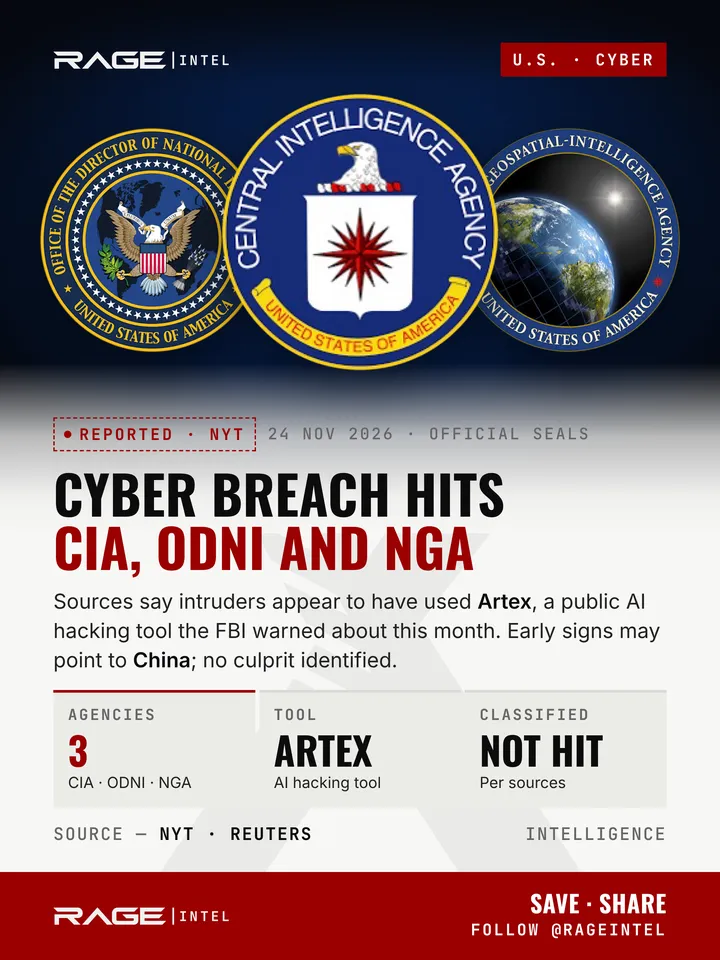
Cyber Breach Hits CIA, ODNI and NGA as Sources Point to AI Tool Artex and Possibly China
The CIA, ODNI and NGA were hit by a breach of unclassified data, the NYT reports. Sources cite the AI tool Artex and early signs of China; no culprit is identified.
2026-11-25 · 6 min read
Microsoft Declares an Internal "Code Red" After Its Historic 24-Hour Outage
Internal memos reviewed by Reuters show Microsoft's Code Red after the 12-13 November outage, blamed on a July Windows defect, with a new one-hour fix target.
2026-11-24 · 5 min read
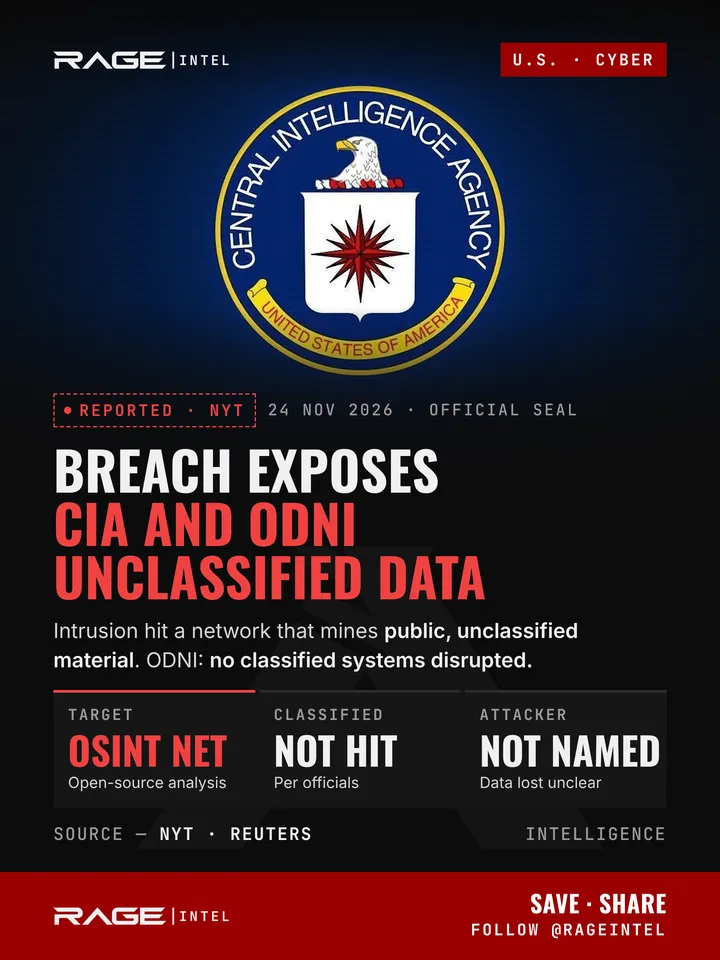
Breach Exposes CIA and ODNI Unclassified Data, New York Times Reports
A cyber intrusion exposed unclassified CIA and ODNI data, the New York Times reports. ODNI says classified systems were not disrupted. No attacker has been named.
2026-11-24 · 4 min read
Today's conflict risk
The daily RAGE INDEX scores global conflict risk across six theaters, with sources and forecasts.
Read the RAGE INDEXReach readers like these
RAGE X sells sponsored content across RAGE Intel, RAGE War and RAGE Global by proposal, always labelled as sponsored.
Request a campaign proposal