The World's Strategic Chokepoints: Hormuz, Bab el-Mandeb, Suez, Malacca and Panama
RAGE Global · Guide · Updated 2026-10-21 · 15 min read
Strategic chokepoints are the narrow straits and canals through which a disproportionate share of world trade and energy must pass, and 2026 has shown how quickly a single one can unsettle the global economy. Seaborne transport carries more than 80 percent of global trade volume, according to UNCTAD, and most of it funnels through a handful of passages that can be closed by war, drought or a single grounded ship. This analysis examines the five most important of them, the military forces that guard them and the risks they pose to energy markets and supply chains.
Key takeaways
- Before the 2026 Iran war, about 20 million barrels per day of oil, roughly 20 percent of global petroleum liquids consumption, moved through the Strait of Hormuz, according to the US Energy Information Administration (EIA).
- After the IRGC declared Hormuz closed on 2 March 2026, transits fell by almost 95 percent for long stretches, according to Al Jazeera analysis of shipping data, and Brent peaked above $130 a barrel in April.
- The Red Sea crisis cut Suez Canal revenue from a record $10.2 billion in 2023 to $4.1 billion in 2025; traffic is recovering in 2026 partly because Gulf oil has been rerouted west.
- The Strait of Malacca is the busiest oil chokepoint by volume, at about 23.2 million barrels per day in the first half of 2025.
- Drought is now a recurring threat to the Panama Canal, which cut daily transits from 36 to 32 in September 2026.
What are strategic chokepoints?#
A chokepoint is a narrow channel along a widely used global sea route. What makes it strategic is the combination of high traffic and the absence of a cheap alternative. When a chokepoint is blocked, ships must either wait or divert, sometimes adding thousands of nautical miles, weeks of sailing time and large increases in fuel and insurance costs. For oil and liquefied natural gas (LNG), where tankers move a large share of daily world consumption, even a temporary disruption can move prices within hours.
Why chokepoints matter more than ever#
Three trends have raised the stakes. First, global supply chains run on just-in-time logistics with thin inventory buffers. Second, state and non-state actors now have cheap drones, anti-ship missiles and mines that can threaten merchant traffic without a conventional navy. Third, climate change is affecting the physical operation of infrastructure such as the Panama Canal. The result is that the risk at strategic chokepoints is no longer only military; it is also environmental and economic.
Oil flows through the major chokepoints#
The chart below shows estimated oil flows through the most important passages in the first half of 2025, before the 2026 Hormuz crisis, as compiled by Anadolu Agency from EIA and International Energy Agency (IEA) data.
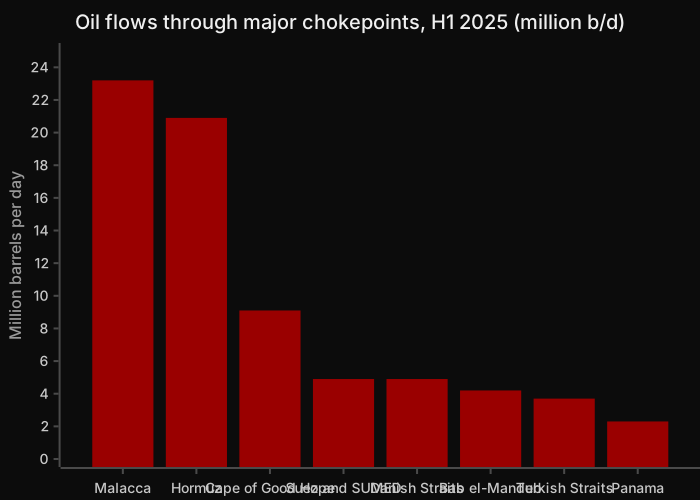
Chart: estimated crude and refined product flows by chokepoint. Data: EIA and IEA figures compiled by Anadolu Agency, first half of 2025 (Panama period not stated by source).
| Chokepoint | Connects | Oil flow (H1 2025, million b/d) | Main exposure | Status, October 2026 |
|---|---|---|---|---|
| Strait of Malacca | Indian Ocean and South China Sea | 23.2 | China, Japan, South Korea | Open; congestion from rerouted energy |
| Strait of Hormuz | Persian Gulf and Gulf of Oman | 20.9 | Asia (84% of crude flows in 2024) | Severely disrupted since March 2026 |
| Suez Canal and SUMED | Red Sea and Mediterranean | 4.9 | Europe, Asia | Recovering, below 2023 levels |
| Bab el-Mandeb | Red Sea and Gulf of Aden | 4.2 | Europe, Saudi exports | Houthi blockade on Saudi shipping since July 2026 |
| Turkish Straits | Black Sea and Mediterranean | 3.7 | Russia, Kazakhstan, Ukraine | Open under Montreux; temporary measures |
| Panama Canal | Atlantic and Pacific | 2.3 | US, Latin America, Asia | Open; drought restrictions |
Sources: EIA and IEA data compiled by Anadolu (flows); EIA (Hormuz destinations, 2024); status from Al Jazeera, Reuters and Tico Times reporting, July to October 2026.
The Strait of Hormuz: the world's energy jugular#
The Strait of Hormuz links the Persian Gulf to the Gulf of Oman and the Arabian Sea. It is the only sea outlet for most oil and gas exports from Saudi Arabia's Gulf coast, Iraq, Kuwait, Qatar, Bahrain, the UAE and Iran. According to the EIA, oil flows through the strait averaged 20 million barrels per day in 2024, equal to about 20 percent of global petroleum liquids consumption, and around one-fifth of global LNG trade, mostly from Qatar, also passed through it.
Who depends on Hormuz#
The EIA found that 84 percent of the crude oil and condensate and 83 percent of the LNG moving through Hormuz in 2024 went to Asian markets. China, India, Japan and South Korea together accounted for 69 percent of Hormuz crude and condensate flows. That makes Hormuz primarily an Asian energy security problem, although price effects are global because oil is traded on a single world market.
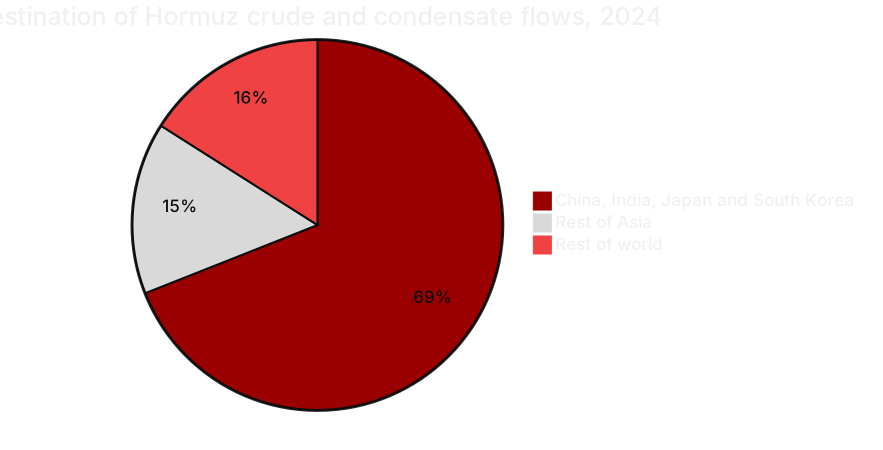
Chart: share of Hormuz crude and condensate flows by destination. Data: US EIA, Today in Energy, June 2025 (2024 data).
Limited bypass options#
Only two pipeline systems can move Gulf crude around the strait. Saudi Arabia's East-West pipeline to the Red Sea has a capacity of 5 million barrels per day, which Aramco temporarily expanded to 7 million in 2019, and the UAE's pipeline to Fujairah has a capacity of 1.8 million barrels per day. Because these lines already carry some oil, the EIA estimates that only about 2.6 million barrels per day of spare capacity would be available in a disruption, a fraction of normal Hormuz volumes.
The 2026 closure#
On 28 February 2026, the United States and Israel launched air strikes on Iran, according to the UK House of Commons Library. On 2 March, the Islamic Revolutionary Guard Corps (IRGC) announced the closure of the strait, and traffic collapsed within days. Al Jazeera's analysis of shipping data found that daily transits fell from about 100 ships before the war to about five a day, and stayed there through an April pause in fighting and a US blockade of Iranian ports.
| Period (2026) | Event | Average daily transits |
|---|---|---|
| Before 28 February | Pre-war baseline | About 100 |
| March to mid-June | IRGC closure, April pause, US blockade | About 5 |
| From 17 June | US-Iran interim memorandum of understanding | About 20 |
| 15 July to 23 August | US blockade resumed on 14 July | About 5 (almost 95% below pre-war) |
Source: Al Jazeera analysis of shipping data, published 27 August 2026; UK House of Commons Library for the 17 June memorandum.
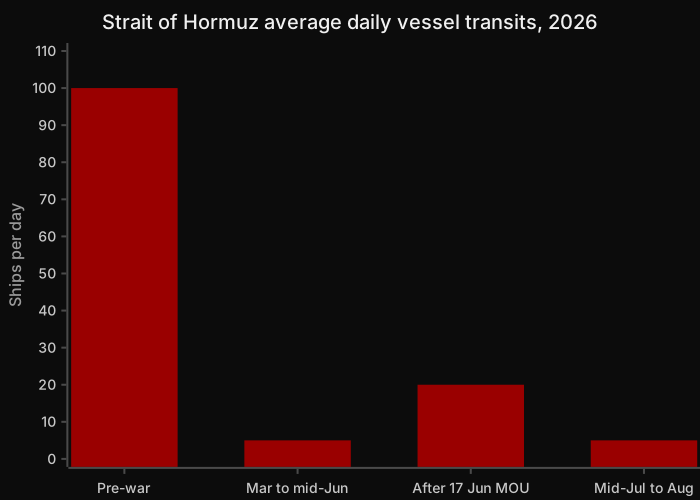
Chart: average daily transits through Hormuz by phase of the 2026 conflict. Data: Al Jazeera analysis of shipping data, August 2026.
The situation in October 2026#
By September, the picture had partly changed. Kpler data cited by Al Jazeera showed Gulf flows through Hormuz, excluding Iran, recovering to more than 81 percent of pre-war levels, helped by a US Navy-escorted shuttle route for Gulf exports. Attacks then intensified. Kpler counted 10 tankers struck between 28 September and 4 October, and UKMTO recorded 15 further attacks between 6 and 14 October. The US Navy-led Joint Maritime Information Center rated the threat to merchant shipping as "severe." Iranian officials have claimed control of the strait, a claim US Central Command rejects, and Brent crude traded above $105 a barrel in mid-October.
Bab el-Mandeb and the Red Sea crisis#
The Bab el-Mandeb strait separates Yemen from Djibouti and Eritrea and links the Red Sea to the Gulf of Aden. It is about 29 kilometers wide at its narrowest point. In 2024, about 4.1 billion barrels of crude and refined products passed through it, roughly 5 percent of the global total, according to figures cited by Al Jazeera. Together with the Suez Canal it forms the shortest sea route between Asia and Europe.
From Gaza to a regional shipping war#
From late 2023, the Houthi movement, which controls much of northern Yemen and is aligned with Iran, began attacking commercial vessels in the southern Red Sea, saying it was acting in response to Israel's war in Gaza. Most major container lines diverted around the Cape of Good Hope. UNCTAD reported in October 2024 that Suez transits had fallen to an average of 33 a day, 57 percent below their previous peak, and that vessel capacity rerouted around Africa had risen by 89 percent.
The 2026 escalation against Saudi Arabia#
The Iran war drew the Red Sea back into the crisis. As Saudi Arabia diverted crude to its Red Sea ports to avoid Hormuz, the Houthis declared a naval blockade of Saudi Arabia on 20 July 2026, according to Al Jazeera. They claimed attacks on Saudi tankers on 22 and 28 July, and the Saudi Press Agency confirmed that one tanker was hit with no crew casualties. Reuters, citing Kpler data, reported that only 11 commodity vessels crossed Bab el-Mandeb on 26 July, the lowest level in months, and that Brent briefly rose 7 percent to $100 after one of the attacks. Reuters also reported that the Yemen truce in place since 2022 had broken down.
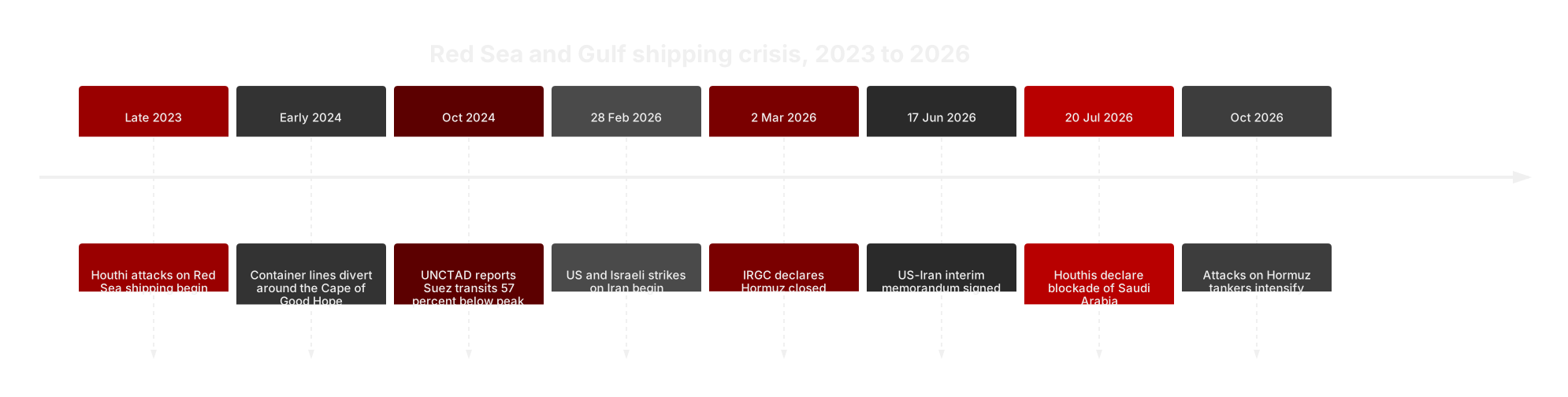
Chart: key events in the Red Sea and Gulf shipping crisis. Data: UNCTAD (2024), UK House of Commons Library, Al Jazeera and Reuters (2026).
The Suez Canal: revenue, rerouting and recovery#
The Suez Canal is Egypt's most important source of foreign currency and one of the world's busiest artificial waterways. It carries oil northbound to Europe, together with the parallel SUMED pipeline, and a large share of Asia-Europe container trade. Its fortunes since 2023 show how a chokepoint can be harmed by a crisis hundreds of kilometers away.
Revenue collapse and partial recovery#
According to Bloomberg reporting republished by gCaptain, the canal earned a record $10.2 billion in 2023, with about 2,300 ships crossing in April 2023 alone. Revenue fell to $4.1 billion in 2025. In July 2026, 1,340 vessels transited, 27 percent more than in July 2025, and revenue reached $505 million, the highest monthly figure since December 2023. The Suez Canal Authority expects full-year 2026 revenue of $5.8 billion to $6 billion.
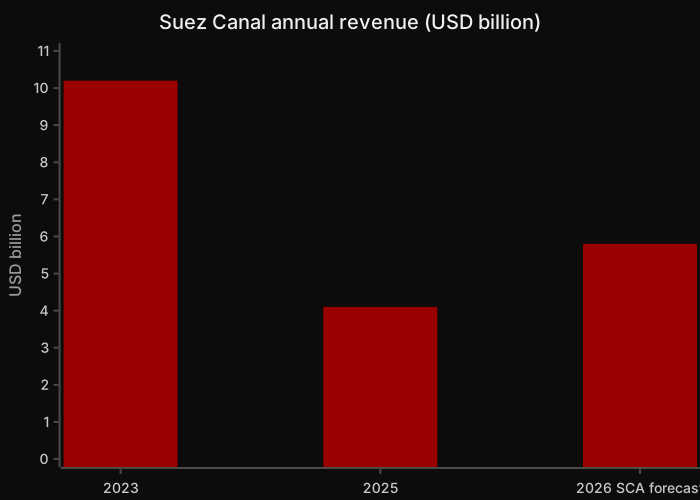
Chart: Suez Canal revenue, with the low end of the authority's 2026 forecast. Data: Suez Canal Authority figures reported by Bloomberg via gCaptain, September 2026.
A recovery driven by another crisis#
The 2026 increase has an unusual cause. Bloomberg attributed it largely to the effective closure of Hormuz, which pushed Saudi oil exports toward the Red Sea and through Suez to Europe and beyond. Oil tankers made up 526 of July's 1,340 transits. This is a fragile recovery, exposed both to Houthi attacks on Saudi-linked shipping and to any reopening of Hormuz that would send energy flows back to their usual routes.
The Strait of Malacca and the Taiwan Strait#
The Strait of Malacca, between the Malay Peninsula and the Indonesian island of Sumatra, is the main route between the Indian Ocean and the Pacific. It is the largest oil chokepoint by volume, carrying about 23.2 million barrels per day in the first half of 2025 according to the EIA and IEA data compiled by Anadolu. Much of the oil that leaves Hormuz eventually passes through Malacca on its way to China, Japan and South Korea.
The "Malacca dilemma"#
Chinese strategists have long described Beijing's dependence on Malacca as a strategic vulnerability, because a hostile navy could interdict energy imports there in a conflict. That concern helps explain Chinese investment in pipelines through Myanmar and Central Asia, overland rail links under the Belt and Road Initiative and a growing blue-water navy. In 2026, Al Jazeera reported that Singapore and Malaysia had become hubs for redirected energy flows, with Russian fuel oil shipments to the two countries rising 2.5 times month-on-month in July.
The Taiwan Strait#
The Taiwan Strait is not a classic chokepoint in the sense of having no alternative, but its economic weight is comparable. CSIS's ChinaPower project estimates that it carries over one-fifth of all maritime commerce. About 30 percent of Japan's imports and 25 percent of its exports, worth about $413 billion in 2024, transit the strait, along with around $300 billion of South Korean trade. Chinese military exercises around Taiwan, and the possibility of a quarantine or blockade, make it one of the most consequential maritime risks in the world.
The Panama Canal and the climate threat#
The Panama Canal, opened by the United States in 1914 and run by Panama since 1999, handles about 5 percent of global maritime trade, according to the canal administration as reported by Tico Times. Unlike sea-level straits, it depends on fresh water. Its locks are fed by rainwater stored in Gatun and Alhajuela lakes, and each large ship transit draws heavily on that supply.
From the 2023-24 drought to a new El Niño#
During the 2023-24 El Niño drought, the Panama Canal Authority restricted daily transits and the permitted draft of ships to protect water supply, including drinking water for Panama's population. Tico Times reported that the restrictions resulted in 2,700 fewer transits. UNCTAD found that by October 2024 transits had recovered to an average of 30 a day, still 30 percent below their previous peak. In September 2026 the canal administration announced a new reduction, from 36 to 32 daily transits from 15 September, and said further cuts in early 2027 could not be ruled out as a new drought developed.
The Río Indio solution#
The canal's main long-term answer is a new reservoir on the Río Indio, which the administration calls its top priority. According to Tico Times, the tender is expected to launch in 2027, and the earliest completion date cited is 2031. Until then, the canal will remain exposed to rainfall variability, and shippers will need to plan for draft restrictions and reduced slots in dry years.
Geopolitics in the Americas#
The canal has also become a point of political friction. Since 2025, the United States has raised concerns about Chinese-linked port operations at either end of the canal and has pressed for preferential treatment for US vessels. Panama has insisted on its sovereignty and the canal's neutrality, which is guaranteed under the 1977 treaties. The episode is a reminder that even a chokepoint far from any war zone can become a theater for great-power competition.
The Turkish Straits and other secondary chokepoints#
The Bosphorus and Dardanelles, known together as the Turkish Straits, are the only sea link between the Black Sea and the Mediterranean. They carried about 3.7 million barrels per day of crude and products in the first half of 2025, including Russian and Kazakh exports. Passage is governed by the 1936 Montreux Convention, which gives Türkiye control over the straits and restricts warship movements in wartime.
Montreux in practice#
After Russia's full-scale invasion of Ukraine in 2022, Türkiye invoked Montreux to restrict the passage of warships from both belligerents. Commercial traffic has continued. In August 2026, after attacks on vessels in the Black Sea, including Turkish-owned ships, Ankara adopted temporary measures affecting commercial traffic entering the Black Sea, according to Reuters, while officials insisted passage remained open. Foreign Minister Hakan Fidan called on Moscow and Kyiv to declare a moratorium on attacks at sea.
Other passages to watch#
The Danish Straits, carrying about 4.9 million barrels per day, are increasingly important for Russian exports from the Baltic and for NATO's security in the region. The Cape of Good Hope, not a chokepoint but the main alternative to Suez, saw flows of about 9.1 million barrels per day in the first half of 2025 as ships avoided the Red Sea.
Military presence and the risk to the global economy#
Because strategic chokepoints are so valuable, they are among the most heavily militarized waters in the world. The US Fifth Fleet is headquartered in Bahrain, and the multinational Combined Maritime Forces operate across the Gulf, Red Sea and Indian Ocean. In the Red Sea, the US launched Operation Prosperity Guardian in December 2023, and the European Union launched its defensive naval mission, Aspides, in February 2024. Djibouti, overlooking Bab el-Mandeb, hosts military bases of the United States, France, Japan and China, whose base there opened in 2017 as its first overseas military facility.
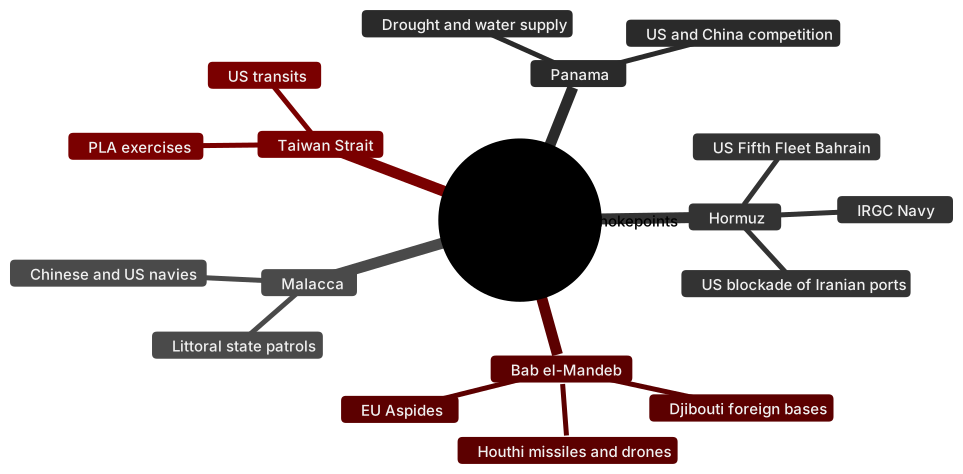
Chart: principal security actors and risk drivers at each chokepoint. Data: RAGE X Intelligence Desk compilation from Al Jazeera, Reuters, CSIS and Tico Times reporting, 2024 to 2026.
How disruption spreads#
The economic damage from a chokepoint crisis travels through several channels at once. Energy prices rise first, as the 2026 Hormuz closure showed, with oil peaking above $130 a barrel in April. Freight rates and war-risk insurance premiums follow, then delivery times lengthen as vessels reroute. Those costs pass through supply chains into consumer prices, and countries with no alternative route, such as Kuwait, whose port calls fell by 86 percent according to Al Jazeera, suffer the most direct harm.
Building resilience#
Governments and companies have three main tools. The first is redundancy: bypass pipelines, alternative ports and diversified suppliers. The second is buffers: strategic petroleum reserves and higher inventories of critical goods. The third is security: naval escorts, convoy systems and diplomatic arrangements that keep traffic moving. None of these fully replaces an open chokepoint, which is why the free movement of shipping through these waters remains a core interest for every major economy.
Frequently asked questions#
What are the world's most important strategic chokepoints?#
The most important strategic chokepoints are the Strait of Hormuz, the Strait of Malacca, the Suez Canal, the Bab el-Mandeb strait and the Panama Canal. The Turkish Straits, the Danish Straits and the Taiwan Strait are also significant. By oil volume, Malacca was the busiest in the first half of 2025 at about 23.2 million barrels per day, followed by Hormuz at about 20.9 million, according to EIA and IEA data compiled by Anadolu. Suez and Panama are critical for container and general cargo trade between Asia, Europe and the Americas.
How much oil passes through the Strait of Hormuz?#
According to the EIA, oil flows through the Strait of Hormuz averaged 20 million barrels per day in 2024, equal to about 20 percent of global petroleum liquids consumption. Around one-fifth of global LNG trade also passed through it. The 2026 Iran war sharply reduced these flows. Kpler data cited by Al Jazeera put the pre-war average at about 17.1 million barrels per day and showed large daily swings in October 2026, from 20.8 million barrels on 8 October to 2.9 million on 11 October.
Is the Strait of Hormuz closed in 2026?#
The IRGC declared the strait closed on 2 March 2026, after US and Israeli strikes on Iran began on 28 February. Traffic fell to about five ships a day for much of the year, according to Al Jazeera, with a partial recovery after a US-Iran interim agreement in June. By September, US-escorted shipments had restored Gulf flows, excluding Iran, to more than 81 percent of pre-war levels, but attacks on tankers rose sharply in October. The strait is open to some traffic but remains highly contested and dangerous.
Why did Suez Canal traffic fall?#
Suez Canal traffic fell because Houthi attacks on ships in the southern Red Sea from late 2023 made the route through Bab el-Mandeb too dangerous for many operators, who diverted around the Cape of Good Hope. By October 2024, UNCTAD reported Suez transits 57 percent below their peak. Canal revenue fell from a record $10.2 billion in 2023 to $4.1 billion in 2025. Traffic has recovered in 2026, with July revenue the highest since December 2023, but remains well below pre-crisis levels.
How does drought affect the Panama Canal?#
The Panama Canal's locks use fresh water from Gatun and Alhajuela lakes, which depend on rainfall. During droughts, the canal authority must limit the number of daily transits and the draft of ships, so vessels carry less cargo. The 2023-24 El Niño drought led to about 2,700 fewer transits, according to Tico Times. In September 2026, daily transits were cut again from 36 to 32. A new reservoir on the Río Indio is planned, but its earliest completion date is about 2031.
What happens to the global economy if a chokepoint closes?#
A chokepoint closure raises energy prices first, then shipping costs, insurance premiums and delivery times. The 2026 Hormuz disruption pushed Brent above $130 a barrel in April and left oil prices about 20 percent above pre-war levels in late August, according to Al Jazeera. Exporters without bypass routes, such as Kuwait and Qatar, see trade collapse, while importers in Asia face supply shortfalls. Effects then pass through to inflation, manufacturing and food prices, especially in import-dependent developing economies.
The RAGE X view#
The events of 2026 have confirmed that strategic chokepoints are not abstractions on a map but live pressure points in the global economy. Hormuz and Bab el-Mandeb are now linked in a single regional crisis in which disruption at one forces traffic into the other, while Suez has become the unexpected beneficiary of instability elsewhere. In the Indo-Pacific, Malacca and the Taiwan Strait remain stable but carry the highest potential consequences, and Panama demonstrates that climate stress can achieve what no adversary has. The most likely outlook for 2027 is continued volatility rather than a clean return to pre-war patterns, with energy prices, insurance costs and naval deployments all elevated.
For governments, shippers and investors, the priority is continuous monitoring of maritime risk signals rather than reacting after a closure. RAGE X tracks escalation at these chokepoints through RAGE INDEX, our global conflict intelligence platform, and reports maritime security developments as they unfold on RAGE Intel. More on our intelligence work is available at theragex.com.
Sources#
- US Energy Information Administration, Today in Energy, Strait of Hormuz oil flows (16 June 2025). https://eia.gov/todayinenergy/detail.php?id=65504
- US Energy Information Administration, World Oil Transit Chokepoints. https://www.eia.gov/international/content/analysis/special_topics/World_Oil_Transit_Chokepoints/wotc.pdf
- Anadolu Agency, "Around 70% of global oil demand transported through strategic maritime chokepoints." https://www.aa.com.tr/en/economy/around-70-of-global-oil-demand-transported-through-strategic-maritime-chokepoints/3857495
- Al Jazeera, "How a 95 percent drop in Hormuz traffic changed global shipping" (27 August 2026). https://www.aljazeera.com/news/2026/8/27/how-a-95-percent-drop-in-hormuz-traffic-changed-global-shipping
- Al Jazeera, "Iran steps up Hormuz surveillance: Attacks soar, oil flows crash again" (14 October 2026). https://www.aljazeera.com/news/2026/10/14/iran-steps-up-hormuz-surveillance-attacks-soar-oil-flows-crash-again
- UK House of Commons Library, "US-Iran ceasefire and nuclear talks in 2026." https://commonslibrary.parliament.uk/research-briefings/cbp-10637/
- Al Jazeera, "Yemen's Houthis claim missile attack on Saudi Arabia oil tanker" (28 July 2026). https://www.aljazeera.com/news/2026/7/28/yemens-houthis-claim-missile-attack-on-saudi-arabia-oil-tanker
- Reuters via Gulf Business, Bab el-Mandeb ship traffic drops after Houthi attacks (27 July 2026). https://gulfbusiness.com/en/2026/middle-east/bab-el-mandeb-ship-traffic-drops-houthi-attacks-strait-of-hormuz/
- UNCTAD, "Suez and Panama Canal disruptions threaten global trade and development" (22 October 2024). https://unctad.org/news/suez-and-panama-canal-disruptions-threaten-global-trade-and-development
- gCaptain, "Suez Canal revival gathers pace as Hormuz crisis reroutes ships" (September 2026). https://gcaptain.com/suez-canal-revival-gathers-pace-as-hormuz-crisis-reroutes-ships/
- CSIS ChinaPower, "How Much Trade Transits the Taiwan Strait?" https://features.csis.org/chinapower/china-taiwan-strait-trade/
- Tico Times, Panama Canal El Niño drought restrictions (7 September 2026). https://ticotimes.net/2026/09/07/panama-canal-el-nino-drought-ship-restrictions
- Reuters via Internazionale, "Passage of ships to Black Sea continues smoothly, Turkish officials say" (9 August 2026). https://www.internazionale.it/ultime-notizie-reuters/2026/08/09/passage-of-ships-to-black-sea-continues-smoothly-turkish-officials-say
- Al Jazeera, "Turkey warns against passing of warships from its straits" (1 March 2022). https://www.aljazeera.com/news/2022/3/1/turkey-blocks-warships-from-straits-amid-russia-ukraine-crisis
- UNCTAD, Review of Maritime Transport 2024. https://unctad.org/publication/review-maritime-transport-2024
About RAGE X: RAGE X is a global media, intelligence and technology organization delivering geopolitical intelligence, military and conflict analysis, OSINT and security insight through RAGE Intel, RAGE INDEX and its wider ecosystem.
Continue the assessment
Related Intelligence
The Strikes Paused. The Risk Premium Didn't
Trump says a deal reopening the Strait of Hormuz is close. Oil prices, travel advisories, and Tehran's crackdown say the war isn't actually over.
2026-08-02 · 6 min read
Two Chokepoints, One War: What the Houthi Blockade on Saudi Arabia Really Signals
The Houthis have opened a second maritime front against Saudi Arabia while Iran keeps attacking tankers in Hormuz. What it means for oil, Gulf politics, and the war's endgame.
2026-07-29 · 7 min read
Russia's War Economy: How Long Can It Actually Last
Russia spent 65% of Q1 federal revenue on defence. The four-month deficit exceeded all of 2025. Growth forecast cut to 0.4%. The sustainability arithmetic.
2026-08-28 · 12 min read
Today's conflict risk
The daily RAGE INDEX scores global conflict risk across six theaters, with sources and forecasts.
Read the RAGE INDEXReach readers like these
RAGE X sells sponsored content across RAGE Intel, RAGE War and RAGE Global by proposal, always labelled as sponsored.
Request a campaign proposal