LUCAS vs Shahed-136: America's Copy Against Iran's Original, Spec by Spec
RAGE War · Drone warfare · U.S. · Iran · Spec sheet · 12 min read
Instagram carousel
Published on Instagram with this story · swipe or use the arrow keys
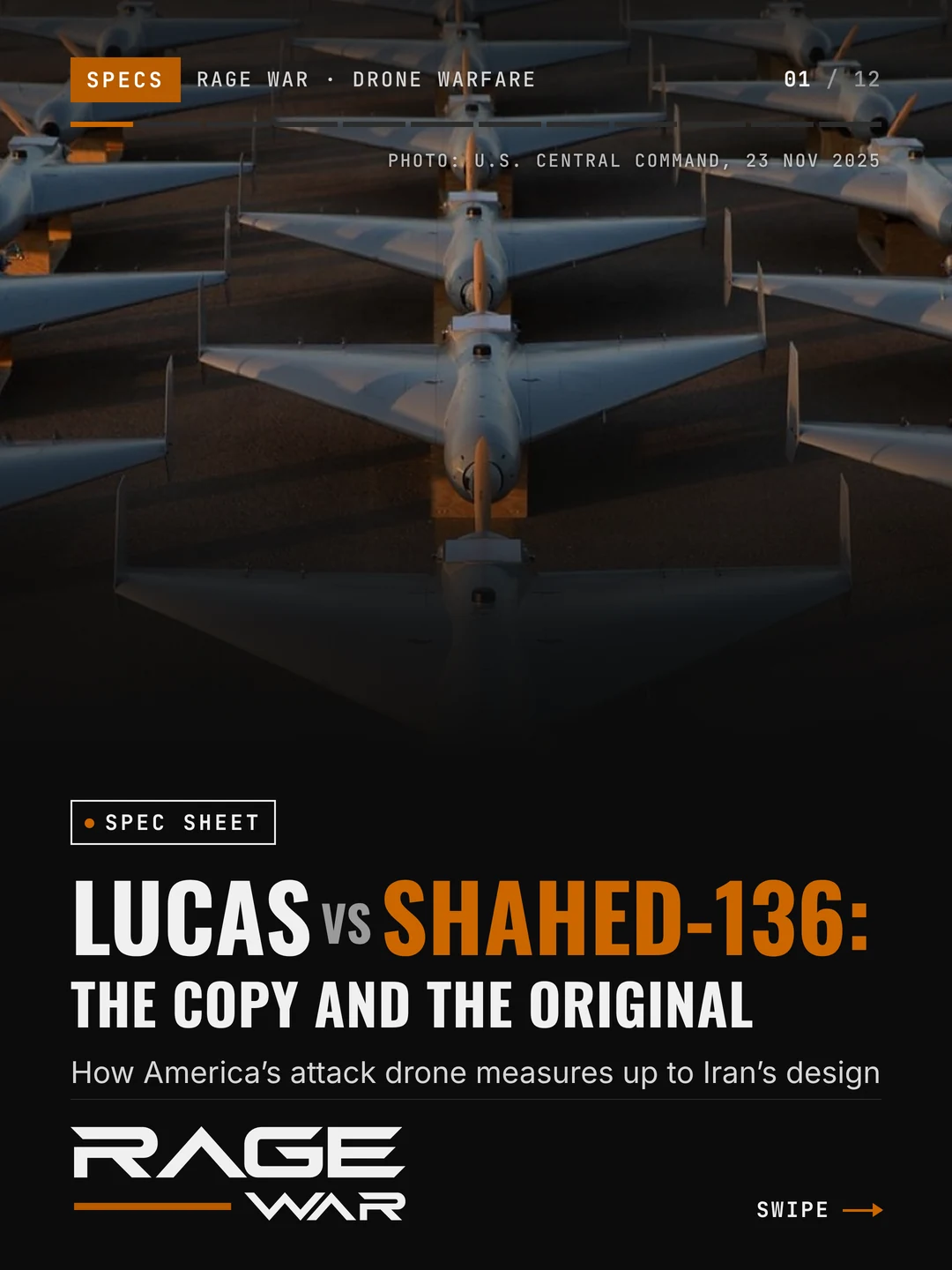
America now flies its own Shahed. The U.S. LUCAS one-way attack drone began as a Shahed-136 look-alike built to train air-defence crews, and U.S. Central Command (CENTCOM) first used it in combat on 28 February 2026. On published specifications LUCAS is the smaller and lighter of the two. It carries up to 18 kg against about 50 kg for the Shahed's standard warhead, and its manufacturer lists a range of 822 km against the 2,000 km or more often reported for the Shahed. The bigger difference is volume. About 32,200 Shahed-type strike drones were launched at Ukraine in 2025 alone, while the Pentagon's chief technology officer put LUCAS numbers "in the dozens" in March 2026. A new $9 million contract to build LUCAS airframes in containerised robotic factories is the U.S. attempt to change that.
Key takeaways
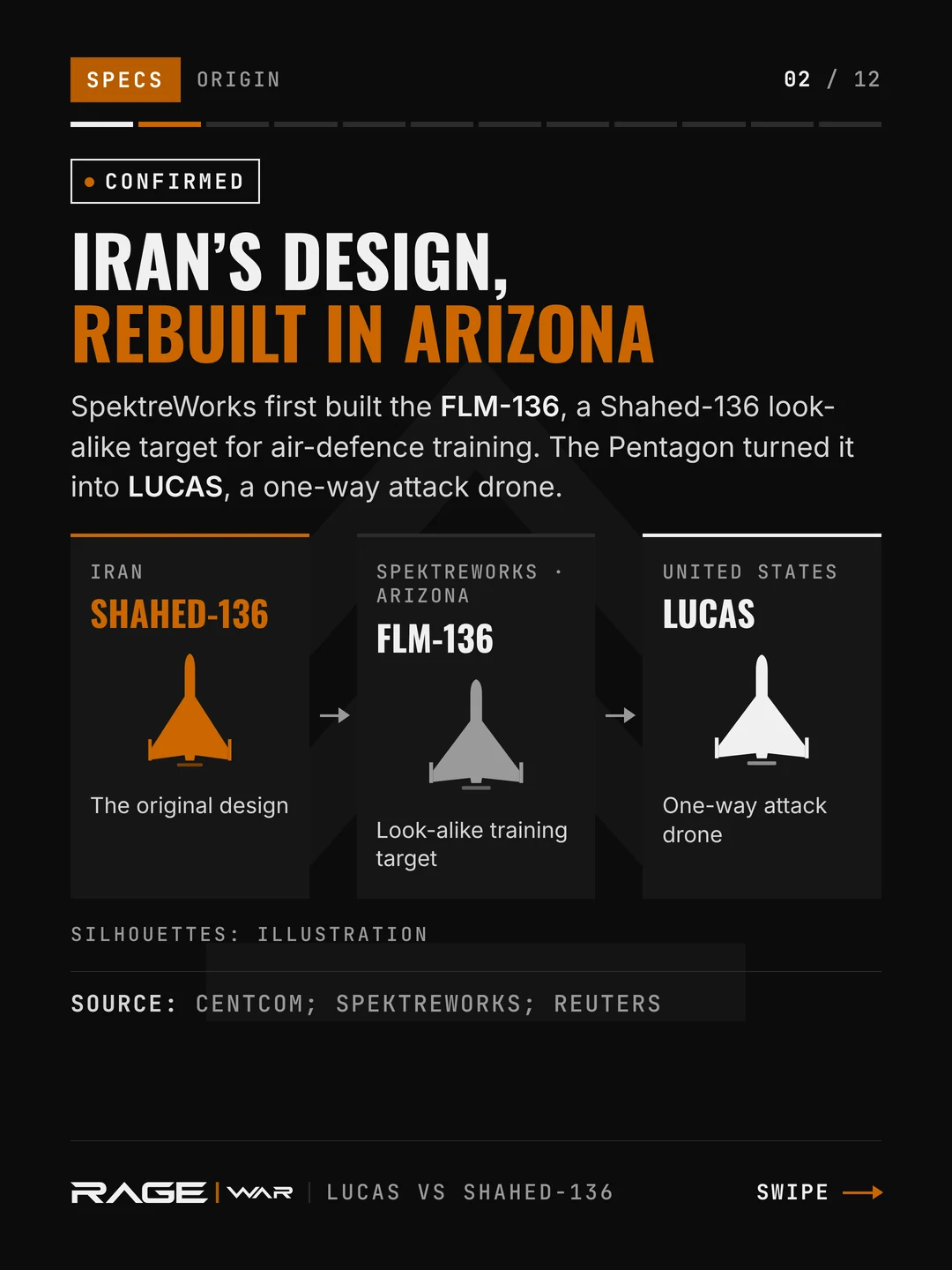
- The lineage: SpektreWorks, an Arizona company, built the FLM-136 as a Shahed look-alike target. CENTCOM describes the combat version, LUCAS, as reverse-engineered after the Shahed-136.
- The specs: LUCAS is 3.0 m long with a maximum takeoff weight of 82 kg. The Shahed is about 3.5 m long and about 200 kg. LUCAS carries up to 18 kg; the Shahed about 50 kg, and Russian Geran-2 versions up to about 90 kg.
- The range: SpektreWorks publishes 822 km for LUCAS. For the Shahed, 2,000 km or more is often reported, though estimates run from about 1,000 km to 2,500 km depending on warhead and flight profile.
- The cost: CENTCOM puts LUCAS at about $35,000 a unit. Estimates for the Shahed are commonly $20,000 to $50,000.
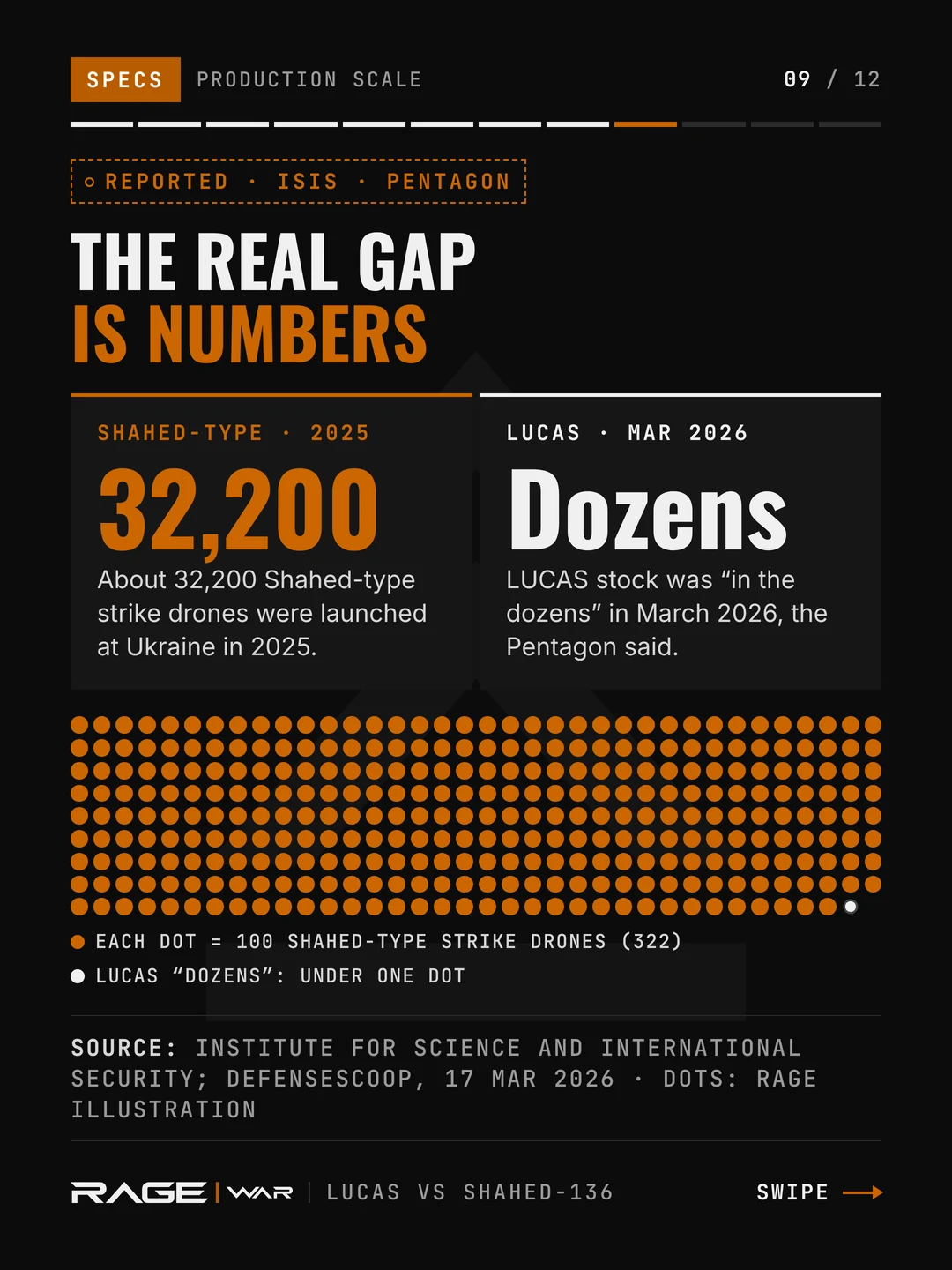
- The gap: scale. Shahed-type launches against Ukraine run in the thousands every month. LUCAS stock was "in the dozens" in March.
- The caveat: most figures on both sides are manufacturer specifications or estimates, not independent measurements.
Confidence: OFFICIAL for what CENTCOM and the Pentagon said about LUCAS's first combat use, its unit cost and its numbers; REPORTED for the specifications, the production figures and the Machina contract, which come from the manufacturer and published coverage; CLAIM for Iran's reports of shooting LUCAS drones down, which the U.S. has not confirmed; ASSESSMENT for the closing analysis. RAGE X relied on published sources and has not measured either drone. Where a figure is an estimate, this article says so.
From training target to combat drone#
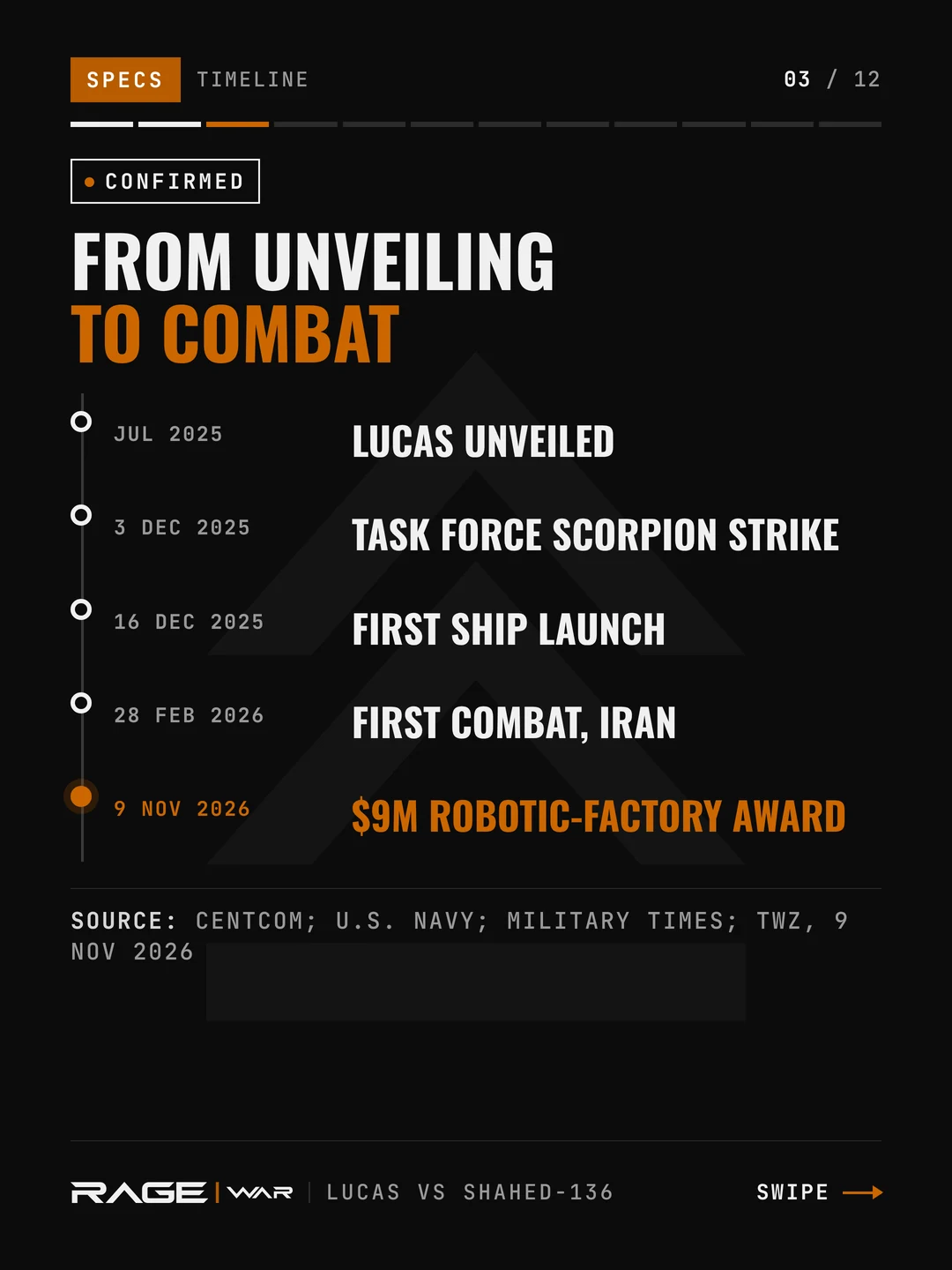
LUCAS stands for Low-Cost Uncrewed Combat Attack System. It grew out of SpektreWorks' FLM-136, a target drone that imitates the Iranian Shahed-136 so that air-defence crews can practise against it. SpektreWorks showed LUCAS at a Pentagon courtyard event in July 2025, and the Air Force later sought a close replica of the Shahed, according to Defense One. Its development since then has been fast.
| Date | Event | Status |
|---|---|---|
| July 2025 | LUCAS shown at a Pentagon courtyard event | Reported |
| 3 December 2025 | CENTCOM announces Task Force Scorpion Strike, a one-way attack drone unit led by U.S. Special Operations Command Central personnel | Reported |
| 16 December 2025 | A LUCAS is launched from the flight deck of the USS Santa Barbara in the Arabian Gulf, the Navy's first such launch from a ship | Official |
| 28 February 2026 | CENTCOM says LUCAS drones were used in combat for the first time, in the opening strikes of Operation Epic Fury against Iran | Official |
| 17 March 2026 | The Pentagon's chief technology officer says LUCAS numbers are "in the dozens" and that the drone is not in full-rate production | Official |
| 9 November 2026 | The War Zone reports a $9 million award to Machina to build LUCAS airframes in containerised robotic factories | Reported |
CENTCOM said the combat drones were "modeled after Iran's Shahed drones." Military Times reported that the strikes targeted Iranian command-and-control sites, air defences, missile and drone launch sites and military airfields. Officials would not say how many LUCAS drones were used. One official told Defense One not to think of the unit as a traditional squadron, because it "could be 100 or 2,000."
The specs, side by side#
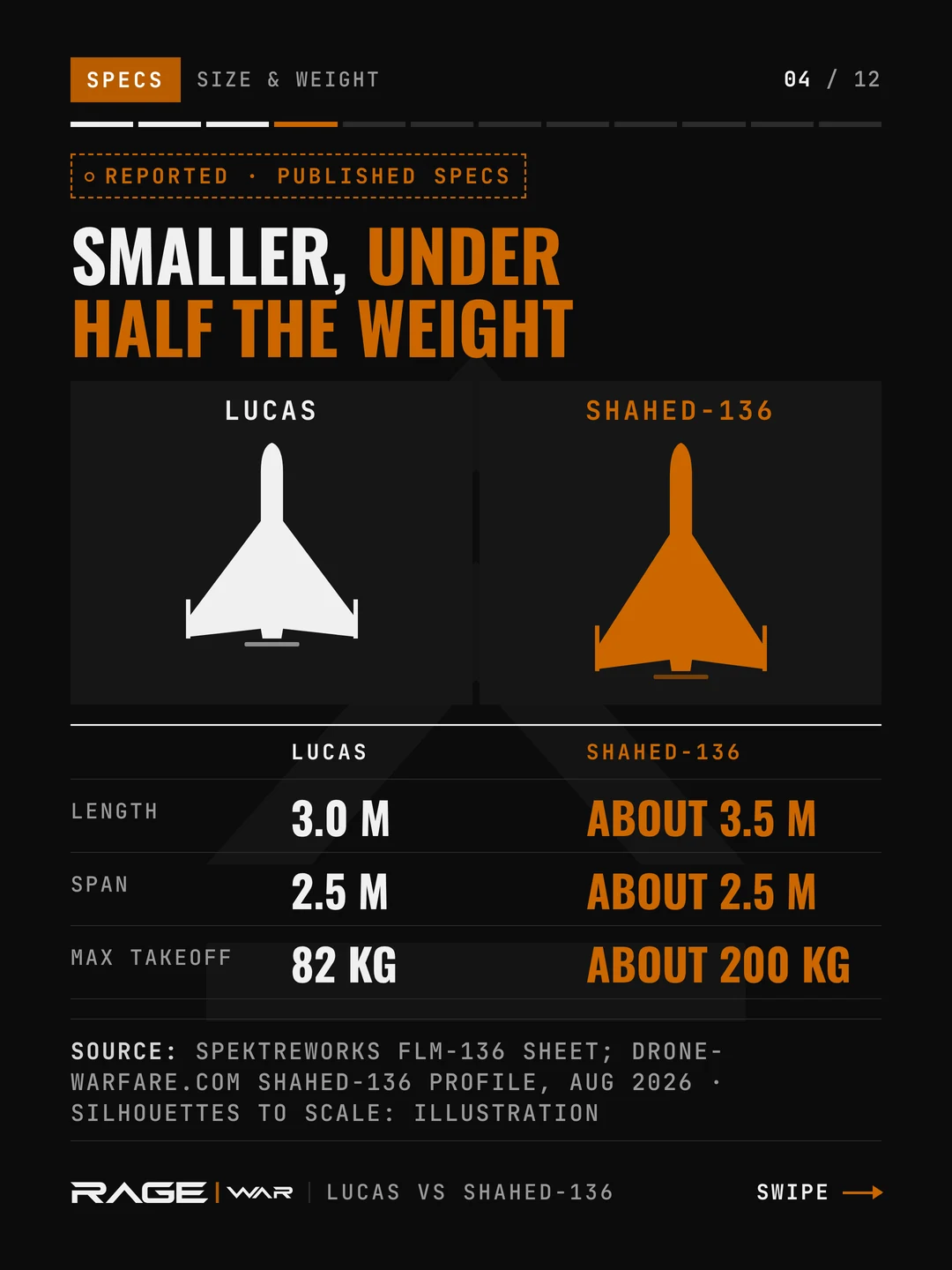
The comparison below uses SpektreWorks' published figures for LUCAS and open-source estimates for the Shahed-136. Neither set has been independently measured.
| Spec | LUCAS (SpektreWorks, as published) | Shahed-136 (published estimates) |
|---|---|---|
| Length | 3.0 m (9.8 ft) | About 3.5 m |
| Wingspan | 2.5 m (8.2 ft) | About 2.5 m |
| Maximum takeoff weight | 82 kg (180 lb) | About 200 kg |
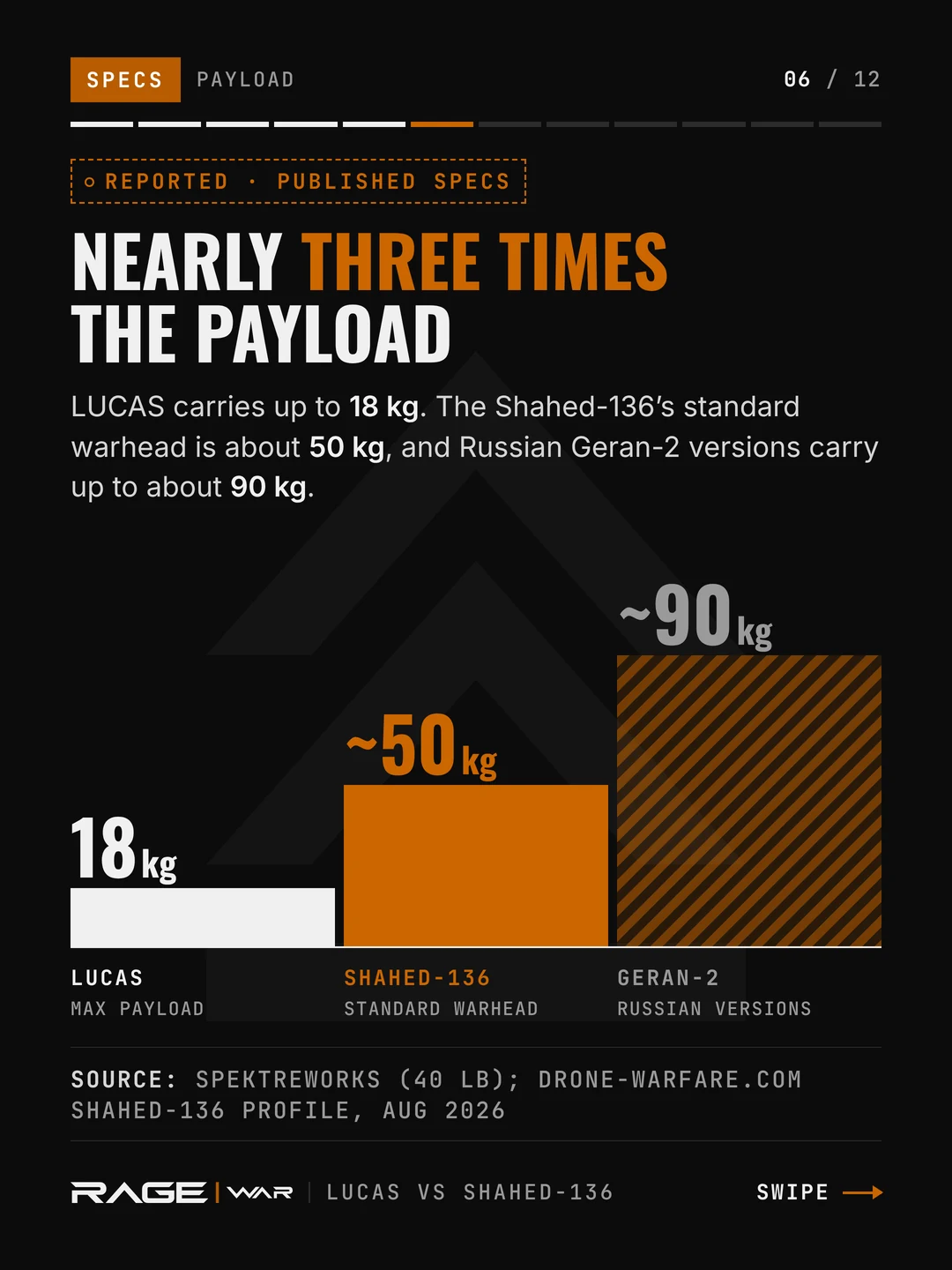
| Payload | Up to 18 kg (40 lb) | About 50 kg standard warhead; Russian Geran-2 versions up to about 90 kg |
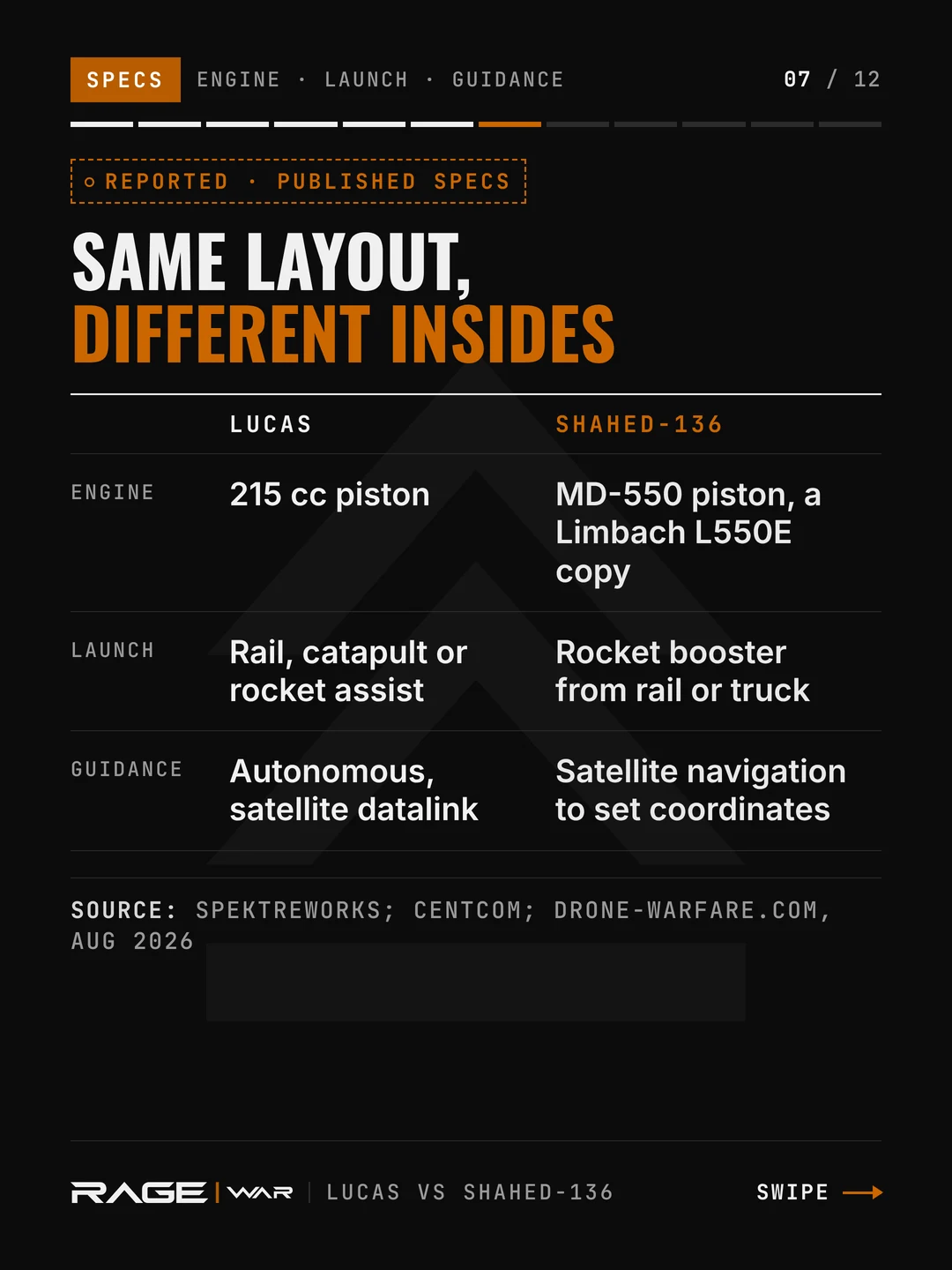
| Engine | 215 cc carburetted piston | MD-550 piston, a copy of the German Limbach L550E |
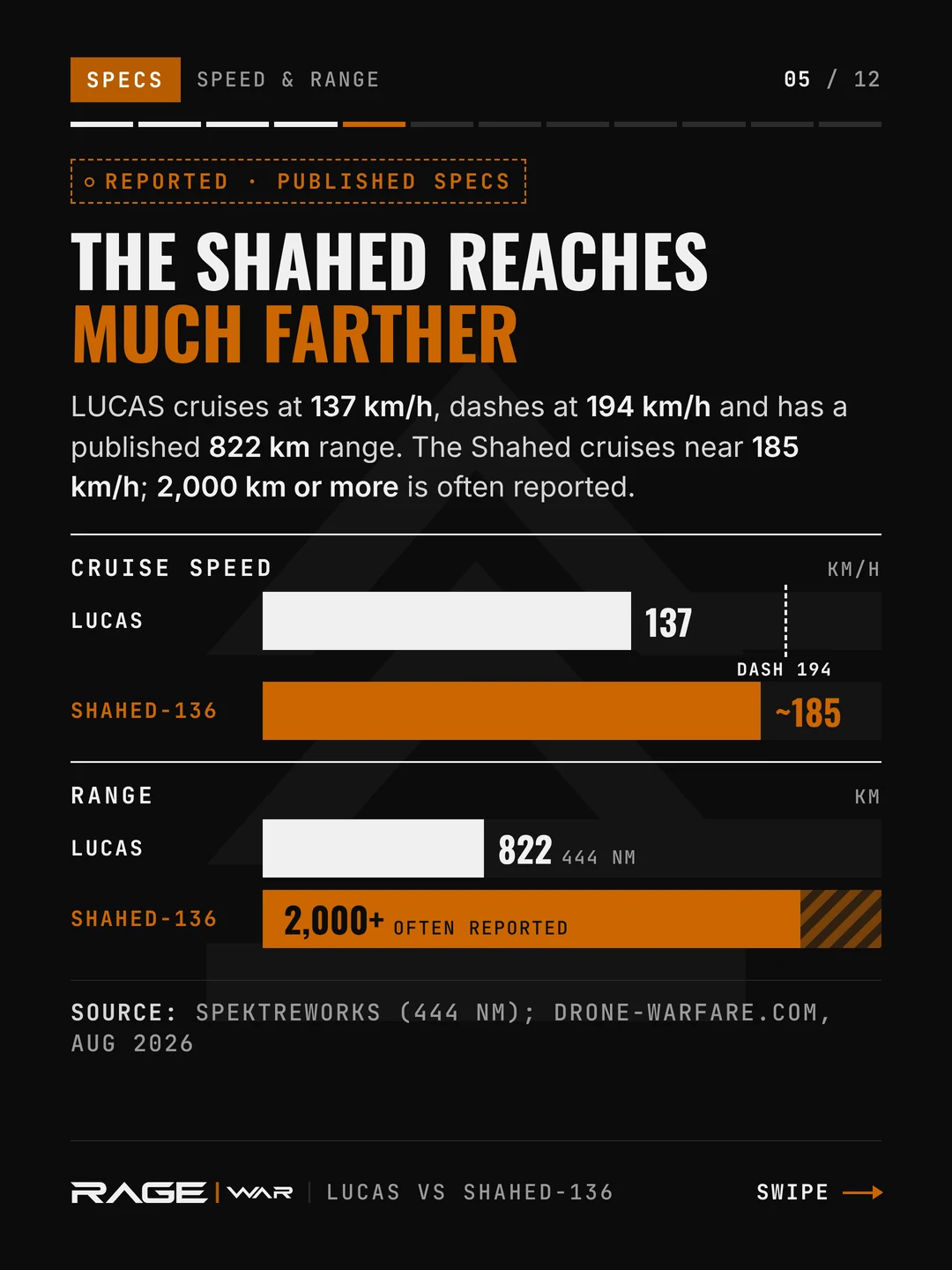
| Cruise speed | 137 km/h (74 knots) | About 185 km/h |
| Dash speed | 194 km/h (105 knots) | Not commonly published |
| Range | 822 km (444 nautical miles) | 2,000 km or more often reported; estimates about 1,000 to 2,500 km |
| Endurance | About 6 hours | Not commonly published |
| Launch | Rail, catapult or rocket assist; also launched from a ship | Rocket booster from a rail or vehicle rack |
| Guidance | Autonomous; a satellite datalink is reported | Satellite navigation to preset coordinates |
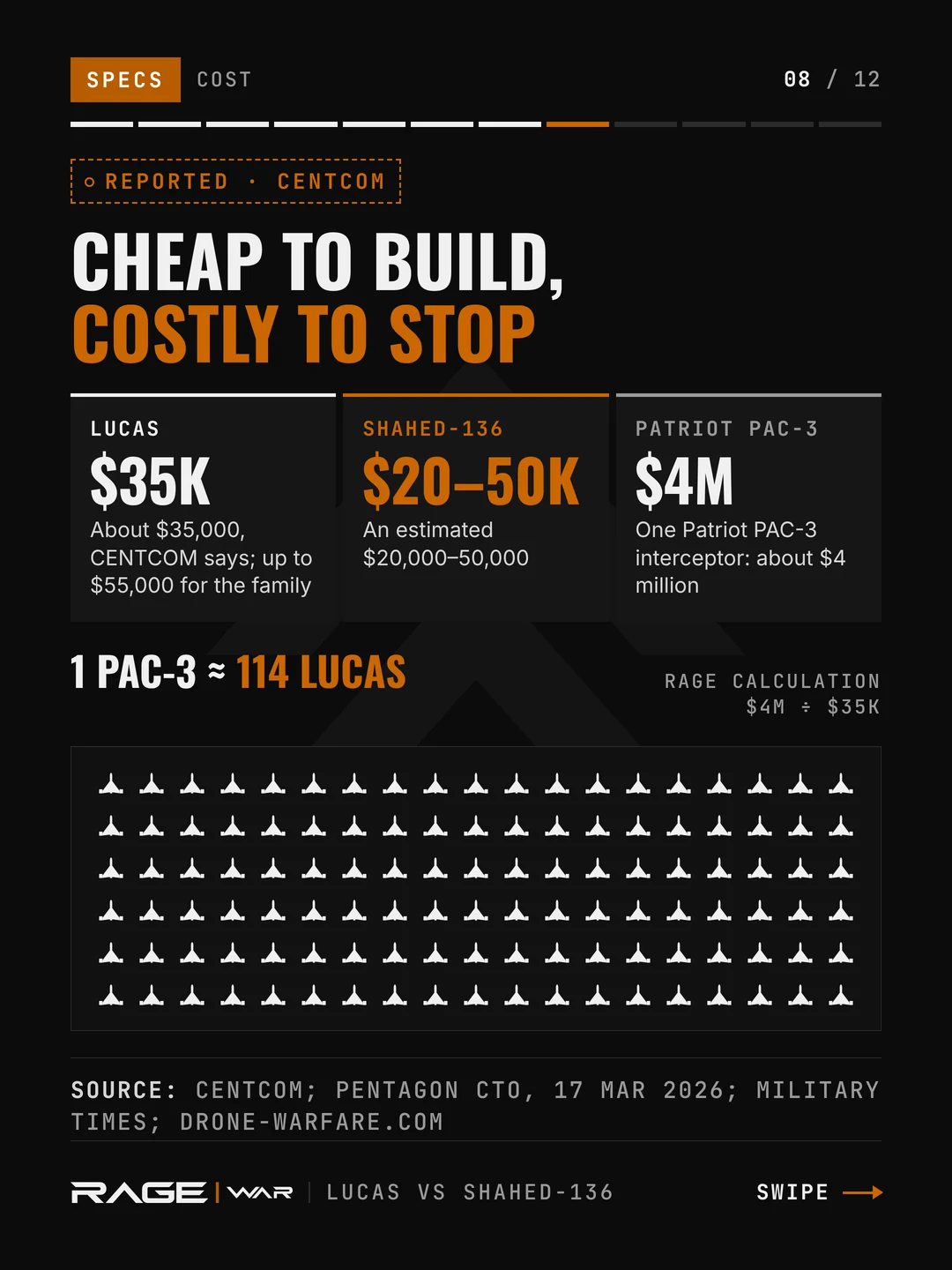
| Unit cost | About $35,000 (CENTCOM) | Commonly estimated at $20,000 to $50,000 |
Two cautions apply to this table. SpektreWorks has published two versions of the LUCAS and FLM-136 figures: an earlier sheet gave a range of 350 nautical miles (about 648 km), a 55-knot cruise and a 100-knot dash, and the current sheet gives the figures above. It is not clear which version flew over Iran. DefenseScoop reported a range of about 500 miles (roughly 800 km), in line with the current sheet. For the Shahed, range depends on warhead weight, fuel, route and weather, so a long range and a heavy warhead are trade-offs, not features that come together.
Size and weight: LUCAS is the lighter airframe#
LUCAS has the same delta-wing layout as the Shahed but a smaller, lighter airframe. At 82 kg maximum takeoff weight it weighs about two-fifths of the Shahed's roughly 200 kg. The wingspan is about the same, at about 2.5 m, and LUCAS is roughly half a metre shorter.
Payload: the Shahed carries nearly three times as much#
The warhead is where the two designs differ most. LUCAS carries up to 18 kg. The Shahed-136's standard warhead is about 50 kg, nearly three times as much, and Russian-built Geran-2 versions are reported to carry up to about 90 kg. A heavier warhead does not come free: reporting on the Geran-2 says the 90 kg version cuts range from roughly 2,500 km to roughly 1,000 km because the warhead displaces fuel. Even then the estimated figure is above LUCAS's published 822 km.
Range, speed and what is inside#
On range and speed the Shahed has the edge on paper. It cruises near 185 km/h against LUCAS's 137 km/h, although LUCAS can dash at 194 km/h. The range gap is larger: 822 km published for LUCAS, against 2,000 km or more often reported for the Shahed.
The engines and guidance differ. LUCAS uses a 215 cc piston engine. The Shahed uses the MD-550, a piston engine copied from Limbach's L550E. The Shahed flies to preset satellite coordinates and needs no live operator link, which makes it cheap and hard to jam but unable to be retargeted in flight, although later Russian versions add data links and, in some cases, cameras. Coverage of LUCAS describes autonomous flight, anti-jamming and a satellite datalink for control, and Reuters could not confirm which connectivity was used in combat.
Cost: cheap to build, costly to stop#
CENTCOM puts LUCAS at around $35,000 a unit. DefenseScoop reported that the LUCAS family is said to cost $55,000 or less; the gap between the two figures is not explained in public sources. The Shahed is commonly estimated at $20,000 to $50,000, though RUSI's 2024 estimate for a Russian-built one was about $80,000, according to Defense One. None of these is an audited procurement price.
The cost comparison that matters is with the defence. A Patriot PAC-3 interceptor costs roughly $4 million in commonly cited estimates. Dividing $4 million by $35,000 gives about 114 LUCAS for one PAC-3. That is RAGE X arithmetic, not a reported engagement: no source says a LUCAS has been traded against a PAC-3, and cheaper counters exist. Defense One notes a Ukrainian interceptor drone costing about $2,500.
The real gap is numbers#
The two drones are not close in volume. The Institute for Science and International Security (ISIS) tracks Russian Shahed-type launches against Ukraine from Ukrainian Air Force data. According to its figures as reported by UNITED24 Media, Russia launched at least 54,538 Shahed-type drones in 2025, and about 32,200 of them were strike drones. The rest were decoys. ISIS's monthly counts for 2026 run from about 4,400 launches in January to more than 8,000 in May.
On the U.S. side, Emil Michael, the Pentagon's chief technology officer, told DefenseScoop on 17 March 2026 that LUCAS drones were "in the dozens" and that the department was not in full-rate production, so it "shipped what we had." No later public figure for the stock has appeared. The two numbers measure different things, launches against stock, and it is not clear whether "dozens" refers to production, inventory or what was sent forward. The direction of the gap is plain all the same.
The U.S. answer: robotic micro-factories#
On 9 November 2026 The War Zone reported that Machina, a California robotics company, had been awarded $9 million to prove it can build LUCAS airframes in containerised robotic cells near where they are needed. According to Military Aerospace, the 18-month award is one of six projects selected under the Defense Department's 2026 Organic Industrial Base Modernization Challenge, and Machina's defence subsidiary, Machina Bellator, leads it.
What the contract covers, as reported:
- The work: develop and qualify a metal airframe for a LUCAS-class aircraft and deploy two pilot "Edge Factories," each built around a containerised RoboCraftsman cell.
- The cells: The War Zone reports each cell is 20 by 36 feet and weighs about 120,000 pounds installed, and can make an airframe in two to five days depending on size.
- The sites: the first two Edge Factories would be in the continental United States, with forward sites such as Kuwait a longer-term goal.
- The output: Machina's chief executive told The War Zone that volume could range from a one-off to thousands, depending on how many cells are ordered. He estimated an airframe at about $15,000 to $40,000. That is an airframe estimate, not a finished-drone price.
The limits are as important. Military Aerospace reports that the award is meant to demonstrate the approach at two pilot sites and does not commit the Pentagon to large-scale production of operational aircraft. A decision on production elsewhere comes later, and The War Zone says the outcome will not be known until sometime in mid-2028.
In the field: what is known and what is claimed#
CENTCOM's account is that LUCAS has been used in combat since 28 February. Adm. Brad Cooper, CENTCOM's commander, has called the drones "indispensable," according to The War Zone, which did not report how they were used. Michael Horowitz, a former Pentagon official, told the outlet that such weapons are accurate but easy to shoot down, and argued that they are a complement to costlier weapons such as Tomahawk missiles, not a replacement.
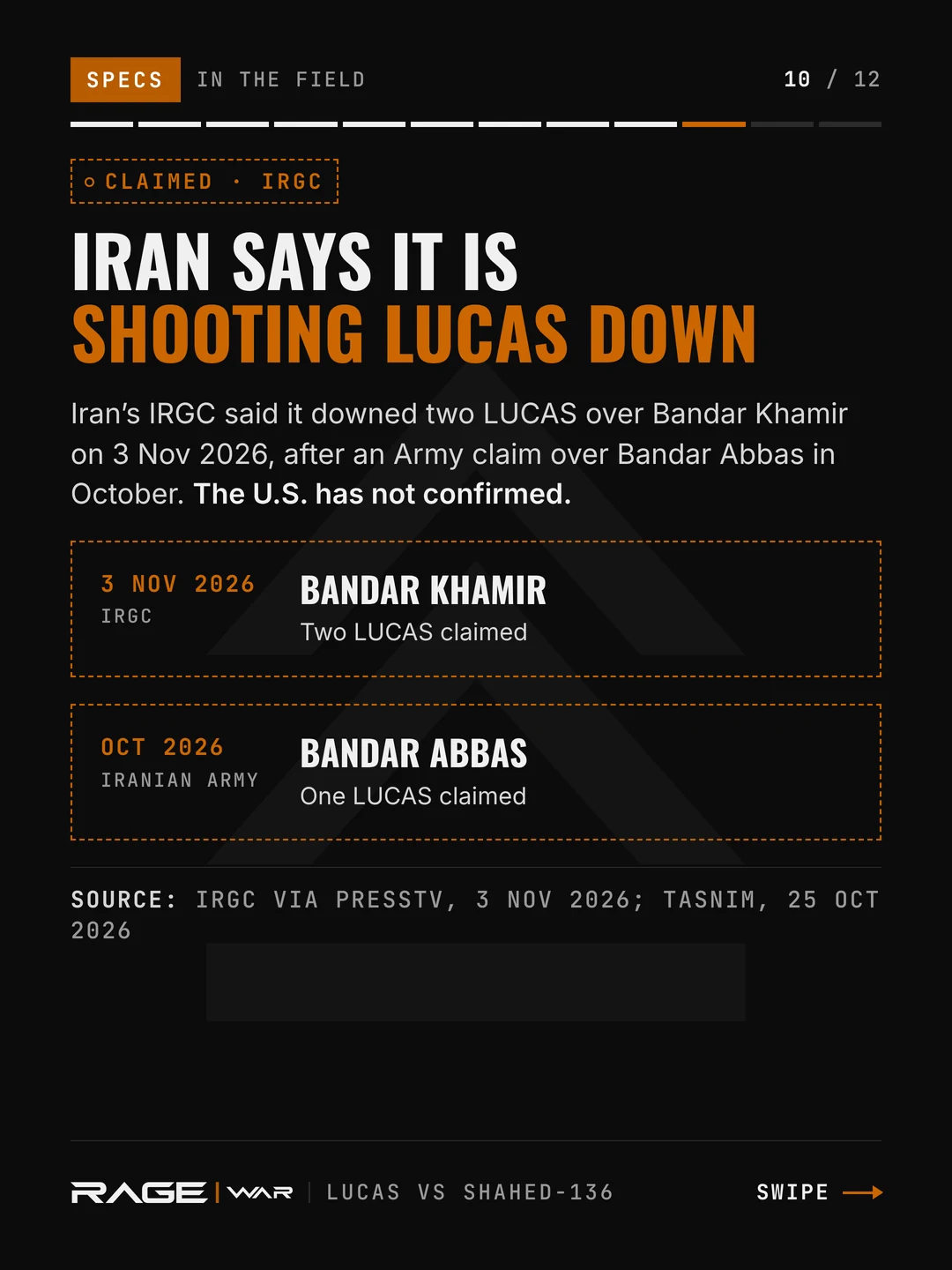
Iran says it is shooting LUCAS drones down. Iranian media reported on 25 October that the Army shot one down over Bandar Abbas. On 3 November 2026 the Islamic Revolutionary Guard Corps (IRGC) said its air defences destroyed two LUCAS drones over Bandar Khamir in Hormozgan province, a claim reported by the Fars news agency. There was no immediate U.S. comment on the November claim. Iranian outlets have carried similar claims several times this year. RAGE X has seen no independent confirmation or wreckage evidence for any of them.
What is not confirmed#
| Question | Status |
|---|---|
| LUCAS's published specs (82 kg, 18 kg payload, 822 km) | Reported, manufacturer figures, not independently measured |
| Which version of the specs applies to the drones used over Iran | Not confirmed |
| The Shahed-136's range and warhead | Estimated, with a wide published range |
| How many LUCAS drones have been built or used | Not confirmed; last official figure was "in the dozens" in March |
| Whether satellite datalinks or swarming have been used in combat | Not confirmed; Reuters could not confirm |
| Iran's claims of shooting LUCAS drones down | Claimed, not confirmed by the U.S. |
| Whether Machina's factories can deliver LUCAS at scale | Unknown until the pilot ends, expected mid-2028 |
Our read · RAGE X assessment
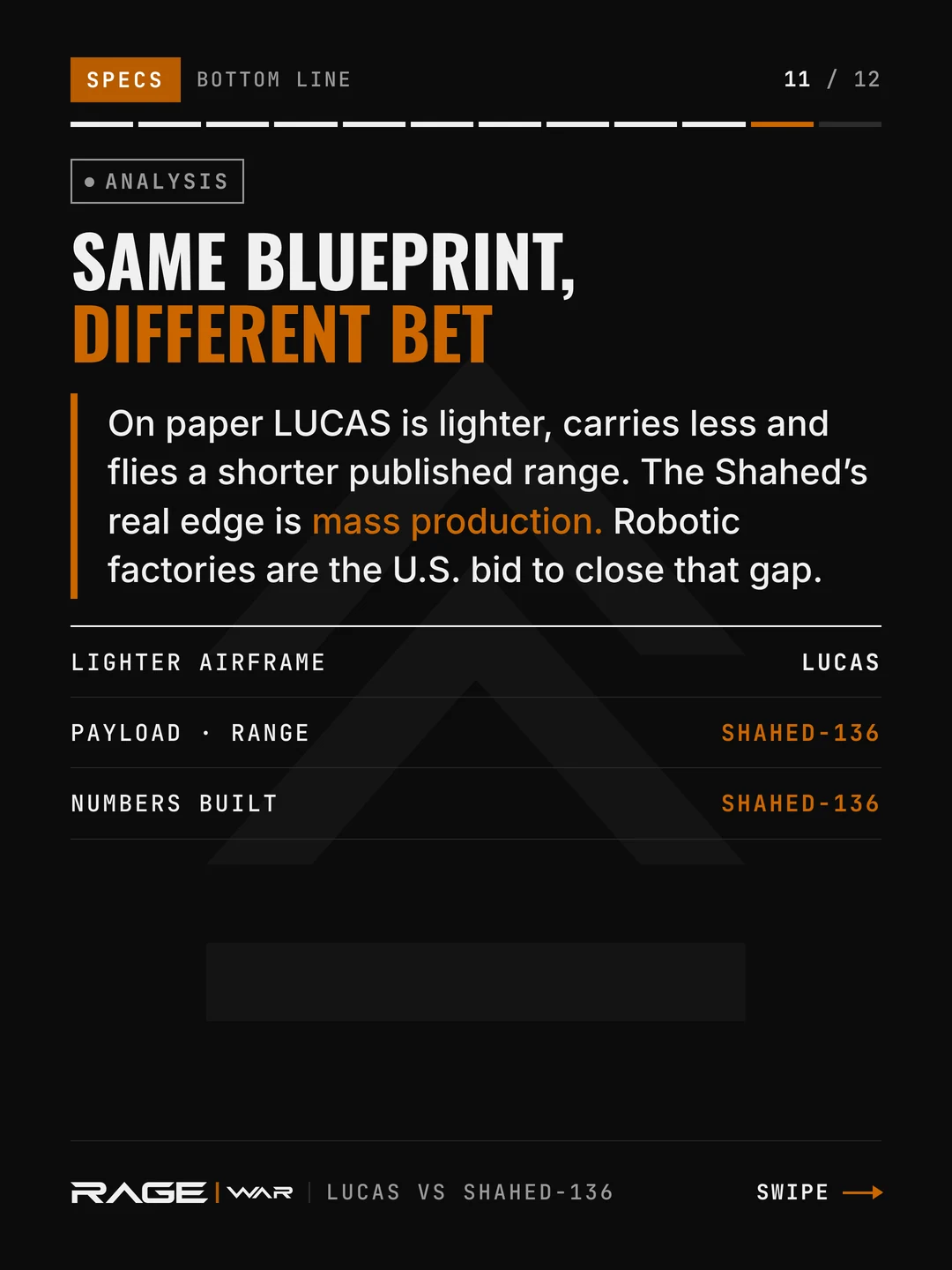
On paper LUCAS is the lighter drone. It is smaller, carries less and flies a shorter published range, and nothing in the public record suggests the U.S. copied the Shahed to beat it on those numbers. The Shahed's real advantage is not a spec. It is mass production, the ability to launch thousands a month and make defenders pay far more per interception than the attacker pays per drone.
The Machina contract is best read as the U.S. bet on closing that gap: build airframes in standard cells close to the front rather than ship them from a few factories. It is a small, 18-month trial. Until the pilot reports and a production decision follows, "dozens" is the last public number, and the comparison that matters between the two drones is output, not wingspan.
This is an assessment, not a finding. It will change if the Pentagon publishes inventory figures or if independent measurements of LUCAS appear.
Questions answered#
What is the LUCAS drone? LUCAS, the Low-Cost Uncrewed Combat Attack System, is a one-way attack drone made by the Arizona company SpektreWorks. It grew out of the FLM-136, a Shahed-136 look-alike target used for air-defence training.
Is LUCAS a copy of the Shahed-136? CENTCOM says the combat drones are modeled after, and reverse-engineered from, the Iranian Shahed-136. It is smaller, lighter and carries less on published specs, but it has the same basic layout and role.
Which is more capable on paper? The Shahed carries more (about 50 kg against 18 kg) and is reported to fly farther. LUCAS has a lighter airframe. Most figures are manufacturer specs or estimates.
How much does LUCAS cost? CENTCOM says about $35,000 a unit. DefenseScoop reported the family is said to cost $55,000 or less.
How many LUCAS drones does the U.S. have? The last official figure is "in the dozens," from the Pentagon's chief technology officer in March 2026. No later number has been published.
Has Iran shot down a LUCAS? Iran says so, most recently on 3 November 2026. The U.S. has not confirmed any of the claims.
What is the Machina contract? It is a $9 million, 18-month Defense Department award for Machina to build LUCAS-class airframes in two pilot robotic factories. It does not commit the Pentagon to large-scale production.
What to watch#
- The Machina pilot: where the first two Edge Factories are set up and whether the airframe is qualified. The outcome is not expected until mid-2028.
- An inventory figure: any new Pentagon number for LUCAS stock or production, to replace "in the dozens."
- Iran's shoot-down claims: whether CENTCOM confirms, denies or releases imagery.
- Independent testing: any published measurement of LUCAS range or payload.
- Shahed launches over Ukraine: ISIS's monthly counts, the clearest read on the volume gap. For the weapon's history and costs, see our Shahed-136 reference and our counter-drone analysis.
This story is developing. RAGE X will update it as new information is confirmed.
Sources#
- Military Times, US confirms first combat use of LUCAS one-way attack drone in Iran strikes, 28 February 2026
- Defense One, Multiple LUCAS drones, a near-copy of Iran's low-cost one-way Shahed-136, February 2026
- Defense News, Navy launches suicide drone from ship at sea for first time, 19 December 2025
- DefenseScoop, LUCAS drone production, Emil Michael and Operation Epic Fury, 17 March 2026
- The War Zone, LUCAS drones to be built in containerized robotic micro factories designed to be forward deployed, 9 November 2026
- Military Aerospace, Machina to develop metal airframe for LUCAS-class uncrewed aircraft, 10 November 2026
- The War Zone, How America's Shahed-136 clone became an indispensable weapon of war, 9 April 2026
- Drone Warfare Intelligence Briefing, LUCAS and Shahed-136 and the Geran family, 2026 (a secondary research site; it cites SpektreWorks sheets and ISIS data)
- UNITED24 Media, From Russia with metal wings: the calculated drone terror against Ukraine, reporting ISIS figures for 2025
- Institute for Science and International Security, Updated analysis of Russian Shahed-type UAVs deployment against Ukraine, May 2026
- ANews, Iran's Revolutionary Guards claim to have downed 2 US drones near Strait of Hormuz, 3 November 2026
- Political.org, Iran's Army says it shot down US LUCAS drone over Bandar Abbas, 25 October 2026, citing Tasnim
- The Defense Post, Lockheed PAC-3, 21 July 2026 (PAC-3 cost context)
Sources checked 17 November 2026. The photograph on the carousel cover is credited to U.S. Central Command (23 November 2025). The aircraft silhouettes and dot grids on the carousel are RAGE illustrations, not images of the drones.
Continue the assessment
Related Intelligence
Loitering Munitions in 2026: Programs, Economics, and Market Analysis
Analysis of the loitering munitions market: Switchblade, Lancet, Shahed-136, LASSO procurement, unit economics, and a $13B market forecast by 2030.
2026-08-05 · 13 min read
The Stockpile Question: What Depleted ATACMS and PrSM Reserves Actually Signal
Reuters reports the US has used 'virtually all' of its ATACMS and PrSM missiles after five months of war with Iran. Why it's a readiness story, not a supply story.
2026-08-04 · 6 min read
Iran Claims Strike on US Early-Warning Radar in Bahrain After Sirik Telecom Attack
Iran's Guards say they destroyed a US early-warning radar in Bahrain after an attack on a Sirik telecom tower. The US and Bahrain have not confirmed.
2026-11-13 · 6 min read
Today's conflict risk
The daily RAGE INDEX scores global conflict risk across six theaters, with sources and forecasts.
Read the RAGE INDEXReach readers like these
RAGE X sells sponsored content across RAGE Intel, RAGE War and RAGE Global by proposal, always labelled as sponsored.
Request a campaign proposal